
The Trump administration has kept on the table the threat of escalating the confrontation with Iran as a necessary show of force. Yet underlying this rhetoric is a rising body of evidence—military, analytical, and historical—that indicates that a ground war in Iran would not only be dangerous but also a strategic disaster for America.
In a series of reports by CNN and other American media outlets, foreign policy analysts inside and outside the administration anticipate a high likelihood of heavy American casualties in the event of a confrontation within Iranian territory. This is not a mere speculation. Rather, such predictions are informed by a body of knowledge garnered from ongoing events and realities on the ground.
Even the latest military advances point to the limitations of U.S. power. According to U.S. intelligence assessments, Reuters reports, , “much of Iran’s missile arsenal remains in working order despite intense bombardment, largely due to its underground facilities and the way its arsenal is dispersed.” Iranian defenses, in other words, are designed to withstand the most intense of assaults while continuing to possess the means of retaliation.
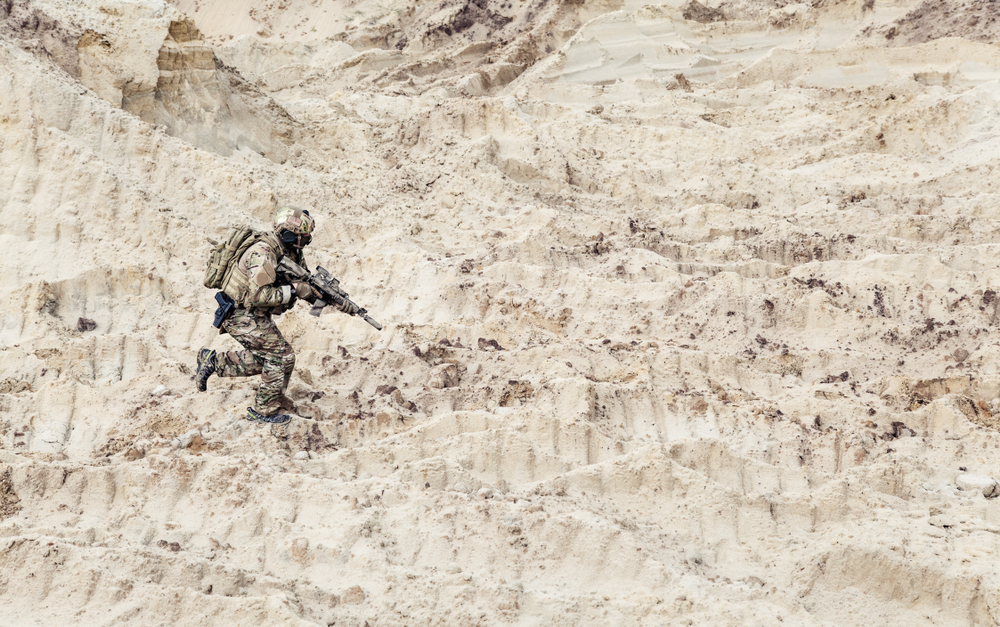
Pentagon talk of the potential for ground operations has also been accompanied by concerns over the vulnerability of U.S. troops. The insertion of ground troops, whether through an amphibious landing or airborne insertion, would place troops in the vulnerable position of withstanding a counterattack, particularly in the Strait of Hormuz.
The underlying problem is the nature of the conflict itself. According to the Center for Strategic and International Studies, Iran has spent decades developing a military doctrine based on asymmetric warfare that includes ballistic missiles, drones, proxies, cyber warfare, and decentralized command structures. On top of more conventional forms of defense, this “layered defense strategy” or “mosaic defense strategy” is designed to confuse and hinder technologically advanced opponents. By distributing forces across various domains and territories to prevent decisive defeat, this approach imposes ongoing costs and drains the political will of the adversary rather than achieve an outright victory on the battlefield.
Logistics might prove the most vulnerable aspect of any ground-based operation. Supply chains and communication links are critical to the success of any operation. In the case of Iran, a nation with vast distances and difficult terrain to cover, such links would always be under attack.
The lessons of the past back up this concern. In the wars in Vietnam, Iraq, and Afghanistan, the United States won every battle in the initial phases of the operation. However, it never managed to win the war. In the case of Iran, the stakes would be even higher, as the nation has a bigger population and its government is more united. Iran, it seems, has learned the lessons of the past. The United States, so far, seems to be ignoring them.
The humanitarian and political implications will be severe. Even the limited military actions so far in this war have already sparked concerns over civilian casualty rates and the accuracy of aerial strikes in densely populated areas. The humanitarian implications of a full-scale invasion would be even worse.
In terms of strategic implications, Iran’s ability to interfere with global systems introduces another level of risk. The Strait of Hormuz is one of the most critical energy chokepoints in the world, and even partial disruption could have significant economic implications. Maintaining this corridor will require constant military presence, even when under threat.
There is also a fundamental asymmetry in terms of objectives. For the United States, success would entail well-defined and attainable objectives—regime change, deterrence, or disarmament. For Iran, success might mean mere survival and perseverance in resistance. Such asymmetry is inherently favorable to the defender. As long as Iran holds together and exacts costs to the aggressor, it is strategically successful.
In such a scenario, a ground war in Iran would not be a conventional war with a terminal point. It would be a long, drawn-out war across various domains—resource-intensive, regionally expanding, and politically debilitating for the United States.
The real issue is not whether the U.S. can initiate such a war but whether it can win such a war. All available indicators of strategic thinking—intelligent analyses and military modeling—point to the U.S. inability to win such a war. As such, a ground invasion of Iran will be a demonstration not of U.S. strength but of its limits.