
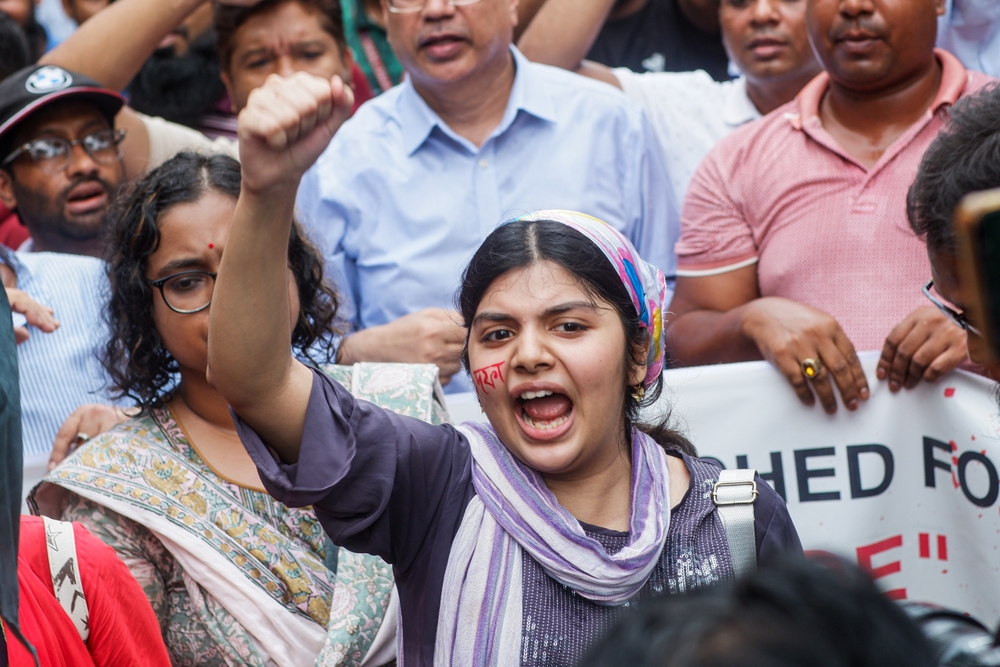
It looks increasingly unlikely that Bangladesh can pull itself out of its current political quagmire to hold national elections on schedule in February. Violent protests have once again engulfed Dhaka, threatening to undo the hard-won gains of the July 2024 student uprising that ended Sheikh Hasina’s long authoritarian rule. The assassination of Sharif Osman Hadi, a prominent youth leader and symbol of that uprising, has become a tipping point, deepening mistrust and fueling a widespread belief among Bengali youth that powerful external forces may be at play.
Hadi, only 32, was not just another activist. As a spokesperson for Inquilab Mancha, the Platform for Revolution, and a prospective parliamentary candidate for Dhaka-8, he embodied the political aspirations of a new generation seeking to reclaim the state from entrenched elites. His assassination attempt on December 12, carried out in broad daylight, and his subsequent death in Singapore have sent shockwaves across the country. Protests demanding justice have escalated rapidly, with demonstrators openly questioning the state’s ability, or willingness, to protect dissenting voices. For many young Bangladeshis, Hadi’s killing is not an isolated crime but a warning that the old forces of repression remain active.
The July 2024 protests in Bangladesh began over a discriminatory job quota system but rapidly became a nationwide uprising against authoritarianism, corruption, and political exclusion. Sheikh Hasina’s violent crackdown, which killed nearly 1,400 people, led to her ouster and the formation of an interim government under Nobel Laureate Muhammad Yunus that promised reform and credible elections. Yet the transition remains fragile, with weakened institutions, political violence, and attacks on the media raising the risk that delayed or discredited elections could undermine the legitimacy of the post-Hasina order.
At the heart of the current unrest lies a far more uncomfortable question: the role of India in Bangladesh’s internal political trajectory. Since 1971, New Delhi has viewed Bangladesh as firmly within its strategic sphere of influence. Under Indira Gandhi, India played a decisive role in Bangladesh’s liberation by backing the Mukti Bahini resistance movement and directly confronting Pakistan. That history has gradually morphed into a sense of entitlement over Dhaka’s political choices.
Sheikh Hasina’s ouster was a major disruption to New Delhi’s strategic calculus in South Asia. For India, a government in Dhaka that is not openly pro–New Delhi is a strategic setback. There is a broad consensus within Indian foreign policy and security circles that an anti-India government in Dhaka would not serve New Delhi’s interests. From India’s perspective, the fear is not the street protests themselves but a deeper political realignment that could destabilize the region, heighten security threats, and alter the balance of power. A Dhaka government less aligned with New Delhi would also open space for rival powers, particularly China and potentially Pakistan, to expand their footprint.
These anxieties are visible in India’s domestic response to recent developments in Bangladesh. Large sections of the Indian media and the broader right-wing ecosystem have reacted with alarm and hysteria, viewing events across the border through an explicitly communal lens. Earlier this week, Hindutva mobs attempted to storm the Bangladesh High Commission in New Delhi, while attacks and threats against Bangladeshi diplomatic missions in other Indian cities have also been reported. Extremist groups such as the Vishwa Hindu Parishad have seized on the tragic lynching of a Bangladeshi Hindu man in Mymensingh to justify these actions, projecting an image of civilizational threat amplified through prime-time television debates and social media networks aligned with Hindutva politics.
The killing itself must be condemned without qualification, and mob violence in any form demands accountability. Yet the dominant narratives emanating from India deliberately strip the moment of context. Rather than pursuing restraint or diplomatic engagement, the issue has been communalized, obscuring the deeper political roots of the crisis.
The rise of anti-India sentiment in Bangladesh did not emerge overnight. It reflects the accumulated resentment of decades of perceived political meddling and diplomatic indulgence of authoritarian rule so long as it aligned with New Delhi’s strategic interests.
This history has shaped how many Bangladeshis, particularly the youth, interpret the present moment. For them, Indian backing enabled prolonged repression and the systematic suppression of dissent under Hasina’s rule. The anti-India sentiment visible on the streets today is therefore not manufactured but deeply rooted in lived political experience, shaped by a belief that interference from across the border helped sustain an authoritarian regime and stifle democratic alternatives.
That reckoning has shifted the political calculus. In the post-Hasina era, there is little appetite for overt reliance on New Delhi or tolerance for interference. The Bangladesh of the future, led by its youth and politically conscious urban middle class, wants to chart an independent path based on balanced relationships, and regional powers must respect that.
The people of Bangladesh have endured years of authoritarian rule, human rights violations, and the suppression of dissent. The assassination of Osman Hadi has only strengthened their resolve to demand justice and reclaim their future. If Bangladesh is to emerge from this crisis and hold credible elections, it will require restraint from external actors, accountability at home, and faith in the people who risked everything to bring about change.
Power must rest where it belongs, with the people.