
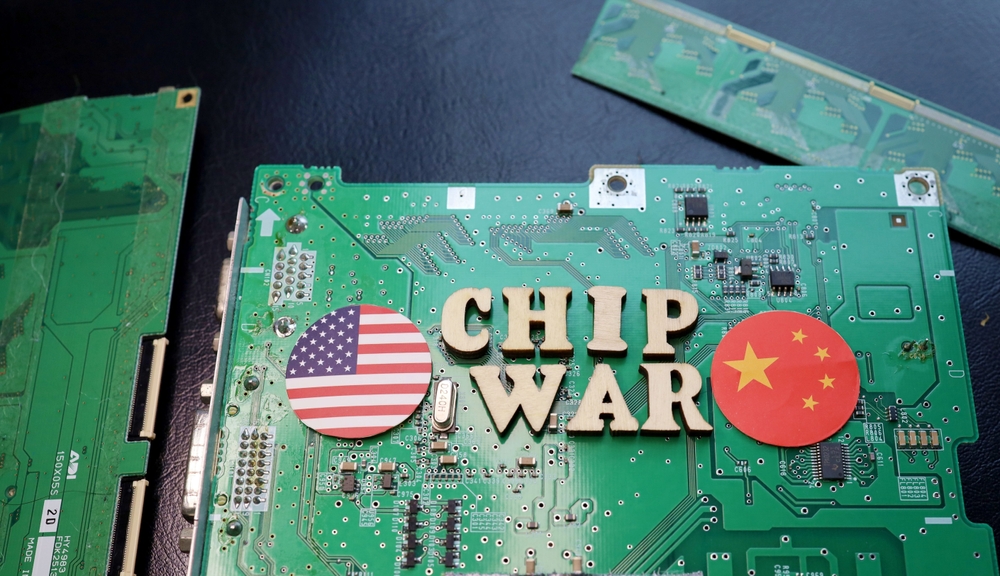
The United States’ latest U.S. salvo in its bid to kneecap China’s technological ascent is as predictable as it is shortsighted. The Department of Commerce’s decision to revoke the “validated end-user” (VEU) authorization for TSMC, Samsung Electronics, SK Hynix, and previously Intel, effective by year’s end, is less a strategic masterstroke than a self-inflicted wound dressed up as geopolitical bravado.
Exemplifying this erratic push-pull dynamic is the Trump administration’s recent reversal on AI chip exports to China. Just three months after imposing a ban in April 2025 on even “compliant” chips like Nvidia’s H20—designed to meet United States export limits—the administration quietly greenlit their delivery in July, following intense lobbying from Nvidia CEO Jensen Huang, including meetings at the White House and in Beijing. AMD secured similar clearance for its MI308 chips, boosting both companies’ shares by over four percent. Yet, in an unprecedented twist, the U.S. government slapped a 15 percent fee on these sales, turning export licenses into a revenue-sharing scheme that could funnel billions to the Treasury.
This flip-flop either underscores the unpredictable nature of Trump-era policy—swinging from hardline restrictions to pragmatic concessions amid tariff brinkmanship—or reveals the sway of lobbying pressures from U.S. tech giants desperate to reclaim China’s lucrative market, which accounts for about 13 percent of Nvidia’s revenue. Far from a coherent strategy, it highlights how techno-nationalism bends to short-term economic imperatives, even as it risks undermining long-term national security goals.
This move, which forces these semiconductor giants to navigate the labyrinthine process of applying for export licenses to ship U.S. chipmaking tools to their Chinese plants, threatens to disrupt not just global supply chains but the very U.S. firms the policy ostensibly aims to protect. It’s a classic case of cutting off one’s nose to spite one’s face, and the reverberations will be felt far beyond the Pacific.
The VEU system, established in 2007, was designed to streamline exports to trusted companies in select markets, sparing them the bureaucratic slog of individual licenses. By dismantling this framework for four of the world’s leading chipmakers, the United States is not only complicating their its operations in China—one of the largest chip markets globally—but also undermining the intricate ecosystem that has defined the semiconductor industry for decades. TSMC’s Nanjing plant, for instance, which accounts for roughly 2.4 percent of its revenue, produces 16-nanometer and other mature node chips critical for a range of applications. The ripple effects of this decision will hit U.S. equipment makers like KLA, Lam Research, and Applied Materials, whose sales to China are likely to take a hit as production slows. The irony is palpable: in its zeal to contain China’s technological progress, the United States is hobbling its own industry.
This isn’t the first time Washington has wielded export controls as a blunt instrument. The revocation of Intel’s VEU status earlier this year set the stage, and the pattern is clear: a relentless campaign to choke off China’s access to advanced technology, even at the cost of global economic stability. The semiconductor industry, as China’s Ministry of Commerce aptly noted, is a deeply interconnected web, forged through decades of collaboration across borders. Disrupting it doesn’t just hurt China—it destabilizes the entire supply chain, from raw materials to finished products. The United States seems to believe that it can dictate the terms of this globalized industry, but history suggests otherwise. Attempts to monopolize technological dominance often backfire, fostering resentment and spurring innovation in the targeted nation.
China’s response has been measured but firm. The Ministry of Commerce condemned the U.S. move as a self-interested ploy that weaponizes export controls, undermining the stability of global semiconductor supply chains. Beijing has vowed to take “necessary measures” to protect its enterprises, signaling a readiness to counter U.S. coercion with its own economic leverage. This isn’t mere posturing—China’s advancements in middle- and lower-end chip production have already shown resilience against previous restrictions. The United States may hope to stifle China’s progress, but the reality is that Beijing’s domestic semiconductor industry is steadily closing the gap, driven by necessity and a national commitment to self-reliance.
The timing of this escalation is particularly curious. Chinese Vice-Minister of Commerce Li Chenggang’s recent visit to the United States underscored the potential for mutually beneficial trade, with discussions involving both officials and American business leaders. The message was clear: Sino-U.S. trade, when conducted on equal terms, is a win-win proposition. Yet, Washington’s decision to tighten the screws on TSMC, Samsung, SK Hynix, and Intel suggests a disconnect between rhetoric and action. Rather than engaging in consultations to resolve trade disputes, the United States has opted for coercive measures that reek of desperation. The revocation of VEU status feels less like a calculated strategy and more like a petulant attempt to flex muscle, with little regard for the collateral damage.
There’s also a whiff of opportunism in the U.S. approach. By forcing these chipmakers to seek individual export licenses, the Biden Trump administration gains leverage to extract concessions—financial or otherwise. Reports of a de facto 15 percent fee imposed on Nvidia and AMD for trading with China hint at a broader pattern: the U.S. government isn’t just playing gatekeeper; it’s playing toll collector. This isn’t about national security—it’s about squeezing maximum profit from a captive industry while it still can. Such tactics may yield short-term gains, but they risk alienating key players in the global semiconductor market, pushing them toward alternative partnerships.
The broader implications are sobering. The US’sU.S. techno-nationalism assumes it can dictate the pace of global innovation, but this ignores the reality of a multipolar world. China’s technological strides, particularly in mature node chips, are not as easily disrupted as Washington might hope. Meanwhile, the global semiconductor industry, already battered by previous U.S. restrictions, faces further uncertainty. Companies like TSMC, which have invested billions in their Chinese facilities, now face increased costs and risks, while U.S. suppliers and customers brace for the fallout. The interconnected nature of the industry means that no one escapes unscathed—not even the United States, which risks undermining its own competitiveness in the long run.
What’s striking is the absence of a coherent endgame. If the goal is to slow China’s technological rise, the United States is betting on a losing hand. China’s domestic chip industry, bolstered by state support and private investment, is making steady progress. If anything, these restrictions may accelerate Beijing’s push for self-sufficiency, reducing its reliance on U.S. technology altogether. And what of the global market? By destabilizing supply chains, the United States risks ceding influence to other players—Europe, Japan, or even a resurgent South Korea—who are less inclined to weaponize trade for geopolitical ends.
The United States would do well to heed the lessons of history. Trade wars, like all wars, rarely produce clear winners. Consultation, not coercion, is the path to resolving disputes in a way that preserves mutual prosperity. By dismantling mechanisms like the VEU system, Washington is erecting barriers not just for China but for itself. The semiconductor industry thrives on collaboration, not isolation. In its quest to contain China, the United States risks isolating itself instead—alienating allies, weakening its own firms, and hastening the very outcome it seeks to prevent. The chips are down, and the United States is playing a dangerous game.