
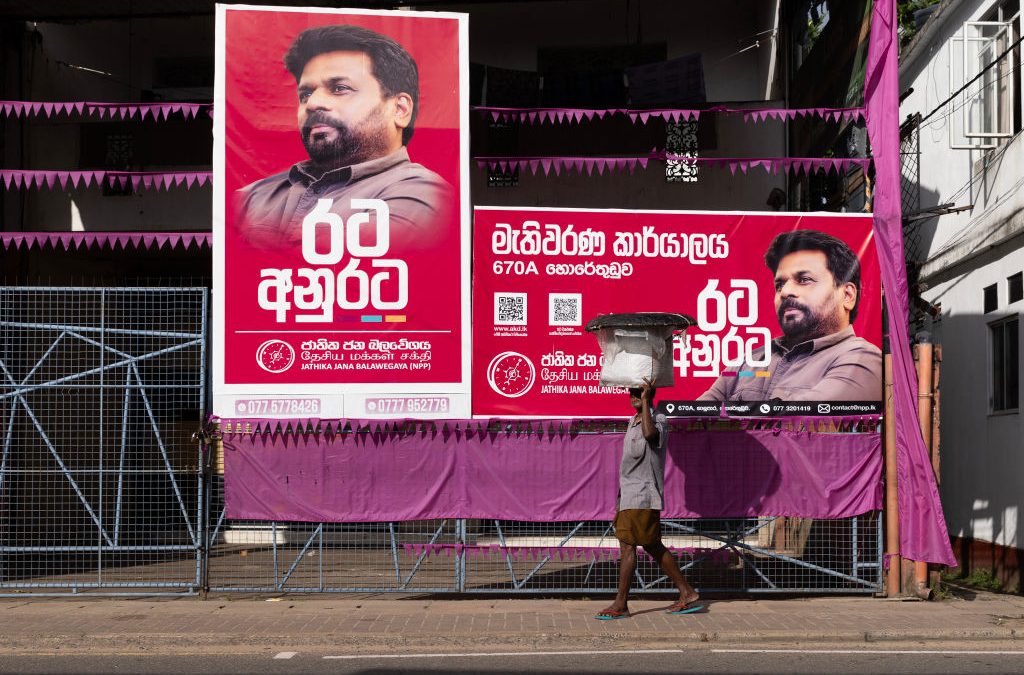
Stung by neoliberal austerity, which triggered economic meltdown in 2022, Sri Lanka has turned to a progressive leader to help forge its path back to economic recovery. Popularly known by his initials AKD, Anura Kumara Dissanayake has long been the leading light of the left in Sri Lanka. He was the presidential candidate of the National People’s Power (NPP), an alliance that he built and of which the People’s Liberation Front (PLF) that he leads is the key member.
Dissanayake and PLF’s ideas on an economy that works for everyone fall within mainstream left thinking. Dissanayake echoes former British Labor Party leader Jeremy Corbyn and U.S. Senator Bernie Sanders, a Social Democrat, on robust state intervention. Yet Dissanayake’s election to the Sir Lankan presidency on September 22 was reported on as if a revolutionary Che Guevara had overtaken reactionary Colombo. His intellectual fidelity to Marxism was presented as something akin to terminal illness. What was woefully ignored here was the constitutional foundation of Sri Lanka as a “Democratic Socialist Republic.”
Dissanayake’s ideas on “radical economics” caught on only when neoliberalism bit hard in Sri Lankans’ pocketbooks in 2022, and the ruling elite turned its back on working Sri Lanka. Inflation soared to 70 percent, the rupee lost much of its value, and foreign exchange reserves became depleted. Mass discontent blazed into a popular revolt, toppling the dynastic rule of the Rajapaksas, a sprawling clan that made a family fief of Sri Lanka. One brother was president, another prime minister, while an assortment of sons and lesser-known relatives staffed key ministries, milking them as cash cows. Cronyism helped birth a class of nouveau riche that bathed in easy money from the “privatization” of state enterprises and the rentier state that the Rajapaksas made of Sri Lanka.
Yet Colombo, paradoxically, remained the most successful social democracy in the region. On all socio-economic indicators, Sri Lanka is Kerala—an Indian state that is the Sweden of social democracy in Asia—on a national scale. The country’s macroeconomy and social metrics are envied across south Asia, and even in the wider world. In 2021, Sri Lanka’s per capita GDP of $4,000 was almost twice that of India’s. Its literacy rate of 93 percent in 2021 was higher than the U.S. rate of 79 percent. All this was the result of a social democratic ethos that valued redistribution and reinvestment in human capital.
Dissanayake vowed to keep these macroeconomic and macrosocial trends growing. He adopted an anti-graft platform that opposed the elite capture of the state and promised to cleanse politics of malfeasance. In that spirit, he announced the termination of a wind power project that he found to be the product of a corrupt deal. The project was set up by India’s Adani group, named after the group’s founder Gautam Adani, who is cheek by jowl with the Indian Prime Minister Narendra Modi.
Dissanayake’s immediate challenge, however, is the economy that has been bent out of shape by a $2.9 billion bailout package that Dissanayake’s predecessor secured from the International Monetary Fund (IMF) in 2023. Its austerity measures put an end to the Sri Lankan welfare state, slashing public subsidies, doubling regressive taxes on sales of everyday staples, and tripling energy tariffs. Dissanayake intends to renegotiate the deal to cushion its impact on low-income, working families. There are concerns that reopening the deal might reprise the economic meltdown of 2022. That is not inevitable, though. The economic meltdown in 2022 was triggered by the IMF’s refusal to budge on its insane austerity measures, which populist Gotabaya Rajapaksa, then president, was rightfully reluctant to accept. This stalemate ballooned into a macroeconomic disaster when Colombo failed to service its $51 billion in foreign debt and went into default in 2022.
If the IMF had approved a $2.9 billion deal in 2022 to a country now with a GDP of $84 billion, it would have saved Colombo economic trauma and the political instability it unleashed. It is important to remember that the IMF’s high-cost lending is too sparse to matter in any substantial way to the recovery of borrowing nations. Its value is, nevertheless, symbolic in assuring that a borrowing economy is on the mend, and credit and equity markets need not panic. This assurance opens the wallets of private creditors and bilateral lenders. This is how the IMF and multilateral institutions exercise their financial imperial power.
Critics faulted Sri Lanka for “unnecessarily” accumulating huge infrastructure debt from China, which is the country’s third largest creditor. This criticism seems unfounded. Sri Lanka’s infrastructure—especially roads, ports, and airports—have long been in disrepair. As a trade, transit, and tourist economy, it desperately needed to rebuild them with the only funding source available, i.e., China. Developing Asian countries like Sri Lanka require $1.7 trillion a year in infrastructure development until 2030. The United States is not in the business of lending, and multilateral loans are not only unbearably costly, they come with too many strings attached. So, it is either China or India that will fill the void.
China and India each sit on a mountain of cash that dwarfs even the IMF’s mint. The foreign exchange reserves of India alone surged to $700 billion in 2024, while China’s went up even higher to $3.2 trillion. The leaders of both nations have spoken warmly of Dissanayake. But just warm words are not enough. China and India can and should keep the Sri Lankan economy from unraveling. There are signs that they intend to do more than they did—nothing—to prevent the 2022 economic massacre of the country.
India is home to the world’s largest progressive movement. Its civil society and the political class will press their leaders to keep Sri Lanka afloat. It is no coincidence that India’s leader of the opposition Rahul Gandhi was the first to congratulate Dissanayake on his electoral victory. The Indian National Congress, India’s founding party, in its message to the newly elected Sri Lankan leader, recalled “a rich legacy of cooperation that dates back centuries.” One of India’s oldest and largest-circulation newspapers, The Hindu, which is the masthead of the country’s progressive movement, hailed Dissanayake’s election as a “new dawn in Sri Lanka” and approvingly reproduced a meme calling Dissanayake’s election “freedom from the bandits.” Relations this dense are a good omen for Sri Lanka’s new leader. Dissanayake showed statesmanship in visiting India in February and China in April. He sought to work with both, instead of working with one at the expense of the other.
Also, Sri Lanka has been one of the most trusted U.S. allies in Asia. On regional issues, such as the Soviet invasion of Afghanistan, India and Sri Lanka counselled Washington against supporting the mujahedin. History has proved them correct. Yet Sri Lanka was induced to publicly support U.S. Afghan policy, which it did. It had since been forgotten in Washington. During its 2022 economic crisis, Washington treated Colombo with benign neglect. The United States will have its interests better served if it helps Sri Lanka’s new leader to deliver for the country instead of forcing him to choose among geopolitical competitors.