
“We don’t need another war in this region. We already have a lot,” the European Union foreign policy chief Kaja Kallas recently said of Iran. “It is true that Iran is at its weakest point that they have been. We should be really using this time to find a diplomatic solution.”
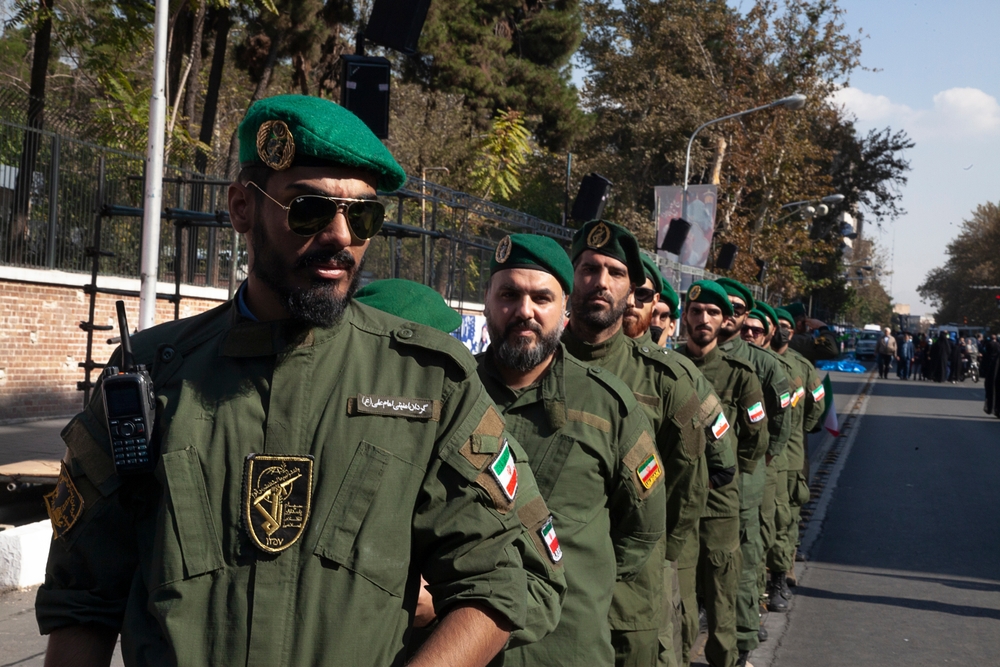
Yet, even as its top diplomat calls for diplomacy, the EU has taken a step that severely undermines that very possibility. The recent designation of Iran’s Islamic Revolutionary Guard Corps (IRGC) as a terrorist organization has been hailed by Kallas and other EU officials as a stand for moral clarity against brutal repression in Iran. But the decision can also be understood as an epitaph for EU-Iran relations that is unlikely to improve Iran’s human rights record, shape its political trajectory, or help avert a possible new Middle East war.
The designation of the IRGC was the culmination of a campaign that began in earnest in 2022 as a response to Iranian security forces repression of the “Woman, Life, Freedom” protests over mandatory hijab. Germany was a key champion of the measure in the EU Council, while France, Italy, and Spain were notable skeptics arguing that such a step would inhibit EU dialogue with Tehran.
Josep Borrell, then EU foreign policy chief, opposed the action on legal grounds, noting that EU rules require a member state court to implicate a body for terrorism and that that threshold had not been met. At the same time, the European Parliament and Iranian diaspora organizations lobbied hard for the IRGC designation and sought to portray it as a key step toward Iran’s political transformation.
Paris, Rome, and Madrid subsequently supported the designation in the wake of the Iranian regime’s far more brutal suppression of a new wave of protests that broke out in late December.
Germany, which with France and Britain was a key negotiator of the 2015 nuclear agreement with Iran and was once Iran’s top trading partner, has become a leading European Iran hawk under Chancellor Friedrich Merz. Merz, who praised Israeli strikes on Iranian nuclear and other facilities in June 2025 as necessary “dirty work” on behalf of Western democracies, predicted, in the midst of the latest protests in Iran, that the Islamic Republic would be “gone in months, if not weeks.”
However, the Iranian regime has not collapsed even as it faces unprecedented external and internal threats, and it remains unclear what Europe’s IRGC designation will accomplish.
A number of key IRGC officials are already sanctioned by the EU under multiple rubrics, notably for human rights violations. More travel bans and asset freezes could have been imposed without designating the entire organization. In practical terms, the new measure forbids any interaction with individuals or entities tied to the IRGC—a 100,000-strong force that includes tens of thousands of conscripts. It complicates diplomacy concerning Iran’s nuclear program and regional policies, empowers hardliners in Tehran who argue that Europe is irredeemably hostile, and undermines efforts to release European dual nationals jailed in Iran.
Iran has designated the naval and air forces of all EU countries as terrorist in retaliation.
Foreign Minister Abbas Araghchi dismissed the move as “PR stunt” and deplored Europe’s role in “fanning the flames” rather than “attempting to avert the eruption of all-out war in our region.”
Notably, Hassan Khomeini, the grandson of the founder of the Islamic Republic and a possible reformist successor to Supreme Leader Ali Khamenei, derided Europe as “an impotent entity incapable of controlling either Ukraine or Greenland” and a “lion without teeth.”
The reformist camp in Iran has looked to Europe to salvage diplomacy in the face of the Trump administration’s withdrawal from the nuclear deal in its first term and increasing belligerence in its second term. However, the EU has chosen instead to join the United States, which designated the IRGC as terrorist organization in 2019. Last September, with U.S. encouragement, Britain and France invoked the “snapback” of UN Security Council sanctions against Iran before the deadline set by the resolution that codified the 2015 nuclear deal (the Joint Comprehensive Plan of Action or JCPOA). The IRGC designation conforms to this same logic.
Iran has certainly played a significant role in the deterioration of relations with Europe. After the nuclear deal was reached, the EU sought to establish a delegation in Tehran, a move welcomed at the time by the Iranian foreign ministry. However, it was blocked by hardline forces in the judiciary, including the then-head of the human rights council Mohammad Javad Larijani, who saw a potential focal point for meddling in Iran’s internal affairs—an absurd claim given that 22 out of 27 EU member states plus Britain already had embassies in Iran at the time.
Iran’s decision to send drones to Russia to use in its war of aggression in Ukraine was key in undermining ties. Europe’s own inability to trade with Iran after the U.S. withdrawal from the JCPOA in 2018 pushed Iran toward stronger ties with Moscow and Beijing. However, neither Russia nor China came to Iran’s defense last summer during the 12-day war with Israel and the United States. And Moscow no longer needs Iranian drones as it now produces its own.
Further, Iran’s practice of arresting EU-Iranian dual citizens poisoned bilateral relations with a number of countries, including France, Germany, Sweden, and Belgium.
However, none of these issues is resolved by blacklisting the IRGC.
The EU has substituted symbolism for strategy. The timing could also be particularly inopportune given that Supreme Leader Ayatollah Khamenei is 86 and the IRGC is expected to play a significant role in shaping the country’s future trajectory. By foreclosing any channel to the very institution at the center of that process, Europe has rendered itself willfully absent at the moment when engagement might have mattered most.
For now, the designation is overshadowed in Tehran by the expectation of a renewed war with Israel and the United States. The EU, once a balancer and mediator, has made itself largely irrelevant.