
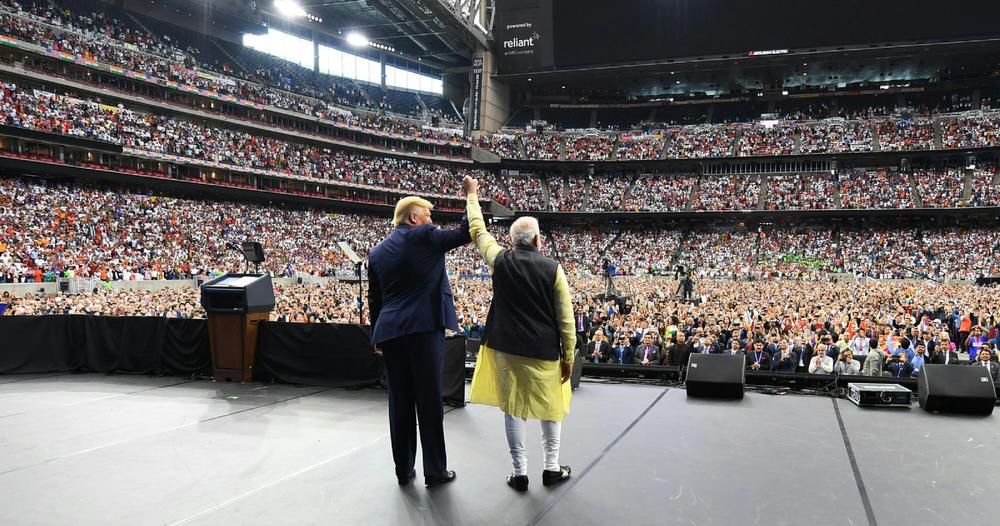
Despite its domestic displays of strategic bravado, India has flinched in the face of real American pressure.
In 2018, India signed a $5.43 billion deal for Russia’s S-400 air defense system, brushing aside the threat of U.S. sanctions. Defense Minister Nirmala Sitharaman was unequivocal: the sanctions were part of U.S. law but not part of a UN mandate, and therefore not binding on India. India later deployed the S-400 during Operation Sindoor against Pakistan in May 2025.
Yet barely nine months after defying Washington on defense, the same government yielded on energy.
The February 2026 US–India trade deal revealed the scale of that shift. Washington pressured New Delhi to halt Russian oil imports. India chose compliance over conviction. Imports fell from an average of 1.7 million barrels per day (33 percent of crude imports) in 2025 to 1.2 million barrels per day (21 percent) by February 2026—a 39 percent cut. India also committed to buying $500 billion worth of U.S. energy, aircraft, precious metals, and technology over five years while reducing tariffs on U.S. goods.
In return, Washington proposed to cut India’s tariff burden subsequently from 50 percent to 18 percent, a burden that hadn’t existed before the US President Donald Trump’s April 2025 “Liberation Day” tariff announcement.
By doing so, India finally surrendered one of the clearest proofs of its independent foreign policy in decades. America’s punitive action wasn’t for buying Russian oil. It was because India could be punished. For being vulnerable.
Iran War
On February 28, when the United States and Israel bombed Iran, Tehran shut the Strait of Hormuz. Brent crude briefly spiked to $119 a barrel from the pre-war rate of $72.48 before dropping below $100 and then inching back up. Trump offered India a waiver to purchase Russian oil for 30 days.
By then, Moscow had recalibrated. Having watched India fold, Russia scrapped its $13-per-barrel discount and charged a $4–5 premium above Brent. Friendship pricing was over. India had surrendered leverage, lost its discount, and was now paying a premium. It was penalized by both sides after capitulating to Trump.
The discounted Russian oil that had cushioned inflation for 1.4 billion people is gone. As a result, the costs of certain petrol, diesel, aviation fuel, domestic and commercial LPG have soared, and both Indian households and Indian businesses are shouldering the burden. The government insists there is no shortage. Yet long queues, enforcement crackdowns, and a government order extending the domestic LPG double-cylinder booking window from 21 to 35 days tell a different story.
Indian Prime Minister Narendra Modi’s deference to Trump reached such a pitch that, two days before the U.S.–Israel strike on Iran, Modi flew to Jerusalem. There he embraced Israel’s Prime Minister Benjamin Netanyahu who is wanted by the International Criminal Court on war crimes charges, upgraded bilateral ties to a Special Strategic Partnership, and declared in the Knesset that “India stands with Israel firmly, with full conviction, in this moment and beyond.”
Gaza went unmentioned. So did India’s recognition of Palestinian statehood in 1988.
Over nine million Indians are working across the Gulf, sending home $50 billion in annual remittances to India. Their livelihoods, and the money flow back to India, have become considerably more precarious because of this war.
India’s foreign policy was built on “strategic autonomy” — the sovereign right of a country to chart its own course without external pressure. India’s first prime minister, Jawaharlal Nehru, helped to build the Non-Aligned Movement precisely on this premise.
Today, as New Delhi repeatedly bows to Washington, one question stands: what has happened to India’s autonomy?
Strategic Independence
India claims to be the world’s fifth-largest economy. It is a nuclear power with Asia’s second-largest military. It belongs to the G20, BRICS, the Quad, and the SCO. It is a major voice of the Global South, with a civilizational history spanning millennia that once produced Ashoka’s moral authority and Kautilya’s strategic clarity.
By every measure, genuine strategic independence is within reach. In practice, India rarely exercises it.
Domestic constraints explain why. According to government estimates India’s unemployment was 4–5 percent in 2024–25 while independent estimates place it at nearly double. Manufacturing remains stuck at 17 percent of GDP. India spends just 0.65 percent of GDP on R&D, far below the global average of 1.8 percent. It imports more than 90 percent of its semiconductors, runs a $60 billion electronics trade deficit, sources 35 percent of its pharmaceutical ingredient requirements and 27 percent of fertilizers from abroad, and depends on a single foreign market for over half of its IT revenue. Despite India’s official data demonstrating sharp declines in poverty, the 2025 Global Hunger Index paints a contradictory picture of the country’s dilapidated health, placing it at 102 out of 123 nations.
Although the government emphasizes industrial policy, India remains dependent on external markets. This dependence directly shapes foreign policy. In practice, India operates in the geopolitical slipstream of the United States. It abstains on UN votes instead of standing up to the United States, calibrates trade policy to placate Washington, and gradually dilutes long-standing ties with Russia, Iran, and Palestine even as smaller, far more vulnerable nations hold firm. Canada, with nearly 77 percent of exports tied to the United States, resisted annexation rhetoric and tariffs, and Mark Carney won the 2025 election by standing up to Trump. Ukraine continues to fight Russia even without direct U.S. military support. Iran continues to fight back against the United States and Israel even after it has lost its top-level leadership. Palestine has maintained its claim to existence for 75 years without a state or army and without much in the way of U.S. support. Vietnam absorbed nearly 7.5 million tons of American bombs between 1965 and 1975 — and still survived with dignity.
None of these countries is more powerful than the United States. But each decided what was non-negotiable.
Consider India’s UN record. In October 2023, India abstained on the Gaza humanitarian truce backed by 121 nations. Two months later, with no tariff pressure, it voted in favor when 153 nations demanded a ceasefire. By June 2025, as trade tensions rose, it abstained again on a resolution backed by 149 nations—one of only a handful of Asian countries to do so.
If abstention is non-alignment, so be it. But India has not shown strong moral leadership at the global level. It has for instance, consistently abstained from condemning Russia for its invasion of Ukraine India’s position shifts not with events, but with its relationship with Washington. Across Ukraine, Gaza, and Iran, its response has been consistent: abstain. Evasion, it seems, has become a doctrine.
Relations with Trump
No amount of capitulation has guaranteed India respect. Despite aligning with U.S. demands, Trump has called India a “dead economy,” publicly demeaned Modi, and claimed credit for the May 2025 India–Pakistan ceasefire, despite it being bilaterally negotiated.
Today, India focuses increasingly on retaining Washington’s favor. This pattern is rooted in structural vulnerability. Since long before the trade deal, India had been importing over 60 percent of its crude oil from the United States and U.S.-influenced regions in West Asia. The United States has been India’s largest export market and more than half of India’s IT revenue comes from America.
Trump has weaponized visas against India. In 2024, nearly 71 percent of the approved H-1B visas went to the Indians. In September 2025, the U.S. president increased visa fees from $1,700–$4,500 to a whopping $100,000. For Infosys, 11.5 percent of revenue depends on H-1B workers, for TCS, 7.7 percent, for Wipro 7.5 percent. A single policy shift has jeopardized nearly all of India’s IT sector.
China presents a sharp contrast. It buys roughly five times more Russian oil than India. Despite high tariffs, U.S. imports from China exceeded $308 billion in 2025 — around 13 percent of total imports, more than three times India’s value.
The scale of China’s economy and the size of its military have allowed it to stand firm. India has not yet been able to establish that reciprocal importance yet.
What Must Change
India must treat energy independence as a national security priority, with a time‑bound transition to renewable energy. The government’s target of 500 GW and 50 percent non‑fossil-fuel power capacity by 2030 are commendable but not feasible targets given rapid demand growth. A more realistic benchmark would be 550–600 GW of non‑fossil capacity by 2030 to minimize renewed dependence on coal and imported fuels. Manufacturing must rise to at least 25 percent of GDP through enforceable industrial policy with domestic capacity in semiconductors, defense, and pharmaceuticals, thereby reducing dependence on external markets and visa regimes. India must restore principled voting at the UN, aligning its actions with its stated values. It must bolster diversified economic partnerships with members of the Global South and reduce reliance on SWIFT and similar American financial systems through alternative payment models and bilateral trade mechanisms.
And India must speak. Silence in the face of injustice erodes its credibility.
An independent India—economically resilient, diplomatically consistent, and strategically autonomous—is achievable. Courage comes with costs, of course. But if the smaller and weaker countries are willing to risk those costs, then India must do so as well.