
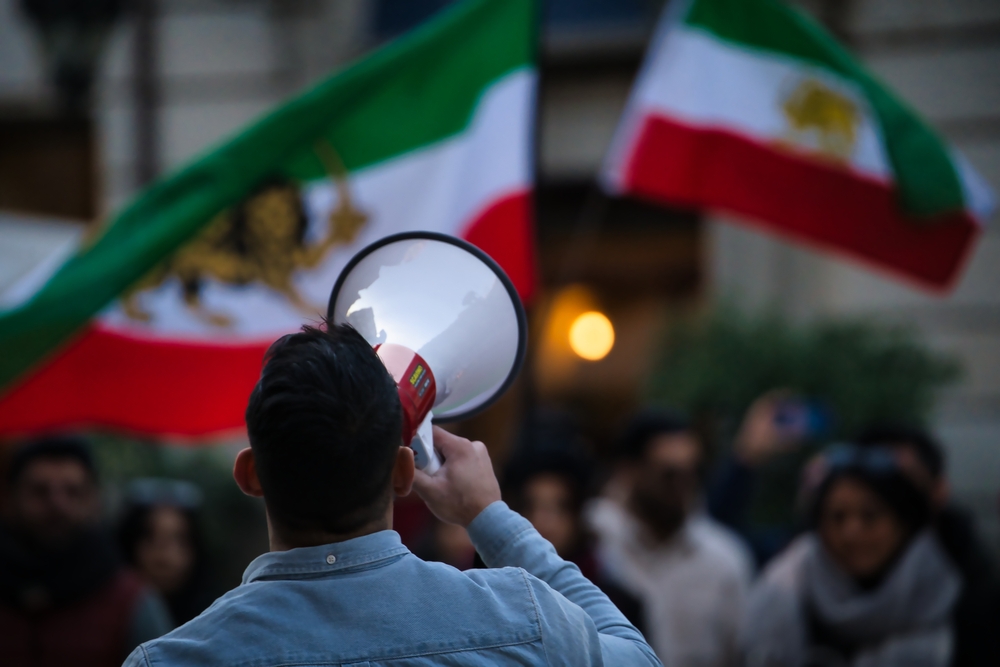
The protests taking place in Iran, which have left thousands dead, have raised the possibility that the theocratic government is on the verge of collapse. “I assume that we are now witnessing the final days and weeks of this regime,” German Chancellor Friedrich Merz declared this week. If this in fact happens, Iran would follow the examples of Nepal and Bulgaria, where protests recently dislodged governments.
Donald Trump has threatened a “strong” military response if the Iranian government attempts to massively suppress the protests or, since it has already done that, execute protestors. If Trump follows through on his threat, Iran would follow Venezuela as the next country to be subjected to the president’s determination to be the world’s policeman.
But Iran might be next in a third sense as well. Because of its ongoing war in Ukraine, Russia has been less effective in supporting its allies around the world.
Bashar al-Assad in Syria, Russia’s closest ally in the Middle East, fled to Moscow in late 2024 when rebel armies overwhelmed his military forces. The Kremlin saved his skin but did little, in those last months, to save his regime. Earlier this year, Russian-made air defenses failed to defend Venezuela against the U.S. forces that intervened to snatch Nicolas Maduro. At one point, the Venezuelan leader was also offered exile in Russia, which is literally the least that the Kremlin can do. Closer to home, Russia didn’t defend ally Armenia against Azerbaijan’s successful attack in 2023. Disillusioned, Armenia has sought closer ties with the West.
And now, when Iran faces the threat of implosion and outside intervention, Russia has done little more than call for negotiations. The Iranians must certainly be disappointed—this is what they get after helping out Russia with drones for its war in Ukraine? But they can’t be surprised. When Israel and the United States bombed Iran’s nuclear facilities last year, Russia denounced the attacks. It didn’t support its ally’s counterattack.
Part of the reason for this reticence, of course, is the Kremlin’s strong aversion to any potential military confrontation with the United States. There has been speculation that Russia didn’t update Venezuela’s air defenses for the same reason: it didn’t want even indirect responsibility for downing a U.S. jet.
But the other reason is that Russia simply doesn’t have the capacity to project power far beyond its borders to defend its allies. Yes, it has the capability—air defense systems, long-range missiles, even nuclear weapons. But because it is singularly focused on gaining a few more kilometers of territory in the regions it has formally annexed in Ukraine, it doesn’t have the bandwidth for any other significant military operations.
Russia’s decision to consolidate control over neighboring territory, in other words, continues to exact a toll on its larger geopolitical ambitions. As a result, its overseas network of friends, allies, and sympathizers is atrophying. The only countries that have sent troops to fight its war in Ukraine—North Korea, Cuba—are small and isolated. The Russian footprint in Africa has expanded, modestly, but it’s largely confined to countries in the midst of war like Sudan and the Central African Republic. Russia’s relationship with India is no longer as solid as it once was. Elsewhere in Asia, with the exception of the neighboring Central Asian states and its ties with Pyongyang, the Kremlin defers to its much more powerful neighbor, China.
When it comes to superpower status, Russia talks the talk but doesn’t walk the walk.
The loss of Iran as an ally would be a serious blow to Russia’s bid for global power status. It wouldn’t just be the termination of military cooperation, the key element of the relationship. It’s the rhetorical claim that Russia has put together a serious anti-Western axis. The prospect of disrupting this largely mythical alliance also motivates the neo-imperialists in the Trump administration to pursue their regime-change agenda in Iran.
Having once feared during the Cold War that one country after another would fall to communism, the United States is now attempting to realize its own “domino theory.” Trump and his cadre look down the row of potential dominos—Venezuela, Cuba, Greenland—and they see a limitless expansion of American power. If Iran falls, the world can that much more easily be remade, with the added benefit that a stake would be driven deeper into the isolationism that still attracts a portion of the MAGAverse.
The Protests in Iran
The economic situation in Iran has been dismal for some time, thanks in large part to the sanctions that the United States and its allies have maintained for several decades. There have been water shortages and electricity blackouts. Inflation has been rampant, particularly food prices, and the economy has slipped into recession. The Israeli and U.S. military attacks last year only made matters worse.
At the end of December, the Iranian currency went into freefall. Shopkeepers in Tehran were the first to protest. The unrest spread from there to other cities and into poorer regions of the country.
The demonstrations haven’t just been about prices. As with earlier waves of protest, Iranians are also making political demands, with some calling for an end to the rule of the ayatollahs. What makes this round of protest potentially destabilizing is the combination of widespread economic and political dissatisfaction. The poor and the middle class are rising up together.
The government of Masoud Pezeshkian, more reform-oriented than the previous hardline administration of Ebrahim Raisi, tried to nip the protests in the bud by empathizing with those who were suffering economically. Pezeshkian offered to disburse the equivalent of $7 a month as a remedy. “Protesters have every right to protest rising prices,” the president said, adding in an extraordinary admission that “if people are dissatisfied, we are to blame. Do not look for America or anyone else to blame.”
But the president in Iran does not hold all the levers of power, and the protestors were not mollified by the modest cash offer. Supreme Leader Ali Khamenei, the reigning ayatollah who has been the target of many demonstration chants, has been less forgiving of the protestors. He derided them for “ruining their own streets … in order to please the president of the United States.” Khamenei has ordered out the security forces to restore order. The state has also blocked the Internet, making news of the protests much more difficult to obtain.
Russia-Iranian Relations
Despite their many ideological differences, Iran and Russia have been strengthening their bilateral ties since the 1990s. The civil war in Syria pushed the two countries toward greater military cooperation in their doomed attempt to save Assad’s regime. More recently, Russia has benefitted enormously from Iranian drones in its war in Ukraine, with Iran even providing the blueprints for Russia to build its own Shahed-style UAVs. Last year, the two countries signed a 20-year strategic partnership agreement.
A strategic partnership, however, is not a military alliance. Neither state has pledged to come to the other’s defense in the case of an attack. At the moment, Russia has such a military partnership with its fellow Collective Security Treaty Organization members (Belarus, Armenia, Kazakhstan, Kyrgyzstan, and Tajikistan), but the Article 4 provision of the agreement (comparable to NATO’s Article 5) didn’t prompt Russia to intervene on Armenia’s side when Azerbaijan absorbed the Nagorno-Karabakh enclave in 2023. Russia’s alliance with North Korea hasn’t yet been tested. The relationship with China falls short of an actually military alliance.
Lacking even a military alliance on paper, Iran cannot expect Russia to jump to its aid in the event of an attack by Israel or the United States. It’s not just the preoccupation with and occupation of Ukraine that restrains the Kremlin’s hand or the reluctance to confront the United States militarily. Russia is also careful to balance its other interests in the Middle East, especially with Israeli and Sunni powerhouses Saudi Arabia and Turkey. Russia can’t risk jeopardizing those relations by putting all of its chips on Iran.
The idea that Russia and Iran form, with China and North Korea, an axis of disruption, or CRINK as it has been dubbed, is frankly ludicrous. These countries do not coordinate policy, are not creating joint institutions, and are not plotting future actions together. China, Russia, and Iran are part of the BRICS, but this bloc too has not taken an anti-Western position. China, the most powerful member of the group, still needs to court the West to achieve its economic goals (growth, growth, growth).
Iran, from the Kremlin point of view, is expendable. But the lack of Russian support will not be the decisive factor in determining if the regime in Tehran can survive this latest challenge.
U.S. Intervention?
Trump likes quick and dirty. He doesn’t want boots on the ground. He doesn’t like quagmires. He likes spectacle.
Above all, he likes Instagram-worthy victories.
If the United States intervenes in Iran, it will likely be in the form of a set of aerial strikes, for demonstration effect, possibly in conjunction with Israel. The United States is already evacuating personnel from U.S. bases in the region, presumably to prepare for Iranian retaliation. Yes, Trump would like a U.S.-aligned puppet in charge in Tehran—much as he has spoken approvingly of Marco Rubio taking over in Cuba. He’s just not going to commit the ground forces to make that happen.
Military intervention would of course make a bad situation worse. As the National Iranian American Council puts it, “Rhetoric suggesting military action against Iran risks escalation, increased civilian harm, and the securitization and further narrowing of civic space inside the country. War and militarization do not advance human rights.” Even Iran’s perennial adversaries in the region—Saudi Arabia and its Gulf allies—are urging the Trump administration to show restraint or else risk destabilizing the region and the global economy. On top of that, 70 percent of Americans are against U.S. military strikes on Iran.
Some aspects of empire certainly appeal to Trump, like land acquisition and naming rights (Greenland to Trumpland?). In all other respects, Trump prefers a different role: global policeman. He doesn’t want the United States to intervene everywhere. And he clearly cares more about certain criminal acts and human rights violations than others (witness the red carpet he rolled out for Saudi leader Mohammed bin Salman).
Rather, Trump imagines himself a bully with a nightstick and a long list of grudges. That version of world’s policeman conforms to the reality of many cops around the world. An even-handed dispenser of justice Trump is not.
Iran has long been near the top of Trump’s grievance list. The president is now wielding his nightstick, promising that “help is on the way” and that the United States will sanction countries that still trade with Iran. He hopes that this kind of bullying alone will get the job done.
But, like the Chekhovian gun introduced in the first act, Trump’s nightstick is there to be used. And this, after all, is Trump’s second act.
So, despite the fact that a military strike would be disastrous, regionally destabilizing, and unpopular with most Americans, Iran could indeed be next.