Tunisia’s militant youth, whose courage brought down President Ben Ali, has been replaced by politicians talking about both free market capitalism and the Koran.

The Amilcar Notes (Part 4): Tunisia — Profoundly Islamic
read more

Tunisia’s militant youth, whose courage brought down President Ben Ali, has been replaced by politicians talking about both free market capitalism and the Koran.
In his remarks to the Australian parliament on November 17, President Obama declared that the U. S. was making the Asia-Pacific region a top priority. While promising a continued U.S. military presence in the region, Obama also expressed his intention to strengthen U.S.-China cooperation. This declaration, however, was made at the same time as Obama announced a series of anti-China measures: to station U.S. forces permanently in Australia for the first time, to promote the Trans-Pacific Partnership (TPP) – a multilateral trade agreement that excludes China – and to discuss the South China Sea Islands at the ASEAN summit, to Beijing’s displeasure. Therefore, the Japanese media view Obama’s emphasis on Asia as strengthening an anti-China containment ring.

While Ennahdha talks unity, in fact it seems to be engaged in a power grab which it could win the battle but lose the war — the future of Tunisia.
In downtown Durban, the climate negotiators have settled into their beachfront hotels, ready for the official UN climate negotiations starting Monday. Already, voices speculate about cracks in the existing negotiating blocs. Will the developing countries hold together all the way? Will the so-called emerging economies flex individual muscles?
At least a dozen CIA sources were reportedly compromised through shocking operational deficiencies that made them easy pickings for Hezbollah’s counterespionage agents.
Instead, Turkey is viewed as having played the “most constructive” role in the past year’s events and its prime minister, Recep Tayyip Erdogan, emerged as the most admired leader by far in the region, according to the 2011 edition of the annual “Arab Public Opinion Survey” conducted by Shibley Telhami of the Brookings Institution.
“When they ask me, ‘What do you want to be when you’re big,’ I respond, ‘I want to be like Lula.’” The statement was not voiced by a progressive president of the region but by the most conservative of all: Juan Manuel Santos.
In every aspect of human existence, change is a constant. Yet change that actually matters occurs only rarely. Even then, except in retrospect, genuinely transformative change is difficult to identify. By attributing cosmic significance to every novelty and declaring every unexpected event a revolution, self-assigned interpreters of the contemporary scene — politicians and pundits above all — exacerbate the problem of distinguishing between the trivial and the non-trivial.
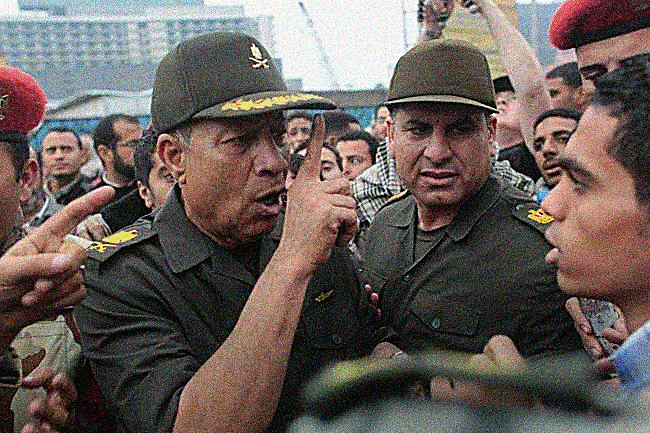
The U.S. does not wish to be seen as responsible for “losing” Egypt to Islamists in the coming elections.
Anyone who claims that the fate of the climate talks is bound to the fate of the Occupy movement better expect a bit of skepticism in return. Now, if it were Occupy and the Climate Justice movement, that would be a different story! Both are complex social movements, and both are driving hard for economic justice. Their overlap is inevitable. But the negotiations themselves? What have they to do with economic justice? What have they to do with the great divide between “the 1%” and “the 99%”?