States that acquire WMD fail to fully anticipate the dangers of their enemies seizing them.
A State’s WMD Are Just as Likely to Threaten It as Protect It
read more

States that acquire WMD fail to fully anticipate the dangers of their enemies seizing them.
The first thing I saw last month when I walked into the belly of the dark grey C-17 Air Force cargo plane was a void — something missing. A missing left arm, to be exact, severed at the shoulder, temporarily patched and held together. Thick, pale flesh, flecked with bright red at the edges. It looked like meat sliced open. The face and what remained of the rest of the man were obscured by blankets, an American flag quilt, and a jumble of tubes and tape, wires, drip bags, and medical monitors.

PTSD and moral injury are the first steps to healing from war.

In July 1990, on my way home from the meeting with our new friends in Moscow, I stopped off in London to do research for The Struggle Against the Bomb. Sitting in the Public Record Office and examining the newly-opened prime minister’s records, I was startled to discover a folder of documents showing that in the late 1950s cabinet-level government officials had launched a conspiracy to undermine Britain’s Campaign for Nuclear Disarmament (CND).

Killing civilians is hardly drones’ only crime.
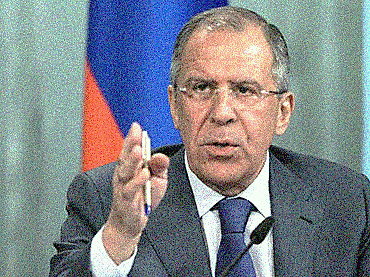
A more accurate bellwether of the tide turning in Syria will be if Russia decides it no longer needs President Assad.

Now that the talks with Iran on its nuclear program appear to be on the ropes, are we on the road to war? The Israelis threaten it almost weekly, and the Obama administration has reportedly drawn up an attack plan. But in a sense, we are already at war with Iran.
It is in Turkey’s best interest to act as negotiator between the hostile parties and move to the forefront of the peace-plan effort.

South Korea is at the cutting edge of global technology. It is one of the most wired countries, and its biggest cities have the fastest Internet connections in the world. Whether it’s cell phones or genetic engineering, Korean scientists and companies set the pace. Korean culture, too, is thoroughly up to date, from K-pop sensations like Rain to blockbuster movies like “Old Boy.” In many ways, South Korea has replaced Japan as the face of the future: wired, fast-paced, dynamic. If Hollywood remakes “Blade Runner”, the characters will navigate an urban landscape that looks more like Seoul than Tokyo.

Despite its close cooperation with the IDF in arresting suspected militants, the PA does not even have total control of its own funds or its security forces.