Sri Lankan President Mahinda Rajapaksa was in India earlier this month making promises to resettle the war-displaced Sri Lankan Tamil minority one year after his government’s forces won a crippling victory over the Tamil Tiger insurgency. But can he deliver on his pledge and begin the healing of Sri Lanka’s deep ethinc wounds?
Remember Vietistan?
The McChrystal debacle dramatizes how military thinking dominates U.S. policy — look at how much of the budget the Pentagon commands — as well as the utter hopelessness of achieving anything but draining defeat from the U.S. occupation of Afghanistan. This lesson should have been learned after Vietnam. As Yogi Berra said, it’s “déjà vu all over again.”
It’s Time to Step up Diplomacy with Iran
Things are heating up for Iran. The international community, responding to doubts over the intentions of the Iranian nuclear program, has passed three sanctions packages over the past three weeks.
Right-wing Loonies Support Okinawa Base Relocation
A Japanese cult leader took out a Washington Post ad in which false claims were made about leftists seeking to expel the U.S. military from Japan. In truth, protesters are focused on halting the building of a new U.S. base in Okinawa.
The Surge of Ideas
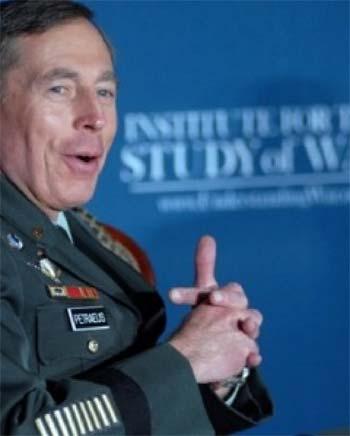
In recent years, there has been a growing tendency for think tanks and military brass to jointly pursue policy objectives, some of which are opposed by the public or the White House—take, for example, the campaigns to build support for the troop “surges” in both Iraq and Afghanistan. This trend, say critics, raises important questions about the appropriate role of the military in promoting particular policies and whether there is enough transparency and accountability in the work of policy groups. And, just as importantly, will there be a new joint campaign aimed at pressuring the Obama administration to delay troop withdrawal from Afghanistan?
Is Success in Afghanistan Really a Question of Command?
Surely, generals play an important role in winning and losing wars. But it is misleading to imagine that they determine the outcome of a conflict whose causes stem from the underlying political and social system.
Petraeus Harbinger of Peace, Not Another Surge?
Obama has stated that, despite firing Gen. McChrystal, our Afghanistan strategy will remain the same. The appointment of Gen. Petraeus to succeed him suggest otherwise — for better or worse.
Anti-Base Movements in South Korea: Comparative Perspective on the Asia-Pacific
Recent scrutiny of U.S.-Japan base realignment and Okinawan anti-base opposition has overshadowed U.S. military issues in South Korea. As others have argued, the struggle in Okinawa represents only one facet of the larger global struggle against U.S. bases.3
Crazy Talk in the Middle East
Trying to track—let alone make sense—of recent developments around Iran is enough to make one reach for that stuff they just found lots of in Afghanistan: lithium.
Call the Politburo, We’re in Trouble: Entering the Soviet Era in America
Gorbachev had dubbed Afghanistan “the bleeding wound,” and when the wounded Red Army finally limped home, it was to a country that would soon cease to exist. For the Soviet Union, Afghanistan had literally proven “the graveyard of empires.” If, at the end, its military remained standing, the empire didn’t. (And if you don’t already find this description just a tad eerie, given the present moment in the U.S., you should.)