
In an era of global unrest and authoritarian resurgence, Kenneth Roth insists that the strategies of the human rights movement still work — but only if people fight for it.
Kenneth Roth has been called “the godfather of human rights.” The former executive director of Human Rights Watch built the organization from a small nonprofit to one of the most powerful human rights organizations globally. He stepped down in 2024, to write his memoir Righting Wrongs. The book looks back at his three decades-long career and illustrates the strategies HRW used to pressure global governments to uphold human rights, and the consequential successes and struggles doing so.
“When I would tell people that I defend human rights, you could see in their eyes very frequently, they would be thinking: ‘Oh, isn’t that nice? But you can’t really get anything done, can you?’” Roth said. “I wanted to show that the defense of human rights is a game of hardball, that we put pressure on governments to force them to better respect human rights.”
The most discussed technique in Roth’s book is that of naming and shaming – exerting pressure on governments by publicly revealing their human rights misconduct. Roth said even the most ruthless dictators are sensitive to their reputation. But, in an era of rising authoritarianism, geopolitical instability, and digital surveillance the question of whether those strategies still holds becomes increasingly pressing.
Roth acknowledged that shaming has become harder in modern times because of disinformation, bots that can target enemies on social media, and AI. But he also emphasizes that those in power realize the truth remains powerful. The evidence, according to Roth, is that autocrats don’t rely solely on propaganda, but also censor people’s access to the truth and people’s ability to communicate the truth. “Even the autocrats don’t have faith in their propaganda alone,” Roth said. “For me, that’s heartening because it shows the importance of shaming — that they still fear shame.”
Can Human Rights Advocacy Survive Without U.S. Leadership?
In Righting Wrongs Roth often uses the United States government as an example of a nation that can be used to exert pressure on foreign governments. But actions of the new administration however, such as the arrests of pro-Palestinian demonstrators and immigrants with legal status, have put the United States recently on a watchdog list by Civicus Monitor for its rapid decline in civic freedoms.
“The U.S. government has basically absented itself from the defense of human rights,” Roth said. “But this is not the first time we’ve had this problem.” During the first Trump administration, Trump pulled out of the UN Human Rights Council. Still, the human rights movement was able to achieve the condemnation of Maduro in Venezuela, for instance. “You can defend human rights very effectively without the United States if coalitions of governments band together. The challenge now is foremost for European governments to recognize that they need to step forward as unified as possible to mount a defense of human rights without the United States.”
There is, however, no guarantee that countries will pressure the United States itself if it violates human rights. The U.S., along with Russia and Israel, is after all not part of the International Criminal Court. There’s little indication that countries are willing to condemn the United States if necessary. Therefore checks and balances need to remain strong, said Roth — the domestic courts, the opposition, the people.
The Republican Party will not counter Trump at this moment, Roth acknowledged. “The Democrats will find their voice at some stage,” he said. “The media is still very important, even though Trump is trying to penalize the media.” In the beginning of April, tens of thousands of citizens flooded the streets in cities all around the United States to protest Musk and Trump. In recent weeks, a Supreme Court race in Wisconsin drew attention. It was seen as a referendum on Trump and Musk — and the liberal judge won the race. Lower level judges have been stepping in repeatedly to stop Trump’s actions, but others are said to fear for their safety.
“There are very significant checks and balances, which I hope will prevail,” Roth said. “But obviously, it’s the responsibility of everybody in the United States to reinforce those tracks.”
The Limits of Shaming
In order for shaming to work, one needs the public to view conduct as wrong, argues Roth. “There are always going to be die hard people who want the wrong thing,” Roth said. “But our aim is to go to the center, and to persuade people who can be persuaded that it is important to stand for human rights.”
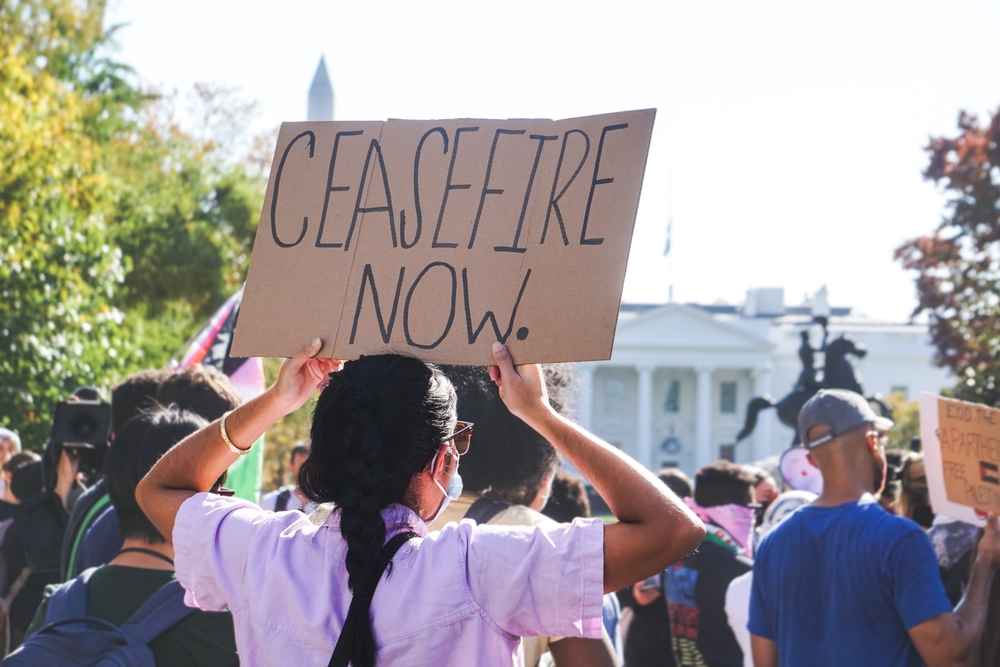
In Israel and Gaza, the events since October 7th have been extensively covered in the news and on social media, sparking global outrage. Multiple human rights organizations have called the war in Gaza a genocide and global protests show that there is a middle that has been moved already – be it to one side or another – a ceasefire is yet to be reinstalled.
“I think this is where leadership matters,” Roth said. “Biden said all the right things: He told Netanyahu to stop starving Palestinian civilians, to stop bombing them, but he was never willing to use his real leverage to stop the arms sales and military aid.” Trump, he said, is basically the same thing as the Israeli far right. “He has this kind of amoral commitment to ignore human rights,” said Roth. “But most Americans, even American Jews are pretty outraged by what Netanyahu has been doing in Gaza.”
The Israeli government is savvy about whenever you point out their war crimes, said Roth. He has criticized Israel extensively over his career, something that did not go unforgiven: He was refused a fellowship position at Harvard after being awarded the position.
“They say: ‘But Hamas’s human shields’ or ‘Hamas’s tunnels,’ which is a kind of facile answer,” Roth continued. “It doesn’t address how even if Israel is attacking a military target, it still has a duty to avoid disproportionate civilian harm.” He said that showing people what’s actually happening and cutting through the Israeli rhetoric is the way to maintain the public’s strong sense of right and wrong in the case of Gaza.
Roth grew up as the son of a Jewish German refugee himself. Stories about the Holocaust and how his father had to flee the Nazis in 1938 drew a red line through his childhood. It formed his personality, and eventually the decision of his career path. While his friends chose private law firms, “I went to this little obscure human rights group that nobody had heard of,” he said. “My parents thought I was wacko.” But they came around. In Righting Wrongs, he writes: “My mother died at age 89 in 2019, my father at age 95 in 2021. By the end of his life, he saw how his experience as a young boy had inspired me to do what I could do so that others would not have to flee their homes the way he had.”
“The lesson I draw from the Holocaust — which is the lesson that I think many Jews draw — is that you need strong human rights standards that make it harder to persecute Jews or anybody else, and that Jews are safest if you have human rights that protect everybody.”
On Gaza today, “Trump has completely bought the far right Israeli line,” Roth said. “He’s trying to censor criticism of Israel.” Trump has revoked millions of dollars in federal aid from universities who he says have failed to battle antisemitism. The administration has also arrested several students, such as Mahmoud Khalil, who was arrested and deported to Louisiana for being one of the lead negotiators during the encampments at Columbia University, and Rumeysa Ozturk, a Tufts student was arrested for writing an op-ed.
But Roth remains hopeful: “Trump, even though today he’s backing Israel 100 percent, this is a guy who doesn’t believe in anything but himself,” he said. “And if he recognizes that his self-interest, his reputation depends on pressuring Israel to change course, he’s fully capable of doing that.”
Staying Hopeful
That is the main lesson Roth shared from his decades fighting for human rights: It is never over. Roth said governments are always tempted to violate human rights, but the perpetual duty of the rights movement is to push back. “That’s a never ending duty,” he said. “And if you can’t accept that, it’s not the right movement for you.”
He opens Righting Wrongs with the bombings in Idlib in Syria by the Assad regime, which was targeting its own citizens. Under Roth’s leadership, Human Rights Watch helped pressure the Syrian and Russian governments to stop the bombing. That part of Syria eventually gave rise to the rebel group that overthrew Assad. “So you never quite know how these things work out,” Roth said. “Sometimes the most you can say is: ‘we prevented things from getting worse.’ Sometimes you can say ‘we made it better for a while.’ That’s just what the defense of human rights is. You just need to keep pushing.”
The human rights movement is not coming to an end, said Roth, even though sometimes it might feel hopeless. “The ability to shame governments depends on the public sense of right and wrong,” Roth said. “And that sense of right and wrong is not fixed: It can get better or worse, and it needs reinforcing.”
Roth argues that the most influential people for anyone are their friends, family, and acquaintances — people trust the people they know more than distant institutions. “I think that puts a responsibility on each of us, whether talking at the dinner table or chatting around the coffee machine or commenting on social media: to talk about global issues and to talk about what’s right and what’s wrong and to reinforce public morality,” he said.
“That is the foundation for the ability to defend human rights. So that’s something that not only can we all do… we all must do, if we’re going to succeed in this.”