
Over the course of the war in Iran so far, U.S. and Israeli aims have overlapped. But this alignment may change. President Donald Trump appears to want to eliminate key leadership figures and work with whatever remains of the governing structure if it accepts U.S. conditions. Israel, however, wants a more complete transformation of Iran’s regime.
The United States has also focused, in terms of the scope of the war, on the military capabilities of the regime, whereas Israel has been striking the country’s energy infrastructure, including in Tehran, to increase the costs of the war. The United States had hoped for a decisive short-term victory, which now appears less feasible. Israel, by contrast, may be prepared for a longer war, potentially several months of intense strikes, to remove what it perceives to be an existential threat.
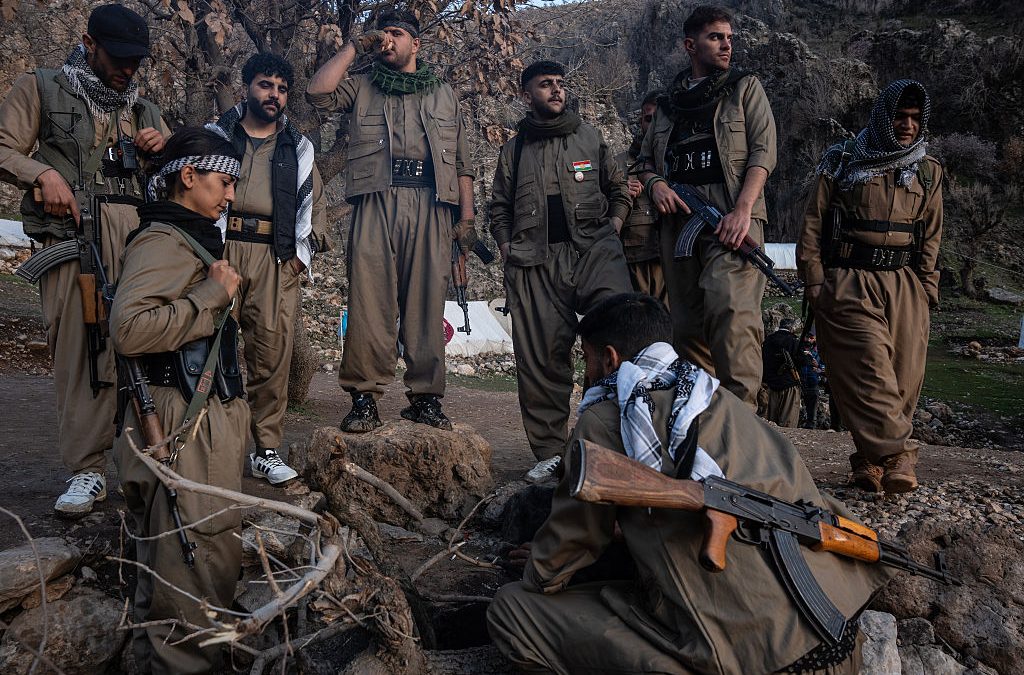
These differences are reasons to remain skeptical about both the conduct of the war and its eventual outcomes. However, beyond these issues, a new and significant element has emerged that has generated serious discussion and concern regarding the war: the potential involvement of Kurdish parties. The CIA, according to several sources, is working to arm Kurdish forces to spark an uprising in Iran. President Donald Trump, however, later opposed having Kurdish forces join the war against the Iranian regime, citing the need to prevent a volatile, high-stakes conflict from becoming further complicated. It’s not the first time that the U.S. government has looked to the Kurds as a strategic ally in the Middle East.
Since 1991, the United States and the Kurds cooperated several times in different parts of Kurdistan. After the 1991 Gulf War, the United States encouraged Kurdish and Shiite uprisings against Saddam Hussein, which were then violently suppressed. This led the United States, Britain, and France to impose a no-fly zone over Iraq, which eventually enabled the emergence of the Kurdistan autonomous region.
A second phase followed the September 11 attacks, when the United States cooperated closely with Kurdish parties in this autonomous region, contributing to the fall of Saddam Hussein and the establishment of the Kurdistan Regional Government as an autonomous entity within a federal Iraq in 2005.
The third episode occurred in Syria after 2015, when the United States partnered with Kurdish-led forces in Rojava to defeat the Islamic State, with U.S. airpower supporting Kurdish ground operations through the Syrian Democratic Forces. However, this partnership weakened after 2025 due to shifting U.S. strategic priorities, increased Turkish pressure in northern Syria, and internal Kurdish debates.
Kurdish Parties of Rojhelat
There are seven Kurdish political parties from Rojhelat, or Eastern Kurdistan. In anticipation of a possible war and under public pressure, these parties recently formed an alliance to coordinate their actions if the Iranian regime weakens and they could establish a political status like the Kurdistan region in Iraq.
According to sources within these parties, they collectively command around 8,000–10,000 fighters, including many returning from long periods of exile. These forces, known as Mountain Peshmerga, operate from the Kurdistan Mountain areas, and they are believed to be supported by Urban Peshmerga waiting inside the Kurdistan region in Iran.
This Kurdish alliance could align with the United States, and there has been communication between Kurdish leaders and President Donald Trump. However, Kurdish leaders have also said that they won’t launch a ground offensive on their own. At this point, a number of scenarios have emerged.
No-Fly Zone Scenario
In 1991, a no-fly zone allowed the two Kurdish parties in Iraq, the Kurdistan Democratic Party (KDP) and the Patriotic Union of Kurdistan (PUK), to build two administrative regions that served their political ambitions for twelve years until the 2003 war began. The Iraqi regime was under heavy Oil-for-Food sanctions during that period. Kurdish leaders have proposed a no-fly zone as a condition for their armed involvement in Iran.
If the United States, Israel, and perhaps several European allies join together to reduce the cost of implementation, a no-fly zone becomes feasible. It would weaken the Iranian regime’s authority and increase the chances of Azeri and Luri peoples joining the Kurdish liberation fronts since they share territories with Kurdistan. If the United States imposed this scenario on Iran in the absence of a decisive victory, it could establish military camps in Kurdistan to monitor the regime closely.
Despite these possibilities, significant obstacles remain. There is no sign that such a decision has yet been made, and the United States might not be willing to bear the costs of maintaining such a zone. It is not clear how the Iranian regime would respond to such a decision since it is transferring more weapons and personnel to the western regions to encounter the Kurdish parties. There is also fear that the United States would not guarantee the continuation of such a plan if negotiations were to occur with a new Iranian leadership.
Federalism Scenario
Kurdish parties support such a federal arrangement similar to that in Iraq for a future Iran. The majority of Kurds, Azeris, Arabs, and Balochs would reject a centralized government, especially one led by Iranian nationalists or monarchists.
Such a scenario would encourage marginalized groups in Iran to participate in shaping the future of the country in the interest of stability, political participation, and power-sharing. A federal arrangement would reduce the risk of civil unrest and civil war. It would also prevent the emergence of a new form of dictatorship or the domination of one nation over others. This scenario would bring the various parts of the country together and therefore prevent partition. A federal state, with Kurds as one region, would be more favorable to Turkey, which opposes an independent Kurdish state. In the absence of a strong central military, regional forces could protect their own regions, which would ultimately contribute to the protection and security of the country. Kurdistan has the means to support such security forces because it is rich in oil, minerals, human resources, experts, and other resources for economic growth.
Iranian nationalists, however, would reject any form of power-sharing under a federal state. Monarchists have already threatened the Kurds with military operations against any perceived threat to the territorial integrity of Iran, using this as justification to impose a centralized government if the regime collapses. These groups oppose federal arrangements because they see them as a potential step toward Kurdish independence. There is also no clear willingness from the United States or Israel to support such a scenario for Iran, as developments in Syria have already raised concerns among non-Persian nations such as the Kurds. If the collapse of the regime does not create a credible threat of territorial division, and if the Azeri population shows no willingness to demand a federal system, Turkey may oppose granting federal arrangements to the Kurds. Even bringing all nations, political groups, and parties to the negotiating table to discuss such a system would be extremely difficult.
Rojava Scenario
The least favorable outcome for the Kurds is if they serve as boots on the ground to spark rebellion in Iran while sacrificing their lives. In this way, they would face the same fate as the Kurds in Rojava. Rojava, as a political entity, no longer exists and is now part of the Syrian central government. However, there are more Kurds in Iran than there are in Syria. Unlike Rojava, most Kurdish cities in Iran are overwhelmingly Kurdish, often up to 90 percent, which makes political organization easier.
Several constraints limit the feasibility of this scenario. The Kurds in Iran hold approximately 80,000 to 120,000 square kilometers of territory. The variation in estimates is due to disputed areas between Kurds and Azeris and uncertainty about whether Luristan would join Kurdish liberation forces. Even if the Kurds were left alone, Azeri, Arab, and Baloch groups might face similar challenges, creating a chaotic situation in which any new central government would confront multidimensional crises. Under such conditions, the likelihood of civil war would be high.
Balkanization of Iran
The maps of Iran and former Yugoslavia share certain similarities. Iran contains several ethnic groups and nations. Although hostility among them is not as intense as it was in Yugoslavia, there is still a high likelihood of conflict in the event of a power vacuum, given the numerous social, cultural, political, and historical disputes among them.
Several conditions could increase the plausibility of this scenario. Iranian ultranationalism led by pro-Pahlavi monarchists and other nationalist groups has also created fear among other nations, signaling possible future hostility. In some of these nations, secessionists are advocating for independent states. Kurdish, Baloch, and Arab groups also possess armed factions that have historically challenged Iranian state sovereignty, often citing the fragility of the regime. Nationalism is also growing among Generation Z within these communities.
However, despite the presence of multiple ethnic and political divisions, hostility among these groups is not yet comparable to the levels that existed in Yugoslavia before its collapse. In addition, the potential emergence of a powerful nationalist state the size of Iran may not be welcomed by neighboring states such as Israel, Turkey, Iraq, Afghanistan, Pakistan, Azerbaijan, and the Gulf countries. These regional actors may prefer a weakened but unified Iran rather than the unpredictable consequences of complete territorial fragmentation.
A degree of uncertainty surrounds these scenarios. However, as soon as the Kurds realize that the regime is weak enough, they may begin operations inside Iran. The Kurdish alliance would likely seek some form of clear support, and the United States or Israel may be willing to work with them, though the exact nature of such cooperation remains uncertain. It is very likely that the United States and Israel would abandon the Kurds in the middle of the war, which could then lead to the slaughter of Kurdish forces and civilians by the regime. Kurds might also be abandoned if the United States and Israel achieve their objectives and end up working with a new centralized authority, as has been the case in Syria. As such, the future of the war, the regime, and Iran itself is still shrouded in uncertainty.