
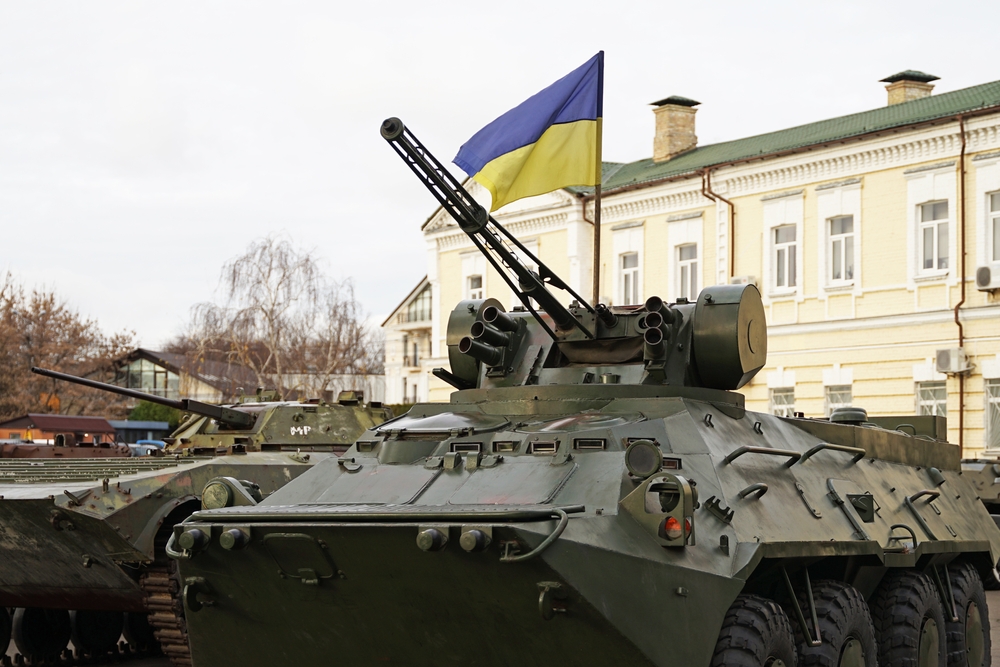
Two days ago, Ukrainian President Volodymyr Zelensky acknowledged for the first time that the Ukrainian military is responsible for the operationally surprising cross-border incursion launched one week ago into Russia’s Kursk region. According to Russia’s defense ministry, Ukrainian forces have advanced as far as 30 kilometers inside Russia.
Speculation abounds about the reasons behind Ukraine’s bold move, which shocked both Moscow and Washington. Russian President Putin has argued that Ukraine’s goal is to lure Russia’s forces away from the Donbas, where Moscow has been making slow but measurable gains. Ukrainian policymaker Oleh Dunda, meanwhile, asserts that the Kursk operation shakes up the long-static front line and makes the war more dynamic. Nimbler than its larger, more bureaucratically heavy adversary, Ukraine can take advantage of rapid changes on the battlefield.
As British historian Mark Galeotti has explained, Kyiv’s strategic objective in Kursk remains murky for operational and political reasons. However, the daring offensive has already achieved substantial symbolic gains, sending a powerful message to Russia, the United States, and the wider international community that the beleaguered Ukrainian military can still fight, that Ukraine has the capacity to militarily threaten Russian soil, and finally, that the Kremlin’s explicitly stated “red lines” can, indeed, be crossed without triggering nuclear catastrophe.
Beyond Stalemate
Earlier this summer, buoyed in part by a six-month delay of American military support for Ukraine and Ukraine’s severe manpower shortage, Russia’s better-resourced forces slowly and painfully gained more territory along the eastern front line and opened another front in the Kharkiv region to attempt for a second time to capture Ukraine’s second-largest city. The Kremlin has also been banking on the possibility of former President Trump returning to the White House and suspending U.S. military aid for Ukraine.
The surprise incursion into Russia forcefully demonstrates that the two-and-a-half-year-long war is far from a stalemate and that Ukraine can still fight. It also sends a reminder to Ukraine’s allies that military assistance is still vitally important.
When key decisionmakers are embroiled in military crises, credible communication with both adversaries and allies matters as much as effective action. As the iconic conflict strategist and scholar Thomas Schelling has observed, “It is a tradition in military planning to attend to an enemy’s capabilities, not his intentions.” A state credibly communicates its capabilities by incurring costs.
This is exactly what the Kursk incursion is accomplishing: Ukraine’s willingness to run the enormous risk of attacking Russia with thousands of troops—including elements from elite units and the American equipment that Ukraine might lose after November—signals not only Kyiv’s deadly serious intention but also its capability to continue fighting.
Threatening Russia
The Kursk offensive also shows that Ukraine can threaten Russian soil as Moscow scrambles to beef up security, relocate hundreds of thousands of residents, issue missile warnings, and send reinforcements. Ukraine’s military leadership boasts that it now controls 1,000 square kilometers of Russian territory. Rather than reporting on horrors taking place in Ukraine, Russian military bloggers are now relaying dispatches from the home front that Ukrainian forces “occupy a portion of the Kursk region,” as one blogger writes. “There is a battle around the city of Sudzha, a monastery is on fire, and our soldiers and civilians are dying.” Although Ukraine does not likely have the necessary troops to expand into and hold a substantial amount of Russian territory, the offensive nevertheless delivers a humiliating blow to the Kremlin.
Ukraine quickly breached the border and overran Russian territory, dramatically exposing the vulnerabilities in Russian border defense and causing severe casualties. Even Russian policymakers have confirmed that the security failure is “serious,” going so far as to muse publicly that the Kremlin must have known about the attack beforehand. In pushing the war onto Russian territory, the Kursk incursion is forcing the Kremlin to recalibrate its strategy, not least by ceasing to regard the border as a dormant front and rushing to fortify it with FSB, national guard, and border troop elements.
In the short term, the gamble seems to be paying off, with Ukraine reporting that Russia has substantially scaled back guided bomb attacks near Kharkiv. Importantly, Ukraine’s push has considerable psychological power. It has brought home a grim reality to Russian citizens who, thanks to successful state propaganda, are both bewildered and apathetic about the ongoing “special military operation” in Ukraine. Now that ordinary Russians are no longer protected from the deadly logic of war, Putin’s tight grip on power—and the narrative that supports it— has already lost some of its legitimacy.
Putin’s Threats
Most significantly, the cross-border assault signals to the entire world that Russia’s most serious stated “red line,” crossed for the first time since the second World War, is not so clear-cut. The reasons behind the Biden administration’s hesitation about permitting Ukraine to use American arms to strike targets deep inside Russia can be traced back to the Cold War, when fears of conventional military conflicts escalating to nuclear crises meant that both the United States and the Soviet Union were deterred from directly confronting one another militarily. Proxy wars—whether in Angola, Chile, or Cuba—were fine but only as long as conflicts were confined to smaller states too weak to refuse to be used as mere battlegrounds.
Now, a foreign country has invaded Russian territory using NATO weapons. Instead of triggering the promised trip wire, the Kremlin initially sought to downplay the significance of the attack, with Putin describing it as a “provocation.”
Does this mean that the vow of retaliation was a bluff? The President of the Kyiv School of Economics, Tymofiy Mylovanov, seems to think so. “Unless Putin retaliates with nuclear weapons, his threats of nuclear retaliation are as good as dead,” he observes. “Remember, he used to threaten nuclear response if Ukraine liberated Kherson. Now Ukraine invades Kursk, and what happens? Nothing.”
Although this might be a risky strategy—attack to see if Russia makes good on its nuclear threat—it also highlights the nature of signaling in international crises. To return to Schelling: “Nations have been known to bluff; they have also been known to make threats sincerely and change their minds when the chips were down. Many territories are just not worth a war.” For now, it’s too soon to tell whether any of these contingencies is true for Russia, especially since Russian forces are likely to soon regain the advantage in Kursk now that the Kremlin has promised a counterattack.
Overall, Kyiv’s unexpected assault is brave, desperate, and very dangerous. With out-manned and outgunned troops already stretched thin along a 1,000-kilometer front line, Ukrainian forces have a lot to lose in Russian territory. Yet, for now, the push has succeeded in shifting the war narrative in Ukraine’s favor and on Ukraine’s terms.