
In Nepal’s western Dailekh district, big rigs have drilled down through Himalayan rock 4,000 meters searching for oil and gas. The exploration, backed by a $18 million Chinese grant, is led by China Geological Survey and Xibu Drilling Engineering Company. Chinese labs will test the extracted rock samples to determine, probably by this summer, whether Nepal has commercially viable petroleum reserves.
Since Nepal is fully dependent on imported fossil fuels from India, many Nepalis have hailed this initiative as a historic milestone towards energy independence. But, in the age of escalating climate crisis, rapid decarbonization, and intensifying regional rivalries, Nepal’s petroleum gamble creates three big risks: ecological, economic, and geopolitical.
Long-Held Aspiration
The Nepal government has strived to explore oil for a long time. The government began poking around the country’s Terai plains in the 1960s but didn’t start systemic exploration until the late 1970s. In 1982, after establishing the Petroleum Exploration Promotion Project with World Bank support, the government invited international companies to explore for oil.
In 1986, the Dutch oil giant Shell partnered with Triton Energy Corp to survey in eastern Nepal in 1986 but abandoned the project after four years claiming no oil. Four other companies came next: the American company Texana Resources in 1998, the Scottish Carin in 2004, and the American BBB Champions Oil and the Dubai-based Emirates Associated Business Group (EABG) in 2012. Most of them didn’t carry out substantial exploration work and suspended the operations themselves. Until 2013, BBB Champions Oil claimed to have begun drilling but never initiated the exploration. In 2014, the Nepal government cancelled all the licences.
In 2016, the Chinese government sent its first team to Nepal to explore for oil and gas.
Himalayan climate risks
Nepal emits less than 0.1 percent of global greenhouse gas (GHG), yet it faces some of the world’s biggest climate impacts. Himalayan glaciers, which provide water for drinking, agriculture, and energy for around 1.2 billion people in South Asia, are melting twice the rate they did in 2000. One third of these glaciers will melt even if the world could limit global warming by 1.5°C. Unpredictable monsoon extremes in Nepal have intensified, triggering deadly floods and landslides. In September 2024, Kathmandu’s floods killed around 250 people and destroyed about $3.4 billion in houses and infrastructure.
Despite emitting negligible GHG, Nepal has committed to achieve net-zero emissions by 2045 or sooner and becoming carbon-negative by 2050. To do so, the country will electrify its transport sector and expand its vast hydropower potential. On international stages, Nepali leaders frequently demand compensation for floods and other climate harm inflicted by industrialized countries.
But Dailekh oil exploration directly contradicts Nepal’s climate commitments. If oil reserves prove commercially viable, Nepal will require massive investment in refining and extraction infrastructure, harming the fragile ecology and locking the country into fossil fuel dependence just as the world transitions away from it.
The Illusion of Economic Gain
Even if Nepal can start commercially viable petroleum extraction, costs will outweigh benefits. Globally, the fossil fuel industry relies heavily on subsidies. In 2022 alone, governments wasted $1.2 trillion on unnecessary subsidies.
Nepal, with its limited fiscal capacity, can’t afford to subsidize a dying industry. The country has more important priorities. Instead, Nepal needs to invest its meager resources in providing climate-safe housing, food security, and vital public services to its people.
In addition, the global energy landscape is shifting. Fossil fuels are dying. Renewables are gaining momentum despite powerful, climate-denying fossil fuel interests blocking the way. According to the International Energy Agency, oil demand will peak by 2030 as renewable energy replaces fossil fuels in transport, industry, and other sectors. By the time Nepal develops its petroleum sector, it may find itself with a stranded asset—an expensive, outdated investment with little economic future.
A Geopolitical Misstep
Also, with the push for oil in Dailekh, Nepal could find itself trapped between China’s growing influence and India’s strategic interest in the country.
In recent years, under the Belt and Road Initiative (BRI), Nepal’s northern neighbor China has expanded its economic ties with Nepal by financing dams and other large-scale infrastructure projects. If commercially viable petroleum reserves are confirmed in Nepal, Beijing might push for exclusive extraction and refining rights given that it is involved in exploration. It might further push for supply agreements that further integrate Nepal into China’s energy network. Consequently, Beijing will gain greater leverage over Katmandu’s political and economic decisions.
This aligns with China’s broader strategy of expanding its energy footprint in South Asia, challenging India’s long-standing dominance.
India has a long held strategic interest in Nepal because of geographical proximity and cultural ties. Nepal is dependent on India for its petroleum supply, and its imports are controlled by the Indian Oil Corporation (OIC). India continues to expand multiple petroleum import pipelines in Nepal to supply fossil fuel despite calls from environmentalists to halt investment.
India has repeatedly used economic pressure to maintain its influence over Nepal. Nepalis haven’t forgotten that in 2015, India blocked the border, which led to fuel shortages and economic hardship. If Nepal moves too close to China, India might retaliate again with trade restrictions, stopping ongoing energy and infrastructure cooperation and demanding extraction rights.
The Alternatives
Nepal started to prospect for fossil fuel long before the climate crisis emerged as a major issue. But in the world of climate emergency, Nepal should focus on just transition that ensures that economy, communities, and workers benefit from the shift to renewable energy.
Rather than betting on a declining fossil fuel industry, Nepal must spearhead a green new deal that prioritizes investing in clean energy, climate adaptation, and green jobs while reducing reliance on petroleum imports.
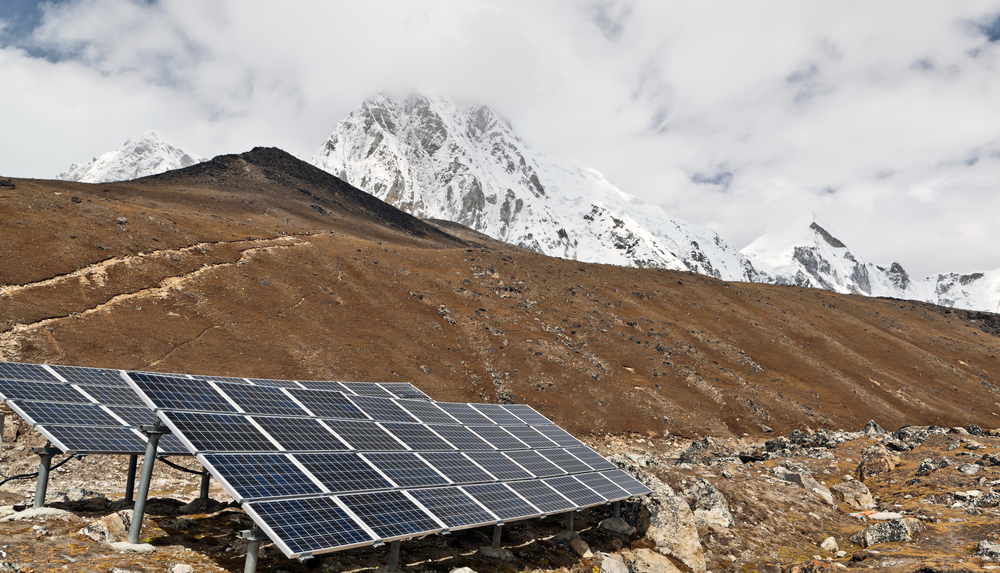
First, Nepal can become a clean energy hub by increasing hydroelectricity production but also by focusing more on solar and wind energy. It needs to strengthen its grid infrastructure for domestic supply and regional energy trade. To manage supply fluctuations, Nepal should invest in storage solutions.
Second, to reduce petroleum dependency, Nepal needs to accelerate electrification. Given that Nepal’s import revenue can’t pay even for half of its fossil fuel needs, Nepal must electrify its transport, agriculture, residential, and industrial sectors. Creating green jobs should be the central strategy in this transition.
Third, and most important, Nepal should focus on building climate resilience. Considering that Nepalis face climate risk in the hydropower sector, Nepal needs to diversify renewable energy generation. It should take leadership in the energy transition by forging international collaborations for technology transfer and demanding climate finance to achieve its green ambitions.
Nepal stands at a critical energy crossroads. Although the Dailekh project offers the promise of domestic petroleum production, the risks far outweigh the benefits. A declining global fossil fuel industry, the rising renewable energy transition, and the intensifying India-China rivalry make this an ecologically, economically, and geopolitically risky endeavor.
Instead of chasing fossil fuels in a warming world, a Green New Deal can provide a roadmap for economic development that aligns with climate goals and positions Nepal as a leader in South Asia’s just transition. The choice is clear: embrace the clean-energy future or be left behind in the fossilized past.