
During his joint address to Congress, President Trump thanked the Pakistani government for its assistance in surrendering an alleged terrorist implicated in the Abbey Gate bombing in Afghanistan in 2021 that killed 13 U.S. service members and 170 Afghan civilians. In this way, Trump signaled the renewal of U.S.-Pakistan military ties and raised questions about whether counterterrorism will once again overshadow concerns over the human rights abuses of Pakistan’s military and civilian leadership.
Historically, successive U.S. administrations have strengthened ties with the Pakistani military to advance their Cold War objectives and, later, counterterrorism goals—often at the expense of human rights, rule of law, and due process in Pakistan. Previously, there was not a lot of pushback against these policies, either within Pakistan or internationally.
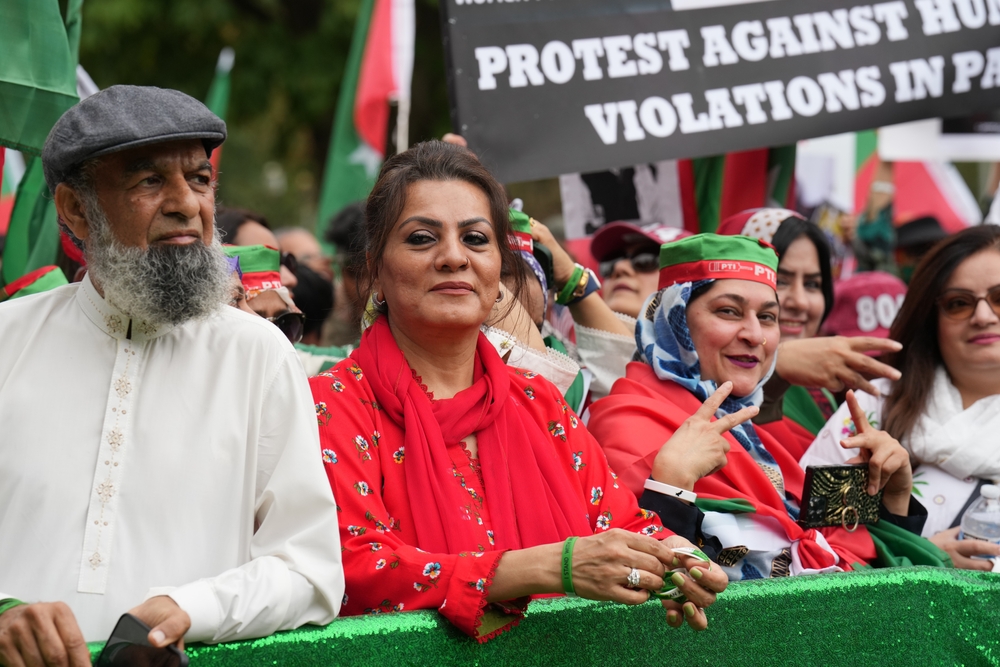
Until now. A rising Pakistani-American diaspora—and its allies including advocates, journalists, influencers, and ex-officials—is challenging this dynamic with a pro-democracy movement that is increasingly vocal.
Since former Prime Minister Imran Khan was ousted three years ago, Pakistan’s military leadership and the civilian regime it backs have brutalized pro-democracy activists, muzzled the media, disappeared and tortured human rights defenders, intimidated senior judges, tried civilians in military courts, used lethal weapons against unarmed protestors, and snatched away fundamental freedoms enshrined in Pakistan’s constitution.
In response, diverse diaspora groups and their allies have mobilized to highlight the increasing repression in Pakistan and to reorient U.S.-Pakistan relations in unprecedented ways.
A Diverse Movement
The Pakistani-American diaspora’s efforts to promote democracy and human rights in Pakistan have triggered significant speculation from Pakistani mainstream media outlets, social media platforms, and regime leaders. Both critics and supporters often portray the diaspora as a monolith, ignoring the diversity among activist organizations and their advocacy approaches.
The majority in this growing movement stands in solidarity with former prime minister Imran Khan, imprisoned for almost two years, and his Pakistan Tehreek-e-Insaaf (PTI) party that has borne the brunt of the violent military crackdown in Pakistan. Although this movement includes PTI diaspora leadership, it is, contrary to popular belief, neither led by PTI nor dominated by it.
In the context of U.S. politics, the movement includes members from a variety of political affiliations. During last year’s election, some diaspora groups backed Trump, hoping his past affinity for Imran Khan would prompt him to push for Khan’s release. This split the movement, alienating those opposed to Trump’s domestic policies and agenda. It also baffled liberal allies who could not reconcile how Trump could be relied on to potentially help restore democracy in Pakistan while actively working to dismantle it at home.
Others in the movement believe the way forward is to build power and influence within Congress and drive policy change through congressional advocacy.
Another divide pits those seeking targeted sanctions on Pakistan’s military leaders against those focused on the civilian regime’s complicity in human rights abuses. Critics of the latter approach say the focus on civilian leaders deflects attention from the military leadership, the main architects of repression. They also believe a divided focus could muddle congressional strategy and confuse policymakers about the goals of the movement.
Overtime, however, as the military’s repression against Pakistani civil society has grown, so has the consensus surrounding the need to hold the Pakistani military leadership accountable, not just its civilian counterparts.
Despite differences, the Pakistani-American diaspora has made considerable gains in challenging military authoritarianism by shifting public perception and advancing a human rights-centered narrative in Congress.
Shifting the Narrative
The Pakistani military has long excelled at shaping the narrative around its actions. For decades, revisionist history textbooks ensured that generations of Pakistanis never learned of the ethnic cleansing perpetrated by the Pakistani military against its own people in former East Pakistan. Censorship of the media and intimidation of journalists meant that the military’s manipulation of Pakistani politics was never openly discussed. Pressure on compliant judges provided legal cover for the multiple coups orchestrated by the Pakistani military. Because of collusion with corrupt politicians, the military was never questioned about the torture and killings of hundreds of Baloch, Sindhi, and Pashtun nationalists.
Over the past three years, the Pakistani diaspora has led efforts to expose the military’s pernicious role in Pakistan’s history. Through daily analyses on YouTube channels, congressional briefings, press conferences, seminars, and investigative reports—amplified by social media—they’ve reshaped the narrative, reaching millions globally. Publicly criticizing the Pakistani military was once considered sacrilegious both within and outside Pakistan. Now an increasing number of Pakistanis are more emboldened than ever to challenge the Pakistani military leadership.
The Pakistani government has tried to suppress these voices by intermittently shutting down the Internet, blocking social media platforms like X, and banning certain news outlets. They have passed laws against “digital terrorists,” engaged in transnational repression, and charged leading diaspora journalists with sedition. However, people in Pakistan have increasingly relied on Virtual Private Networks (VPNs) to access the Internet and, at great personal risk, have added their voices to the growing chorus of anti-military sentiment.
Engaging with Congress
Perhaps most significantly, this nascent pro-democracy movement has secured the support of congressional representatives from across the political spectrum to develop a compelling narrative in Congress away from a purely national security-centered perspective to one that centers issues of human rights and democracy in Pakistan.
Following the widespread, military-backed rigging of parliamentary elections last year, 368 bipartisan members of Congress voted to pass House Resolution 901, calling for an investigation into the rigged election. In addition, multiple congressional letters came out within months of each other, with more than 100 congressional reps calling for the release of Imran Khan and thousands of political prisoners detained illegally, as echoed by the UN and Amnesty International. In October, 62 congressional Democrats wrote a letter to then-President Biden supporting targeted sanctions against Pakistan’s military and civilian leadership, specifically naming Pakistan’s army chief, General Asim Munir.
With the recent announcement by Congressman Joe Wilson (R-SC) of the proposed Pakistan Democracy Act, many in the community have pushed him to introduce legislation akin to the MEGOBARI Act that he’d introduced for the country of Georgia. It would make visa bans and asset freezes binding against Pakistan’s military leadership. The community has made clear to Wilson’s office that anything less would be seen as a mere half measure allowing the military leadership to escape accountability.
Through congressional briefings, diaspora advocacy groups have warned members of Congress that the Pakistani military is an unreliable partner, accusing it of fostering militants and undermining U.S. interests in Afghanistan.
This comes at a time when the Pakistani military is reportedly planning a military campaign against ISIS-K in Afghanistan to position itself as a key security partner for the United States. The military leadership has portrayed the militant group as an international security threat. It remains unclear whether this strategy will draw in the United States at a time when the current administration is trying to disengage from the region.
Moreover, diaspora groups are building a narrative among congressional offices that the once-revered Pakistani military is now despised by millions of Pakistanis. They warn that continued U.S. support of the military at the expense of democracy risks alienating a youthful population, two-thirds of which is under 30.
In response to the diaspora’s lobbying in Congress, Pakistan’s Foreign Office and parliamentarians tied to the current regime accused the diaspora of inviting U.S. interference in Pakistan’s internal affairs. Members of the diaspora countered that as American citizens, they have a right and responsibility to ensure that U.S. policies towards Pakistan do not result in democratic backsliding—especially since U.S. silence could imply approval of its human rights abuses.
Moreover, these groups contend that the push for democratic norms through congressional engagement is a diaspora-led effort and not tied to particular U.S. government agendas. At a time when the increasingly authoritarian Pakistani regime has left no space for Pakistani civil society groups to advocate for their rights inside Pakistan, the diaspora with strong linkages and roots in the country feels compelled to act.
The Pakistani diaspora and its allies in Washington are just beginning to flex their muscle. It is unrealistic to expect their efforts will yield overnight shifts in U.S. policies that are decades in the making. And yet, one thing is clear: the Pakistani-American diaspora, dug in for a long fight, is poised to confront the military’s ongoing assault on the constitution. Beyond this, the diaspora will continue to push the U.S. government to abandon its myopic policies that for far too long have undermined its own interests and trampled the will of the Pakistani people. This movement is not a fleeting protest but, increasingly, a sustained uprising.