Could Japan and China — the number two and three largest economies in the world — really get into a punch-out over five tiny islands covering less than four square miles?

Japan v. China: Smoke or Fire?
read more

Could Japan and China — the number two and three largest economies in the world — really get into a punch-out over five tiny islands covering less than four square miles?

Actress Sandra Oh has taken on a new starring role: North Korean adoption activist. In a new ad, Oh pulls heartstrings for the rescue of North Korean children who have escaped and who “are living alone and without family in foreign lands” like China. “They need us,” she says against a backdrop of fleeting images of emaciated children. But who are these children?

Would that the Chinese rich were addicted to designer drugs instead of ivory.

In her new book The China Threat, the distinguished American diplomatic historian Nancy Bernkopf Tucker combed manuscript collections, searched through oral histories, conducted interviews in both Beijing and Washington, and reviewed numerous other published documents to present the memories, myths, and the realities of the 1950s and 1960s.

Two parallel narratives surround globalization and the trade imbalance between China and the United States. One side moans that competition with China has squeezed traditional U.S. manufacturing jobs and caused the middle class to disappear. The other side declares that a new Chinese middle class is riding the wave of China’s inexorable economic boom. A particularly hyperbolic headline in Forbes, for example, proclaimed the rise of China’s middle class to be “The Biggest Story of Our Time.”

Apple, the most profitable company in existence and one of the most popular brands ever created, has gotten used to being the glowing center of attention. The release of the next iPhone or the new iPad invariably stirs an orgy of conspicuous consumption. Recently, however, a series of exposés have shifted some attention to the darker side of Apple, shining a light on the working conditions at the Foxconn factories in China where its products are made.
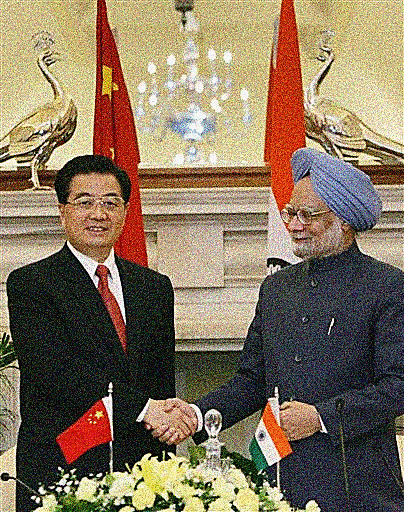
Since the Cold War, India and the United States composed a mutual admiration society.

Behind the political crisis that saw the recent fall of powerful Communist Party leader Bo Xiali is an internal battle over how to handle China’s slowing economy and growing income disparity, while shifting from an export-driven model powered by cheap labor to one built around internal consumption.
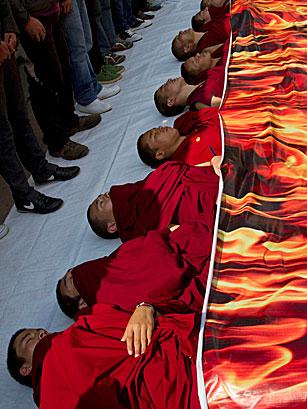
Western China’s Sichuan province, where most ethnic Tibetans reside, has recently become the epicenter of more than two dozen self-immolations by Buddhist monks, nuns, and lay Tibetans. These protests against the policies of the Communist regime in the region not only has stunned exiled Tibetans but has also shocked the world community. The latest self-immolation came on March 17when a 44-year-old Tibetan farmer set himself on fire in northwestern Qinghai province. There have now been 30 self-immolations since February 27.
They say that it’s only in hard times that you really see who your true friends are. What separates opportunistic partnership from genuine alliance isn’t necessarily treaties, but a willingness among both parties to hang onto their relationship when the going gets tough.