Europe & Central Asia
Europe’s Dilemma: Immigration and the Arab Spring

Europe’s Dilemma: Immigration and the Arab Spring

Much of the West voiced great support for the Arab Spring. However, the European Union in particular soon curbed its enthusiastic reaction when residents of the Middle East and North Africa (MENA) began streaming into Europe after turmoil from the Arab Spring left many MENA civilians unable to remain in the region. Immigration from the Middle East and North Africa to the European Union surged over the past year, causing the leaders of many EU countries to speak out against the growing influx of Arab immigrants seeking refuge within their borders.

read more
The Pentagon’s Obesity Problem

The Pentagon’s Obesity Problem

America has a problem with portion control. U.S. restaurants serve enormous entrees, convenience stores sell “Big Gulp” cups of soda, and Americans routinely compete to see who can eat the most hot dogs or pizzas or chicken wings in ten minutes. It’s not just the quantity. It’s also the quality. Americans get as much as one-third of their calories from junk food. No wonder that Americans are fatter than citizens of any other developed country, with the obesity rate twice that of many European nations. The Pentagon has the same problem with portion control.

read more

Israel’s Reluctant Friend

A new and perhaps surprising country took center stage recently in the ongoing row over Iran’s nuclear program – Azerbaijan. Citing anonymous “high-level sources” from U.S. diplomatic and intelligence circles, a controversial article in Foreign Policy at the end of March suggested the possibility that Israel might have been proffered the use of Azerbaijani airstrips for any strikes against Iran’s nuclear facilities.

read more
Morals in the Age of One Superpower

Morals in the Age of One Superpower

Interjecting the consideration of moral values into foreign policy decisions is, unfortunately, often ridiculed by the political establishment of Republicans and Democrats in the United States. For instance, one supporter of Bill Clinton in 1992, Michael Mandelbaum, expressed how foolish it is to construct policies based on moral values.

read more
Annotate This: EU Response to Argentina’s Nationalization

Annotate This: EU Response to Argentina’s Nationalization

Despite being immensely popular among the people of Argentina, the Argentinean government’s decision to nationalize the YPF oil company has continued to come under attack by those who obstinately promote extractive capitalism. The measure would nationalize YPF and restore 51 percent of the company’s ownership to Argentina. It would thus end sister company Repsol’s 57.4 percent majority stake in the company.

read more
The End of Austerity in Europe?

The End of Austerity in Europe?

A few months ago, when Occupy movements bloomed across Europe, the absence of any similar uprising in France appeared to be an anomaly in a country infamous for its people’s propensity to take the streets. One explanation was that the presidential election was just around the corner, and that after 10 years out of government, the Left was capable of channeling the French people’s indignation into electoral gains.

read more
NATO vs. Rogues?

NATO vs. Rogues?

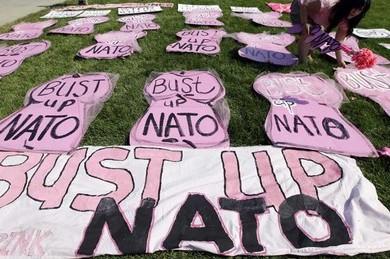
Institutions rarely vote themselves out of existence. Not if they still have money in their budgets. Large institutions in particular have an almost genetic propensity to cling to life even after their reasons for being have vanished. That’s why I don’t expect NATO, which will gather in Chicago later this month, to suddenly declare game over and disband – even though the alliance’s rationale has become wafer-thin. The Soviet Union is no more, al-Qaeda is a spent force, and NATO members are rushing for the door in Afghanistan. Indeed, most of Europe is cutting back on military spending, and the debt-saddled region has a diminished appetite for intervention.

read more