Will this election be contested, too?

A Voter’s Guide to Iran’s Presidential Race
read more

Will this election be contested, too?

As Iran’s presidential election approaches with the speed of an out-of-control train, its passengers are certainly curious about who’s going to be the next conductor. Yet as they take in the political infighting that so consumes the country’s ruling classes, ordinary Iranians understand that one of the most salient facts of life in Iran—the international sanctions regime—will not be on the ballot.
From Iraq to Iran to Syria.
Emphasis, as always, added.
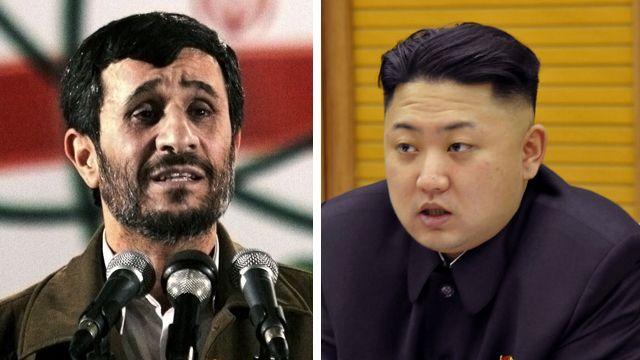
North Korea’s nuclear weapons and Iran’s purported nuclear ambitions are the subject of constant speculation by Western pundits. However, the connection between the two is often overlooked. Although Northeast Asia and the Middle East are home to different geopolitical realities, the resolution of tensions on the Korean peninsula will almost certainly influence calculations made in Washington and Tehran regarding the Iranian nuclear program.
What does Syria plan to do, if anything, about Israeli air strikes?
Emphasis, as always, added.
While U.S. politicians Friday debated whether Sulaiman Abu Ghaith, a son-in-law of Osama bin Laden and former Al-Qaeda spokesman, should be tried in New York City, foreign policy analysts were speculating about the circumstances under which he was apprehended by U.S. authorities.
Retaliate against hackers with nukes!

After eight months of diplomatic hiatus, Iran and the so-called “P5+1” powers—including the United States, China, Russia, France, Germany, and the United Kingdom—were finally able to return to the negotiating table. And, to the surprise of many observers, they managed to pull off a potential breakthrough in the decade-long standoff over Iran’s nuclear enrichment program.