Most combat radar is kept in a passive mode to prevent a potential enemy from mapping out weaknesses or blind spots that can be useful in the advent of an attack.
In its haste to placate Israel, the United States may have lost sight of its own goals toward Iran.
Alex has a big problem. Since his earliest years he has been addicted to a potent combination of sex and violence. When he hangs out with his friends, their favorite activity is to break into people’s houses and terrorize them. But that’s actually not Alex’s big problem. That comes later, when he’s apprehended by the state and subjected to an extreme form of aversion therapy that makes him physically sick whenever he sees or contemplates violence. Worse, at least for Alex, is that he is repulsed by the art that once soothed his savage breast.
Israel’s nukes beg to be balanced, claims a noted international relations scholar.
This breakdown means we must prepare for the return of another onslaught of articles baldly assuming a military strike on Iran’s enrichment facilities is imminent.
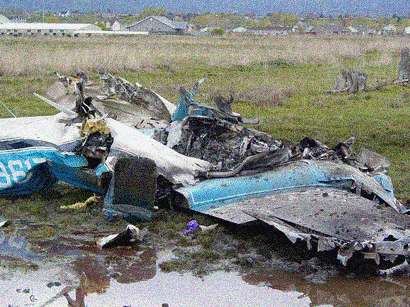
Between downing a Turkish war plane and military defections, President Assad is beginning to look cornered.
Qatar, home to only 225,000 natives and 1.7 million foreign workers, has emerged as an influential regional actor in recent years. Emir Shaikh Hamad bin Khalifa Al Thani has ruled Qatar since 1995, when he replaced his father in a bloodless palace coup, and has pursued an ambitious foreign policy for his statelet. Natural resource wealth, ownership of Al Jazeera, and a carefully constructed web of foreign alliances have allowed Doha to project itself throughout the Middle East.
If international relations scholarship is to advance policymakers’ understanding of transnational organized crime and its role with respect to state power, new frameworks are needed.
If rebels knew how to behave in advance, the process of providing them with aid would be expedited.
In the most violent day in Iraq since the United States pulled out its remaining troops last December, a series of well-thought-out and coordinated terrorist strikes across the country killed approximately 80 Iraqis last Wednesday. As is usually the case in Iraq, members of the Shia community constituted most of the casualties, with some of the most powerfully built bombs detonated in neighborhoods jammed packed with Shia worshipers making their way to northern Baghdad on a religious commemoration ceremony.