Now we know why the House voted to kill emergency funding for PBS — it linked to Right Web.
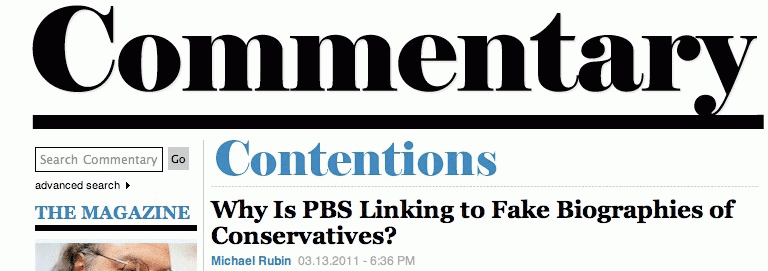
Commentary Urges Congress to Investigate PBS for Linking to Right Web!
read more

Now we know why the House voted to kill emergency funding for PBS — it linked to Right Web.
On 9/11 Flight 111 flew over New York’s Indian Point power plant.
With a new Congress with a House controlled by Republicans who have trumpeted deficit reduction as one of their central priorities, it would be logical to expect that there might be trimming in one of the largest and most bloated areas of US government spending: the nation’s $700bn military budget. However, the realities of Washington, DC are different than the rhetoric.
With Libyan government forces advancing towards the rebel capital of Benghazi, the time for possible military intervention by the U.S. and its NATO or other allies appears to be running short.
Just how American bullets make their way into Bahraini guns, into weapons used by troops suppressing pro-democracy protesters, opens a wider window into the shadowy relationships between the Pentagon and a number of autocratic states in the Arab world.
Global warming and financial considerations fuel the proliferation of nuclear energy.
When it comes to nuclear energy, a return to the Dark Ages can be a good thing.
Is the nuclear energy too entrenched, especially with Peak Oil looming, to be slowed in its tracks by the reactor crises in Japan?
Meanwhile, Moscow once again boasts more billionaires than New York City.

Wajahat Ali is a playwright, lawyer, and political commentator. His play, The Domestic Crusaders, made its Off Broadway premiere at the Nuyorican Poets Café in 2009 and was published by McSweeney’s last year. He is currently doing research on Islamophobia for ThinkProgress and preparing a pilot for HBO. In our special focus on Islamophobia, he talks with FPIF about the Homeland Security Committee hearings on Muslim extremism, the “threat of sharia,” and the reception of his play.