
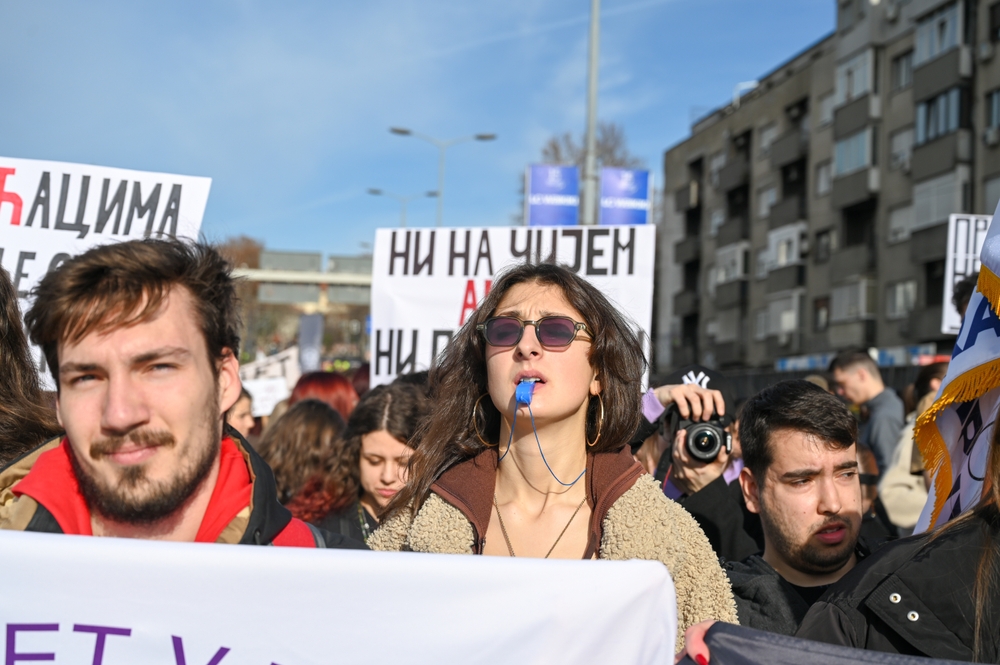
A newly constructed canopy collapsed in front of the central station in Novi Sad on November 1, 2024 at 11:52 am. Fifteen people lost their lives and two others were seriously injured. This tragedy now represents a powerful symbol of a state corruption, ineptitude, graft, and criminality. The motto of the student revolt in Serbia became “You have blood on your hands.”
Under President Aleksandar Vučić and his Serbian Progressive Party (SNS), which has ruled the country for over 12 years, Serbian democracy has obviously collapsed along with part of the railway station in Novi Sad. Still, Vučić has followers in the country and semi-allies all around the globe that have their own agendas. Moscow wants to keep a finger in that part of Europe. The European Union is counting on Serbia’s lithium and would also like to diminish Putin’s influence in that part of the Balkans. The Chinese are already business partners (including the construction of the collapsed canopy).
As it turns out, the United States also has some interests in the country. Jared Kushner, President Donald Trump’s son-in-law, happily posed for the cameras in Belgrade where he is reportedly working on a deal to build a Trump-branded hotel. Ironically enough, the site for the future hotel is that of the General Staff Building in Belgrade bombed by NATO in 1999. Various Gulf states are expected to provide the necessary capital. Many Serbian students and many citizens are not impressed.
Students Have Had Enough
In their recent letter to students around the world, students from the Faculty of Dramatic Arts from Belgrade declare: “The world is on the brink of collapse, representative democracy is failing, and our future is at risk. This is the only way to take control and change the course of the world. There are countless reasons for a blockade, and you know best what yours is.”
For the last three months, Serbian students have engaged in ever-growing protests, blockades, and a general strike that has involved tens of thousands, even occasionally 100,000 people as other citizens join. Each day at 11:52 am, protestors stop for 15 minutes of silence for the victims. This action resonates with undeniable power, for it derives not from resignation but well-articulated revolt. Before and after the silence, protestors grab for their whistles, which is the only weapon they use. The revolt is spreading.
The students are demanding full documentation of the reconstruction of the railway station, prosecution of those responsible for the tragedy, criminal charges against the people who attacked students, professors, and citizens at earlier commemorative gatherings, and the dismissal of charges against all those arrested and detained at those protests.
Some documents about the reconstruction have been released; the charges against the arrested students have been dismissed. Serbian prosecutors have also indicted 13 people for their role in the disaster, including the former minister for construction, transport, and infrastructure who resigned days after it occurred. The Serbian prime minister also stepped down. But protesters have said that more must be done to hold people politically and criminally accountable. The students aren’t demanding the resignation of the president, but other protestors are calling for this.
The movement in Serbia continuous to grow. On January 27, students, supported by their professors, public figures, judges, farmers, lawyers, journalists, medical staff, taxi drivers, and employees of the state electricity company blocked a major intersection in Belgrade. This action followed calls for a general strike when many people stopped work and schools, as well as small businesses, closed. An estimated 100,000 people attended a demonstration in Belgrade, and anti-government rallies have spread to more than 100 provincial towns and villages nationwide. Farmers are forming chains around the students with their tractors to protect them from government thugs who have crashed into crowds with cars or hit protesters randomly with batons.
Parents, neighbors, and strangers are showing solidarity by bringing coffee, food and blankets for active participants. Over the weekend, some 900 people walked and another 400 cycled 80 kilometers from Belgrade to Novi Sad, helping to block bridges that have been rebuild after NATO aircraft destroyed three of them during their controversial military intervention against Yugoslavia in 1999. A huge number of motorcycles followed. The blockade of Novi Most lasted 27 hours and ended when participants thoroughly cleaned the bridge and its environs. Later in the day Belgrade taxi drivers arrived in large numbers to take home those who came by foot two days previously. New actions and locations will be announced shortly.
Government Responses
Aleksandar Vučić has defended his government’s response to the Novi Sad disaster, promising a dialogue with the protesters that he regularly labels as “foreign agents.” He has said that Serbia is under attack, from abroad and from inside, neglecting to name these foreign powers that plan to oust his government.
In 1968, Yugoslav leader Josip Broz Tito addressed the nation during students’ revolt. The differences with Vučić’s response are striking.
Tito, labelled by many an autocratic dictator, thought that the students were in the right. Back in 1968, students were forced to protest because of the bad economic situation, chronic unemployment, and a concern for the future of the country. That year, students stayed on the streets from June 2 to 9, and Tito interrupted them with his famous speech:
A large number, 90 percent of students, are honest youth about whom we did not take enough care, in whom we saw only students, only pupils in schools, for whom it is not yet time to join the social life of our socialist community. That was wrong. We left them alone… Some say this reflects what is happening in France, in Germany, in the Czech Republic… This is not true. It is not a reflection of that. It reflects our accumulated weaknesses, which we must solve today, and not blame some external influences…
The ruling Serbian Progressive Party has tried to defuse the situation by releasing classified documents about the railway station’s collapse and has even gone so far as to say that it will meet all the students’ demands. When Prime Minister Miloš Vučević resigned, he said that he did so to reduce tensions in society. The mayor of Novi Sad resigned as well. But this has done little to satisfy the protesters. It is simply not enough.
Vučić’s options are limited. A violent crackdown would effectively write his own epitaph. An alternative could be a snap election, in which Vučić could seek to regain control of the narrative, take advantage of the decentralized nature of the protests, and the lack of either a strong, united political structure or a charismatic potential leader (like Zoran Đinđić, who became prime minister before he was killed). The third option, transitional government, is not something Vučić would choose if he can help it.
Grassroots Movement
The Serbian opposition has been organizing for decades. This time around, the students’ uprising has its own specific profile. In the past, “socialist self-management” was instituted by law. The Communist Party of Yugoslavia imposed it from “above” while obscuring its origins in anarchist doctrine, and self-management stayed stuck in the grip of the party.
What is happening in Serbia today is a reinvention of the concept with one vital difference: it operates as a grassroots movement. There are no leaders, and decisions are made in plenaries. Every student has the right to express her/his opinion or make a proposal that can be accepted or not by a simple majority of votes. The people who lead these plenary sessions oversee the facilitation and take minutes. At the end of each session, a new group of moderators is elected, who prepare and lead the next meeting. There are also working groups—for media relations, agitation, legal issues, social networks, security—in which everyone can participate.
In simple words, it is direct democracy.
The students distance themselves from any political party, which makes their fight more palatable for a wide range of citizens who feel motivated and united in grief and who are opposed to the country’s culture of violence and omnipresent corruption. The space for solidarity is widening while students continue to proclaim the simple wish: Serbian institutions must work in the interest of citizens and insure justice. As CounterPunch reports:
The student movement’s plenary self-organization emerged as an authentic political expression that transcends the impotence of outdated systemic options… They are fighting to clear a path out of the years of chaos devoured by locusts—a path that others like them can follow.
Through their actions, the students are learning more every day. Buoyed by hope and a revival of utopian energy, they are ready to continue. Support from neighboring countries and around the globe is increasing by the day. As the student’s letter emphasizes, there are countless reasons for a blockade, and everybody knows best what their own reasons are.