
The impacts of our ongoing climate crisis can sometimes be difficult to grasp. Gradual changes in average temperatures, shifts in ocean acidity, or fluctuations in rainfall patterns often don’t trigger alarm bells for the average person.
Sometimes though, impacts break through. In order to build the mass movement needed to dramatically reduce greenhouse gas emissions and rebuild a sustainable economy, we need to make the links between climate change and natural disasters as clear as possible.
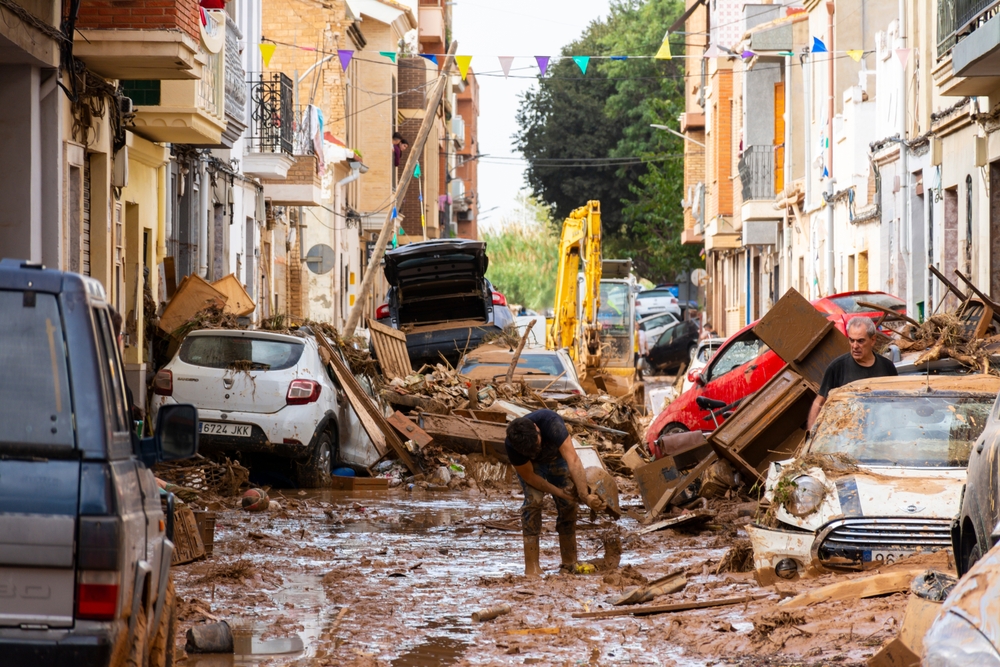
Late this October, portions of southeastern Spain were hit with a year’s worth of rainfall in just a 24-hour period, shattering precipitation records and leaving over 200 people dead and nearly a hundred more unaccounted for.
The devastation has been brutal — villages across the province of Valencia were nearly fully submerged in floods that rendered most transportation options unusable. In Paiporta, a municipality of roughly 30,000 people considered the epicenter of the disaster, over 60 have been confirmed dead and cleanup of wrecked vehicles, buildings, and furniture is expected to take weeks.
Although it remains early to make definitive conclusions about the cause of the destructive storm, the role of climate change in exacerbating its impacts is clear.
“The flooding that we’re seeing in Spain is just one of many, many, many, extreme weather and water-related disasters that have been taking place around the world this year. Almost every week we’re seeing such shocking images,” said Clare Nullis, spokesperson for the World Meteorological Office (WMO) at the United Nations, at a post-storm press conference.
This particular type of storm has become so common in Spain that residents have two shorthands for it: gota fría, or “cold drop,” and DANA, an acronym for depresión aislada en niveles altos, which translates to “isolated depression at high levels.” The phenomenon falls under the category of a cut-off low system in the English-speaking world.
This variety of storm is formed when a pocket of cold air from the polar jet stream breaks off and moves southward toward the Mediterranean Sea. The cold air forces warm, humid air sitting over the water up rapidly, forming enormous clouds capable of holding immense amounts of rain.
The DANA phenomena has been destructive to southeastern coast of Spain before — floods in 1957 and 1962 were destructive, with the latter killing over 500.
While these storms do form naturally, scientists say that climate change is increasing their frequency and intensity. The warmer the air is, the more humidity can accumulate in the atmosphere, which in turn increases the magnitude of precipitation.
For every one degree celsius of warming, air can contain 7 percent more water vapor, according to the WMO. World temperatures have already increased 1.3 degrees celsius from the preindustrial era largely due to fossil fuel combustion, and are predicted to continue to rise unless drastic action to limit emissions is taken.
Two early analyses of the floods in Valencia provide further evidence for this link between climate change and natural disasters.
Torrential downpours like the one this October are about 12 percent more intense and roughly twice as likely in today’s climate than they would be absent human-caused climate change, according to World Weather Attribution, an academic collaboration tracking extreme weather events.
ClimaMeter, another academic consortium monitoring natural disasters, this time coordinated by the French government, found storm patterns like the one in Spain are 15 percent wetter than they would be without warming. The Mediterranean is also 3 degrees Celsius warmer than it would be otherwise, which increases the likelihood of storms.
The conditions that facilitated this destructive storm aren’t going anywhere — Spain’s weather forecaster recently issued red alerts for more devastating floods.
Similar storms could also become more likely outside of Spain soon. A recent preprint suggests that extreme precipitation events from cut-off low pressure systems will increase over the next few decades in the western United States absent emissions reductions.
Demystifying how climate change is affecting us by making its impacts tangible is critical to break through complacency and empower the public to advocate for the kind of structural changes needed to confront the crisis.