
The United States recently accused Russia of secretly funding and directing the production of thousands of YouTube videos—amassing over 16 million views—in an attempt to influence U.S. public opinion on Ukraine and related issues. This case highlights a modern, high-tech form of political communication that relies on digital media to shape perceptions and sway public discourse.
In contrast, not long ago, nations communicated their political messages through simpler, low-tech methods. Instead of flashy videos and high-definition visuals, countries often relied on more subtle means, such as postage stamps, which, despite their smaller canvas, offered an innovative way to engage with global audiences.
A notable example of this occurred during the Cold War, when the U.S. Post Office issued a series of stamps featuring prominent leaders from independence movements around the world. One such stamp honored Thomas Masaryk, the first president of Czechoslovakia, who had championed democratic values. When envelopes bearing his image arrived in Communist Czechoslovakia, however, the government returned them, branding them as propaganda. In this way, stamps became more than just postal tools; they were quiet but powerful instruments of ideological communication, both at home and abroad.
The study of historical stamp designs provides valuable insights not only into their artistic merit but also into the enduring power of images to spread ideas. In an era dominated by fast-moving online platforms and digital communication, revisiting these older visual narratives is especially useful today. Stamps, despite their simplicity, offer powerful examples of how images can transcend language to convey political messages. An examination of these designs demonstrates how visual communication has the potential to grab attention, stir emotion, and prompt action—capabilities that remain just as relevant in today’s media landscape.
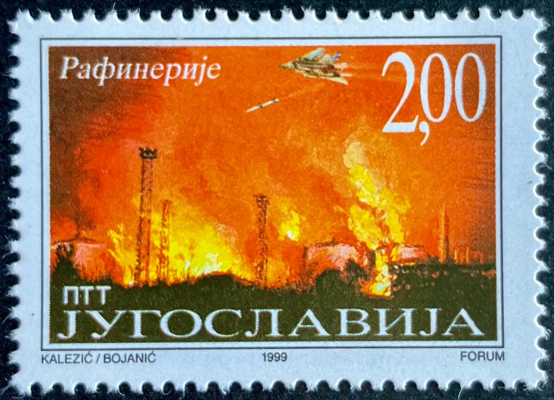
For example, many nations that have been victims of U.S. military action have used stamp designs to challenge this violence. These countries employed various visual strategies to convey their message. One such approach was to depict vivid scenes of destruction caused by American bombs, a powerful way to communicate the devastating impact of military force.
This 1999 Yugoslavian stamp depicts a NATO jet launching a missile at an oil refinery, symbolizing the destructive toll of the Kosovo War.
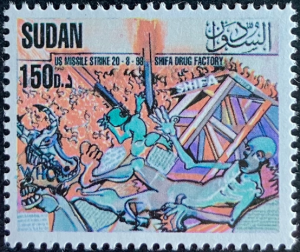
This 1999 Sudanese stamp depicts the victims of the U.S. cruise missile strike on the Al-Shifa pharmaceutical factory. Ordered by Bill Clinton, the attack came just days after the Lewinsky scandal dominated the headlines, seemingly timed to divert attention from the growing presidential controversy.
Another approach to stamp design focused on the deliberate U.S. targeting of civilians, often incorporating the U.S. flag as a central design element to emphasize the identity of the aggressors.
This 2002 Iraqi stamp depicts U.S. missiles hurtling toward the Al-Amiriya air-raid shelter during the Gulf War, killing hundreds of Iraqi civilians.

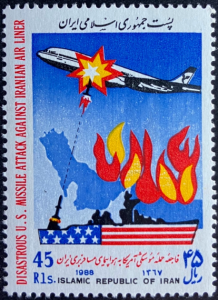
This 1988 Iranian stamp depicts the shooting down of Iran Air Flight 655 by a U.S. Navy ship operating illegally in Iranian waters—a reckless and criminal act that killed 290 people and became a symbol of American aggression in the Middle East.
Although many stamps focus on the violence perpetrated by the United States, others highlight the resistance to these actions, celebrating the determination and endurance of those who were impacted.
This 2009 Libyan stamp depicts the downing of a U.S. Air Force plane during the 1986 U.S. bombing of Libya, which was condemned by the United Nations General Assembly.

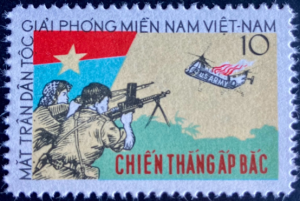
This 1963 Viet Cong stamp commemorates the Battle of Ap Bac, in which the vastly outgunned Viet Cong forces destroyed five U.S. helicopters. The stamp was featured on the cover of the February 26, 1965, issue of Life magazine, bringing its provocative portrayal of war to the attention of millions of Americans.
Finally, some stamps highlighted the decline of U.S. influence, a result of its persistent pursuit of military power and global hegemony.
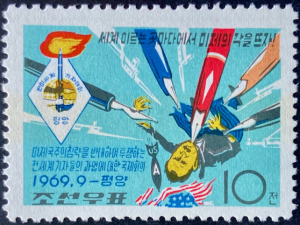
At the International Conference of Journalists against U.S. Imperialism, held in Pyongyang in 1969, journalists from 90 countries pledged to “wield our militant pens, first of all, to lay bare the aggressive nature of U.S. imperialism and its policy of war.” This North Korean stamp, issued during the conference, depicts five pens—representing five continents—stabbing Richard Nixon.
This 1964 Cuban stamp, issued on the third anniversary of the Bay of Pigs invasion, depicts the unambiguous symbolism of a fallen eagle—representing the defeat of U.S. imperialism.

The images on these stamps convey a range of messages: mourning, indignation, resistance, and solidarity. When viewed collectively, however, they tell a broader story. Issued across four continents over a span of 40 years, these stamps expose the repetitive, destructive nature of U.S. foreign policy, offering a powerful visual narrative of global defiance and opposition to American actions abroad.