
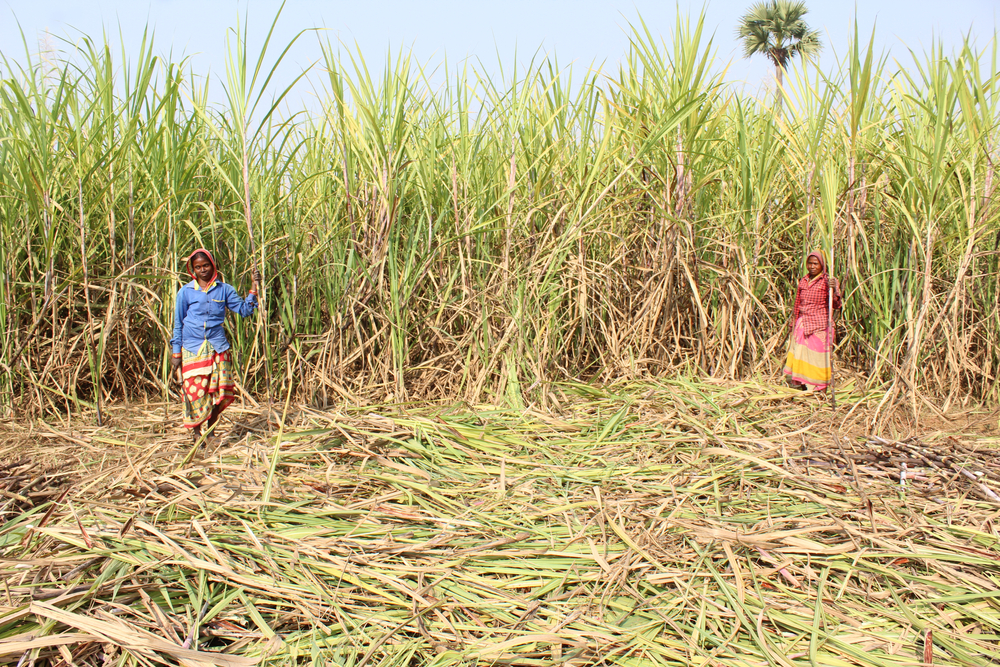
Over the past decade, reporting and surveys from Maharashtra have revealed a pattern so stark that it has become shorthand for structural violence: women working the cane harvest are undergoing medically unnecessary hysterectomies, often in their twenties and thirties. This is not because of any medical need but because the labor system effectively insists that they never menstruate, never become pregnant, and never miss a day of work.
This is the predictable outcome of a political economy that, since the acceleration of India’s liberalization after 2014, has restructured agriculture, privatized health care, and disciplined reproductive time to fit the rhythms of global supply chains.
The Logic of Extraction
Mills in Maharashtra—some owned by large conglomerates like Bajaj Hindusthan, Dalmia Bharat, and NSL Sugars—procure sugar cane through contractors who recruit family units, or jodis, to work the season. Payment is advanced at the start; repayment is collected through expected output. The accounting favors the recruiter: opaque deductions and discretionary fines mean that advances are rarely cleared in one season. Debt is built into the contract.
As economist Jean Drèze has noted, debt and advances are not just financial instruments—they are mechanisms of control. When survival depends on returning to the same contractor each year, exit ceases to be realistic.
Women face a particularly cruel calculus. Because contractors hire couples, household income depends on both partners working. Any day missed means real hunger. Menstruation and pregnancy become immediate economic liabilities. In fields without sanitation, living in makeshift tents under the sun, menstruation is practically impossible to manage with safety and dignity. Missing work compounds debt. The result is a choice between two unacceptable options: lose pay or pursue a “permanent” medical fix.
Hysterectomy becomes that fix. Private clinics in the sugar districts, operating in a deregulated medical economy that expanded after the initial liberalization of the economy in 1991, offer hysterectomy as an efficient solution for recurring gynecological “complaints.” A woman who is not menstruating can work longer hours and represents less financial risk for a contractor. When medical providers and contractors coordinate through loans that fund surgery and repayments added to labor accounts, the outcome is medicalized labor discipline. The body is altered so capital flows without interruption.
This is not anecdotal. Local NGO surveys from districts like Beed reported hysterectomy rates among sugarcane migrants many times India’s national average. Government-commissioned inquiries have recorded thousands of operations among working-age women.
Feminist Political Economy Meets Agrarian Crisis
Silvia Federici traces how capitalism has always sought to control reproductive labor to lower labor costs. Nancy Fraser argues that capitalism survives by externalizing care work until the resulting contradiction becomes politically explosive. Bina Agarwal’s empirical studies demonstrate how women without secure land lack bargaining power in rural labor markets, making permanent surgical interventions seem rational though they are anything but.
The post-1991 policy regime mattered because it reframed agriculture for capital. Liberalization encouraged private investment in agro-processing, eased regulations, and pushed an export orientation that rewarded scale and supply security. Sugarcane expanded as a corporate crop. The state’s role shifted toward facilitating private procurement rather than strengthening rural health, sanitation, and employment protections. Private clinics proliferated where regulation lagged; public gynecological services remained underfunded. In that environment, a surgical intervention that secured a reliable seasonal worker became commercially plausible.
Since 2014, this trend has deepened. The central government’s emphasis on “ease of doing business” and valorization of big agriculture shifted incentives further. Labor inspection remained weak. Local political networks tied to mill ownership limited scrutiny.
Caste, Climate, and Compounded Vulnerability
The women bearing the brunt are overwhelmingly Dalit and Adivasi. Sharmila Rege’s scholarship demonstrates how Dalit and Adivasi women are made especially vulnerable by social hierarchies that render their suffering both invisible and socially acceptable. The caste system has historically relegated these communities to the most precarious and physically brutal forms of labor. In the sugar belt, caste determines who can refuse exploitative work, who has access to alternatives, and whose bodily autonomy is treated as negotiable.
Contractors draw almost exclusively from Scheduled Castes and Tribes—communities lacking land, social capital, and political voice. Caste ensures that when economic coercion demands a surgical “solution,” the bodies available for discipline are already socially marked as disposable. It also determines access to public health infrastructure. Even where government clinics exist, Dalit and Adivasi women report discrimination and refusal of care. Private clinics step into that void as business opportunity.
Climate change has accelerated this catastrophe. Maharashtra’s drought cycles and heatwaves have become more frequent, pushing more households into seasonal migration as smallholder farming becomes unviable. Barbara Harriss-White’s work highlights how environmental shocks transfer harm onto human bodies: when yields fall, demand on labor rises. The body becomes the shock absorber.
The sugarcane crop itself is water-intensive, thriving in a state where groundwater depletion and erratic monsoons have created chronic water stress. As climate instability worsens, more households are forced into sugarcane labor precisely because their own farms have failed, and conditions in the cane fields—heat exposure, lack of water for sanitation, longer hours to meet quotas—become more brutal.
Women working through menstruation in 40-degree heat, without access to clean water or shelter, face health risks that are not abstract. The pressure to undergo hysterectomy is not just economic; it is climatic. Climate adaptation here does not mean resilient infrastructure or social protection. It means adapting the worker’s body to survive capital’s demands under environmental collapse.
What Is to Be Done?
Organizing seasonal, indebted, migrant women in dispersed camps is difficult but not impossible. Women’s collectives and grassroots NGOs have documented abuses, filed public interest petitions, and organized campaigns that forced limited state inquiries. Groups like the All-India Democratic Women’s Association have produced data that made broader scrutiny possible. But seasonal work disperses organizing capacity. Patriarchal constraints limit women’s public leadership. The coercive power of contractors makes dissent risky.
Durable unionization requires structural supports: a legal framework making mills and buyers liable for contractor practices; state-funded health and sanitation infrastructure in camps; and sustained funding for organizing across seasons.
Political parties face different incentives. The Congress party has occasionally raised worker grievances and faces an opportunity to demand supply-chain audits and worker protections. Regional formations often have deep ties to the sugar lobby, complicating their willingness to confront abuses.
Realistic political moves include: legislating supply-chain liability so mills and purchasers bear legal responsibility for contractor practices; mandating public health clinics with oversight that preclude unnecessary surgeries through independent pre-operative reviews; and implementing debt-redemption schemes that prevent advance loans from becoming binding bondage.
Journalists have a central role. Long-form investigations mapping procurement, tracing payments, and documenting clinic practices have already prompted state scrutiny. Investigative reporting needs to focus not on individual tragedy but on the institutional chain: clinic records, contractor agreements, advance-payment ledgers, mill procurement data. When reporting moves from moral outrage to political economy—showing how brands and mills benefit—public pressure becomes leverage.
A Global Pattern
This is not an “Indian cultural failing.” Maharashtra is a striking but logical instance of a wider global pattern in which capitalist supply chains seek to remove anything they identify as an interruption to production. Eduardo Galeano showed in Open Veins of Latin America how extraction economies historically reorganize entire regions as appendages serving distant centers of power—which is precisely what happens when Maharashtra’s bodies are disciplined to serve global supply chains. Across sectors and countries, the bodies of the most precarious—overwhelmingly women, overwhelmingly racialized and marginalized—are modified, disciplined, or discarded to maintain output.
That transnational perspective is crucial because it shows remedies must work at multiple scales. Local organizing and state regulation are necessary, but so are accountability standards applied by multinational purchasers and international labor rights enforcement. The road ahead requires legal responsibility that reaches beyond contractors to mills and buyers, health systems that prioritize minimally invasive care, debt-redemption schemes that remove economic incentives pushing women toward surgery, and sustained public investigations that make the institutional chain transparent.
What happens in Maharashtra matters far beyond sugar. It shows what happens when modern markets, climate stress, and caste and gender hierarchies converge: when the state abdicates basic protections, when private health becomes a revenue stream, and when global demand is legally insulated from the human costs it requires. If the question is framed as one of productivity—how to keep women working without interruption? —the answer embedded in current practice is surgical: remove the interruption.
But the moral, political, and economic answer must be the opposite. A just economy recognizes biological life, invests in care, enforces labor rights, and holds supply chains accountable. Until that happens, the women of India’s sugar belt will continue to pay a price that no market ledger should be allowed to count as profit.