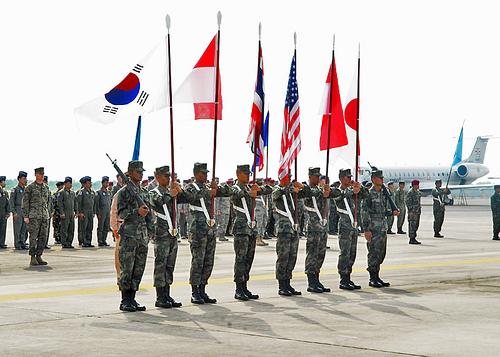
North Korean motives for attacking Yeonpyeong Island remain unclear, but U.S. South Korean military exercises run the risk of escalating the situation.
China’s hostility toward African traders in its midst mirrors its ambivalence over its integration into the world economy.
“The Communists have taken over the World Bank!” So far, this phrase hasn’t appeared on Glenn Beck’s infamous chalkboard. I’m still waiting for Beck or Rush Limbaugh to make a big stink that the World Bank’s chief economist is from Mainland China. Justin Yifu Lin has been in his position for more than two years and the right-wing crazies have been largely silent. Maybe they’re too busy attacking their fantasy version of President Barack Obama – the Muslim/elitist/socialist-in-chief – to pay much attention to what’s going on in the real world.
The Pentagon has more on its plate but, because of domestic factors, will have comparatively less money to deal with it all. Washington has concluded that the only way to solve this particular dilemma is to rely more on partners in the region. The United States has always emphasized its partnerships with Japan, South Korea, and (less so) Taiwan. At times of austerity, Washington is putting more emphasis on burden-sharing. Today, however, the United States will be pushing for more than just additional resources from its allies. More and more, these allies will have to do the heavy lifting themselves.
The U.S. is ill-served by its paranoia about Chinese moves to enter its market. It needs Chinese savings to energize its economy.
A minor collision between a Chinese fishing boat and Japanese Coast Guard vessel last August might seem unlikely to precipitate the two countries breaking off relations. But the uptick in tensions reflects policies that both Beijing and Tokyo see as vital to their self-interest.
On September 7 Japanese patrol boats intercepted a Chinese fishing trawler near Kubashima, one of the Senkaku [Chinese: Diaoyu] Islands in the East China Sea. After it repeatedly rammed the patrol boats in attempting to escape, the fishing boat was detained and its captain arrested and charged with interference in the execution of official duties. The incident would come to have enormous repercussions, shaking up Sino-Japanese relations.
Will Beijing continue to prop up the dollar or will it conclude that it’s just throwing good money after bad?
Does China bear some responsibility for the high jobless rate and the inability of the American economy to recover from the deep recession?
The gap between federal spending on military as opposed to climate security has narrowed since 2008. Compared to China, though, our progress is meager.
Though its military spending is not wholly transparent, it is estimated that China spends one-sixth as much as the United States does on military security, and twice as much on climate security.