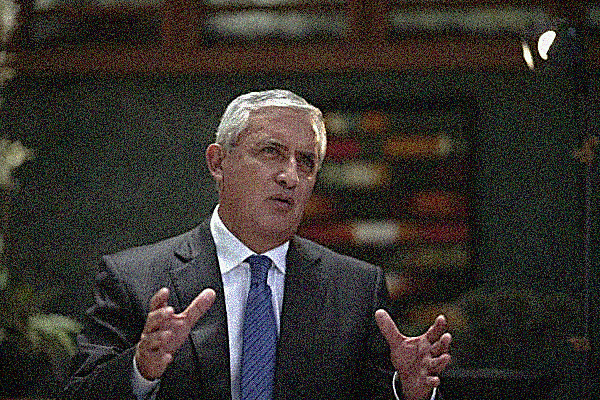
In the latest challenge from Latin America to drug war orthodoxy, the Uruguayan government unveiled a proposal to create legal, government-controlled markets for marijuana.
Peru President Humala Can’t Put Drug Reform Genie Back in the Bottle
In Latin America, ex-officials, officials, and even sitting presidents question the drug war, but the Peruvian government is increasingly out of step with calls for reform.
U.S. Hand in Honduran Massacre
Hilda Lezama was taking passengers back upriver to the township of Ahuas after a fishing expedition in a remote area of the Mosquito Coast in Honduras. In the pre-dawn darkness, she could hear the helicopters buzzing overhead, but she thought nothing of it at first. Suddenly, bullets shot from U.S. State Department helicopters with DEA agents and Honduran police aboard penetrated both her legs.
Playing the Spoiler in Colombia
When Barack Obama entered office in 2009, many Latin America specialists reveled in the prospect that U.S. policy would reform its Cold War approach to a region that is a major source of foreign oil, illegal immigration, and illicit narcotics. The United States would at last recognize and address the complex political and economic dynamics of a region still struggling with its colonial legacy, and where one-third of people still endure often extreme poverty.
Violence, Human Rights Abuses, and Corruption Exploded After Mexico’s Military Entered the Drug War
Mexico’s military is crumbling under the weight of corruption.
Honduras Coup Delivering a Bloody Return on Washington’s Military Investment
The United States has significantly scaled up its military presence in Honduras in recent months.
Foreign Policy Magazine Analyst Stokes Fears About Mexican-style Drug War in Venezuela
Foreign Policy magazine publishes fear-mongering accusations that Venezuela is becoming a narco-state.
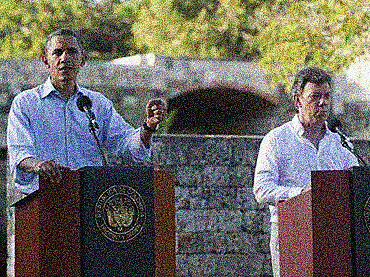
Drug-Law Reform Genie Freed From Bottle at Summit of the Americas
The legacy of the Cartagena summit, however, will likely be the beginning of a serious regional debate on international drug control policies.
Honduras: When Engagement Becomes Complicity
U.S. Vice President Joe Biden traveled to Honduras on March 6 with a double mission: to quell talk of drug legalization and reinforce the U.S.-sponsored drug war in Central America, and to bolster the presidency of Porfirio Lobo.
The Honduran government issued a statement that during the one-hour closed-door conversation between Biden and Lobo, the vice president “reiterated the U.S. commitment to intensify aid to the government and people of Honduras, and exalted the efforts undertaken and implemented over the past two years by President Lobo.”
The Drug War’s Invisible Victims
There are many kinds of war. The classic image of a uniformed soldier kissing mom good-bye to risk his life on the battlefield has changed dramatically. In today’s wars, it’s more likely that mom will be the one killed.
UNIFEM states that by the mid-1990s, 90% of war casualties were civilians– mostly women and children.