So desperate were Saudi officials to make an example of Hamza Kashgari that they pressured Malaysia into arresting and extraditing him while he was traveling there.

Mid-East Tweeters Probe the Tenderest of Saudi Sore Spots
read more

So desperate were Saudi officials to make an example of Hamza Kashgari that they pressured Malaysia into arresting and extraditing him while he was traveling there.
Radio Tahrir: a marathon retrospective on the Arab awakening, the Indignados and the Occupy movement.

Israel has long been stronger militarily than its adversaries. This was actually true as early as Israel’s War of Independence in 1948. Since 1967, the United States has helped its ally maintain this edge. Today, thanks to a single significant arms sale, that may no longer be the case. Last December, the United States finalized a roughly $30 billion sale (part of a much larger package) of 84 F-15SA Strike Eagles to Saudi Arabia, along with upgrades to the Kingdom’s 70 existing Strike Eagles to bring them up to a comparable standard.

Even though one of his country’s princes is a major investor, the Grand Mufti of Saudi Arabia has issued a fatwa against Twitter.

The Saudis in particular, and the other Gulf States in general, are fearful of two main threats, real or perceived. The first threat is Iran, which challenges their long-held religious and ethnic tenets. The second threat is the Arab Awakening, which challenges them ideologically and politically. The two threats seem to be connected now, and they will only be more so in the future. The Gulf State strategy seems to be based on the assumption that the stability of all Gulf regimes can only be disturbed by outside forces.

A substantial part of that re-invention is the capacity to ask tough questions of powerful officials.
In 2010, the U.S. made its largest single arms sale ever: $60 billion worth to Saudi Arabia.
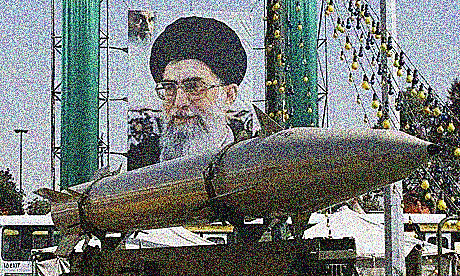
The outcome of a war between Saudi Arabia and Iran might depend on who gets the most third-party assistance.
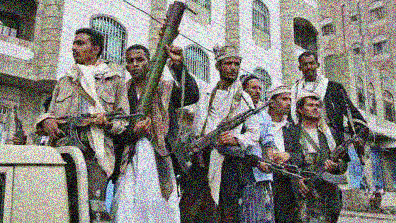
The Islamist specter in Yemen is driving cooperation between the U.S. and the Saudi government with its questionable human rights record.

Saudi Arabia has actively worked to encourage the forces of counter-revolution throughout the Middle East and North Africa. From Morocco to Bahrain, Saudi financing, support, and intelligence has sought to prevent political turmoil, reinforce existing dynasties, and crush nascent democratic movements before they could reach critical mass. This reactionary tide has been supported by some ideologues in Washington, who worry that Arab democratization would be detrimental to U.S. policy objectives.