Wars are rarely lost in a single encounter; Defeat is almost always more complex than that. The United States and its North Atlantic Treaty Organization (NATO) allies have lost the war in Afghanistan, but not just because they failed in the battle for Marjah or decided that discretion was the better part of valor in Kandahar. They lost the war because they should never have invaded in the first place; because they never had a goal that was achievable; because their blood and capital are finite.
Pakistan’s Insurgents More Like Our Founding Fathers Than We Know?
The Times claims that Pakistan’s inequitable tax system helps drive the insurgency, but offers no proof.
Outraged by Drone Strikes? Some Drone Operators Are Too
Some CIA officers involved in the agency’s drone strikes program in Pakistan and elsewhere are privately expressing their opposition to the program within the agency, because it is helping al Qaeda and its allies recruit.
Readers’ Challenge: Why Ahmadis Now?
Yesterday was almost equally violent for both India, where suspected sabotage of train by Maoists left at least 74 dead in West Bengal, and Pakistan. In Lahore, an equivalent number were killed in the attacks on the two Ahmadi mosques. According to the New York Times: “Geo TV, a leading news channel in Pakistan, reported that members of the Punjab branch of the Pakistani Taliban were claiming responsibility for the attacks.”
Readers’ Challenge: Have IR Deadlines Outlived Their Usefulness?
People tend to balk at pressure. Isn’t it time to find an alternative to deadlines and timelines?
Shahzad: A Pretext, Not a Man
The competing assertions about Times Square-bombing suspect Faisal Shahzad’s links relationship with Pakistani Taliban reflects a broader debate both within the U.S. and between the U.S. and Pakistan over how to handle Taliban elements in Waziristan province.
Terrorism in a Teacup?
The bubble is bursting.
I’m not talking about the Greek economy, the collapse of which has bankers and finance ministers trembling from Athens to Antarctica. Nor am I talking about the oil spill in the Gulf of Mexico, which reminds us once again that our current energy security rests on shaky foundations.
Obama: Say Yes to Afghan Peace Talks
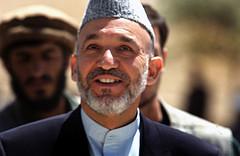
Afghan President Hamid Karzai is in Washington this week, where he’ll be meeting with President Obama on Wednesday. Afghan government officials have said that a top priority for these talks is to win President Obama’s full support for the Afghan government’s efforts to reconcile with senior leaders of the Afghan Taliban insurgency in order to end the war.
Don’t Negotiate with the Taliban
The Afghan problem can’t be addressed, let alone solved, by force. Nor can it be solved through negotiations between the Afghan government and the Taliban. The conflict, after all, is not between two distinct segments of the population. Negotiation is an appropriate strategy when there is indeed a two-party conflict—as in a civil war—and both sides have support among different factions of the population. But neither the government nor the Taliban has much popular support. The problem is not the presence of the Taliban; it’s the absence of good governance.
UN Report Misleading on Afghanistan
As President Obama and his advisors debate future troop levels for Afghanistan, a new report by the UN Office on Drugs and Crime (UNODC) muddies the water on one of the most important issues in the debate — the effects of Afghanistan’s drug production.