
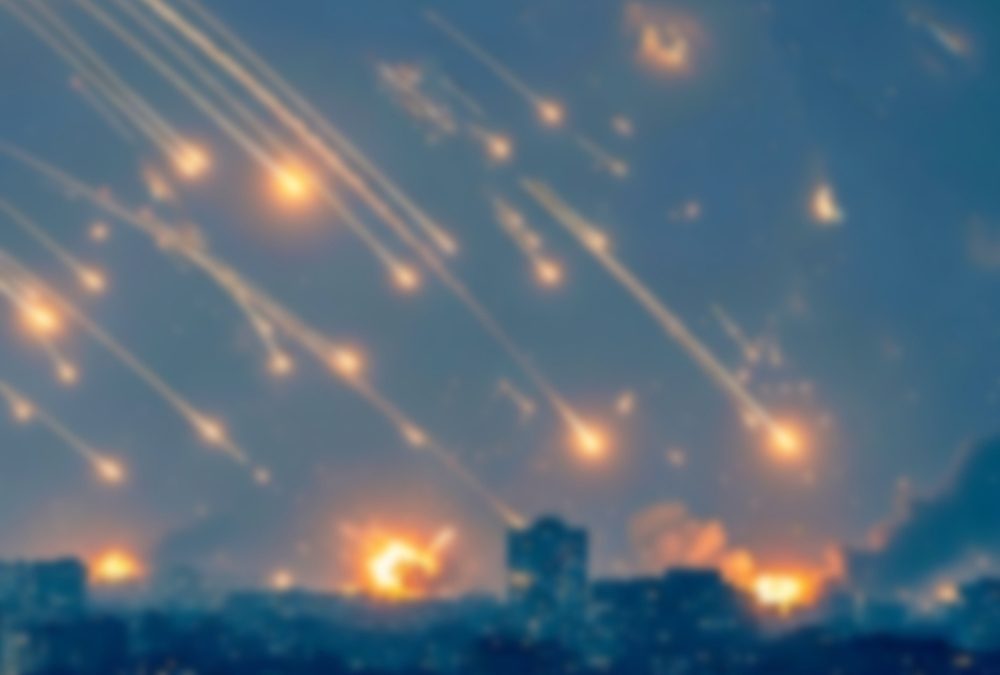
On February 28, the world watched in stunned silence as reports confirmed a devastating U.S.-Israeli kinetic operation in Tehran. According to reports, supreme leader Ayatollah Ali Khamenei and a number of other senior leaders were killed in the massive strikes. This was not the “limited surgical strike” previously whispered about in the corridors of Geneva; it was a decapitation of the Islamic Republic’s nervous system.
As the Islamic Revolutionary Guard Corps (IRGC) vows a “historic” retaliation, the smoke rising from Tehran signals more than just a military escalation. It marks the violent collapse of the long-standing “little cold war” and the descent into a terrifying, uncharted global vacuum.
Only days ago, the third round of negotiations in Geneva offered a flickering hope for de-escalation. Although diplomats spoke of “meaningful agreements,” the Pentagon was overseeing the largest military mobilization in the region since the 2003 Iraq War. The timing of this strike—carried out in broad daylight during concurrent high-level political and military meetings—reveals a chilling strategic clarity. For the current U.S. administration, diplomacy is not a priority but a tactical screen.
According to historian Peter Kuznick, significant diplomatic progress reported by Oman may have actually “frightened” a president seeking a “war of choice” to divert attention from his historic unpopularity and the looming shadow of the Epstein files. For a White House mired in domestic scandal, the flames in Tehran serve as a violent distraction from a presidency in freefall.
Meanwhile, Washington has signaled a total divorce from the rules-based international order it once claimed to lead. The war in Iran is no not about preventing a nuclear breakout. Rather, it is about the systematic dismantling of a sovereign state’s leadership. However, the tactical success of these strikes may mask a strategic catastrophe. Although the United States hopes that striking the head will kill the snake, history suggests that in the Middle East, such vacuums are filled not by democratic reformers but by the most radicalized elements of the mid-level military cadre, now unmoored from any rational centralized control.
The fallout of this operation is already fracturing the Western alliance. Unlike the 2003 invasion of Iraq, where a “coalition of the willing” shared a tenuous ideological consensus, today’s Europe stands in horrified opposition. French President Emmanuel Macron, for instance, furiously pointed out that France was “neither informed nor involved” in a move that betrays every tenet of transatlantic diplomacy.
Simultaneously, the global economy is bracing for a shockwave. The immediate reaction in oil markets is just the beginning. Should Iran follow through on its blockage of the Strait of Hormuz—the world’s most vital energy artery—global supply chains will be disrupted and financial markets will collapse. Iran, despite being weakened, still holds the suicide switch for the global economy. In its darkest hour, a regime with nothing left to lose is the most dangerous actor on the world stage.
Since 1979, the two nations have been locked in what can only be described as a “little cold war.” This was never a mere disagreement over policy. It was a fundamental clash of state identities.
For Iran, political Islam is the very DNA of its legitimacy. Its pillars—theocratic rule, social justice, and anti-liberalism—were designed as a direct antithesis to Western secular liberalism. For the United States, Iran represented the most significant ideological challenge in the post-Cold War era. This little cold war mirrored the U.S.-Soviet struggle in its zero-sum nature. In this framework, ideology is not just a mask for power but power itself. Any strategic compromise by Tehran was viewed domestically as an existential betrayal, while any concession by Washington was seen as a sign of terminal weakness.
For four decades, this little cold war provided a perverted kind of stability—a predictable cycle of threat, negotiate, sanction, repeat. Iran acted as a rational actor, using tactical flexibility (such as the 2015 nuclear deal) to ensure regime survival. However, the current administration in Washington has decided that the little cold war is no longer sustainable. By liquidating the Iranian leadership, the United States has forcefully moved from containment to conclusion.
The tragedy of the current moment is that the little cold war is ending in the most violent way possible. When a state’s ideological and political core is physically destroyed, the rules of the game vanish. The Iranian regime, now in its most isolated and vulnerable state since the 1979 revolution, is unlikely to pivot toward reform or opening.
Instead, with the appointment of the hardline Ahmad Vahidi as the new commander-in-chief of the IRGC, the military apparatus has moved beyond rhetoric to what it calls “Operation True Promise 4.” Vowing the “most ferocious offensive in history,” the regime has shifted its focus to asymmetric warfare and extensive missile strikes across the region, signaling that it will choose the path of a “wounded martyr” over any tactical surrender to Western pressure. If the nuclear program has indeed been dispersed, as some experts suggest, the surgical strike may have failed its primary objective.
Ultimately, the United States and Israel have gambled that the jungle law of sheer force can birth a new Middle Eastern order. But as the global south looks on with increasing resentment at the weaponization of international rules, the new uncertainty injected may prove far costlier than the little cold war ever was. The smoke over Tehran may be the herald of a world where diplomacy is dead and the only remaining language is the roar of bombs in the afternoon sun.