
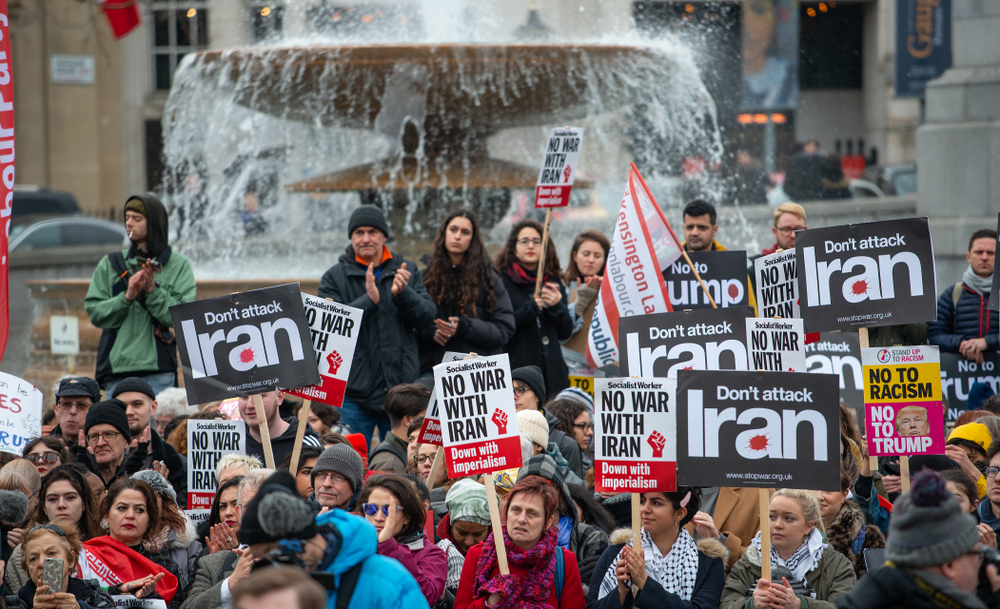
Americans oppose a war with Iran—and that opposition has grown since last summer. After U.S. strikes on Iran’s nuclear sites in June 2025, Quinnipiac found that the country was only narrowly against joining further attacks (51 percent to 42 percent). By mid-January, Quinnipiac found that seven in 10 voters were opposed to U.S. military action, including a majority of Republicans, even if Iranian protesters were killed.
Other polls agree: Americans lean against military action and reject bombing as an answer to repression. The arithmetic is clear. Yet the street is not.
No movement has materialized around that majority. This is not because Americans stopped marching—Gaza filled city blocks, and domestic issues keep pulling crowds into the streets. The capacity for dissent is frayed but functional. What the issue of Iran disrupts is the ability to do dissent together: to compress a position into a sentence short enough for a sign, broad enough for a coalition, and sturdy enough to survive contact with the evening news.
In 2003, as the United States moved to invade Iraq, the anti-war case fit on a placard: don’t launch a preventive war on disputed intelligence about weapons of mass destruction. Humanitarian arguments mattered, too—Saddam Hussein’s record from the crushed 1991 uprisings onward was well known—but the fight turned on a future-threat claim.
Iran’s crisis arrives in the opposite register: deaths running into the thousands have spilled onto social media—videos from forensic centers, families searching, and mourning that makes the violence present tense. “No war” can sound like looking away, while “pressure to protect” slides toward open-ended coercion. These two moral gravities pull would-be marchers from a shared vision.
That split is sharpened by an inversion. In past conflicts, diaspora communities supplied the human face of restraint. Today, Iranian gatherings from Melbourne and Munich to Toronto and Los Angeles have demanded accountability, tougher measures, and protection for those inside Iran—and, at the margins, humanitarian intervention. The loudest Iranian voices abroad argue for more pressure, not less, leaving organizers without the constituency that once made “not in our name” credible.
The Trump administration widens the fracture when it frames coercion as rescue—force for protesters rather than against a state. In this way, human-rights language migrates from the anti-war toolkit to the escalation case. The administration’s approach is disorienting for progressives who built real solidarity during the Woman, Life, Freedom movement, while Gaza has divided the left and absorbed much of the remaining capacity to mobilize. Coalitions can survive policy disagreements; they rarely survive a fight over what their own moral vocabulary means.
Credibility problems run in both directions. The Iraq-era lever—“the government is lying about weapons”—is weaker when the nuclear dispute is real and internationally monitored; enrichment to 60 percent is not a rumor. Yet the opposite claim—“a strike will stay limited”—was politically strengthened in June 2025: force was used, retaliation was absorbed, and escalation did not become a ground war. If war feels containable, people postpone marching.
Other factors compound the paralysis. There is no draft, and the posture most often discussed—standoff strikes, naval assets, air defense—keeps personal stakes low. The organizations that once coordinated national demonstrations have thinned, and campus activism has been chilled by mass arrests and crackdowns. Bandwidth is finite: immigration enforcement, civil liberties fights, and cost-of-living stress compete for it daily. Years of overlapping crises—from Ukraine to Sudan—have dulled the nerve that once converted shock into action. Polarized party politics has turned “war” into a tribal signal, not a shared alarm. A fragmented media ecosystem rarely produces a single shock big enough to synchronize action.
Congress has struggled to impose brakes. In June 2025, the Senate voted 47–53 to keep an Iran war-powers resolution bottled up. The moment passed quietly.
International politics further scrambles the slogan. Iran’s transfer of Shahed drones to Russia ties Tehran, in many minds, to the bombardment of Ukrainian cities. And Europe has moved onto harsher terrain: the EU has now blacklisted the Revolutionary Guards as a terrorist organization, making “hands off Iran” easier to caricature as defense of an entity placed beyond the pale. Movements struggle when their slogan needs footnotes—and preferences do not become marches.
Put together, the paradox resolves into a genuine anti-war majority that is structurally homeless. It has been denied a usable slogan, stripped of a natural anchor, and outflanked by its own language.
If restraint still matters, it cannot depend on the street alone. It has to be written into the machinery: congressional authorization before escalation, time limits that force diplomacy back to the table, and sunset clauses that make war the exception requiring justification rather than the default requiring opposition. Otherwise, the United States will drift into conflict not because its citizens demanded it, but because their reluctance never found a way to become constraint.