
Originally published in Rosa Luxemburg Stiftung.
To combat climate change, the entire world has to make the transition away from fossil fuels. If a major emitter like the United States or India doesn’t substantially reduce its emissions, it will doom the entire enterprise. As never before in human history, richer and poorer must work together.
But what will that joint action look like?
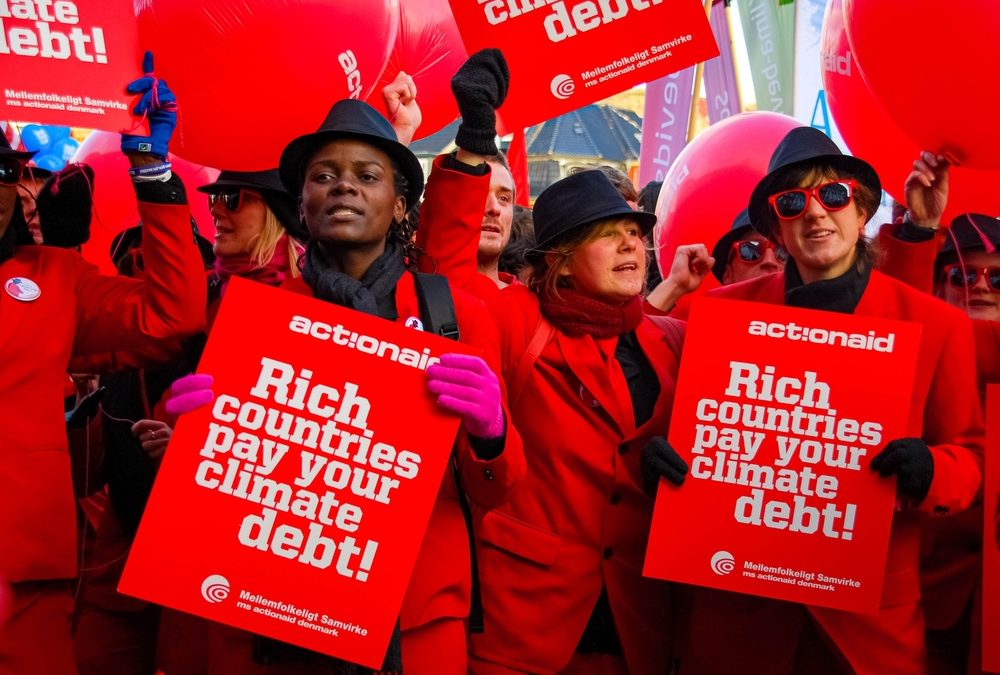
The industrial revolution, which coincided with peak colonialism, enriched the Global North at the expense of the Global South. In the process of spewing out vast quantities of greenhouse gasses, richer countries also racked up an enormous climate debt beginning in the nineteenth century. Now, the richer countries—and the richest individuals wherever they might live—must pay back this debt by funding the clean energy transition of poorer communities.
Paying reparations in this way is not just an act of justice. It is indispensable to the saving of the planet.
In theory, that’s what the Just Energy Transition Partnerships are all about. South Africa’s JET-P, for instance, is designed to finance the country’s shift away from coal-fired power plants to renewable sources of energy. Currently, 83 percent of South African electricity is generated by fossil fuels, with 58 percent coming from the dirtiest source, coal.
The JET-P for South Africa, which it launched with a consortium of richer nations in 2021, has marshaled around $12.4 billion. This money has been earmarked for building out solar and wind capacity, expanding the electricity grid to support that buildout, and setting up programs for retraining workers, particularly those in the coal sector.
“It’s a big fund,” notes University of Johannesburg sociology professor Patrick Bond, “and it should allow us to close down our coal-fired power plants early. And to the extent that we need to import turbines for wind or solar panels and batteries and inverters, then we can make that transition.”
After five years, however, the project is still in its early stages.
“We are talking about replacing 88 coal-fired power units that produce just under 50GW of electricity,” explains Roland Ngam, Project Manager for Climate Justice at the Rosa Luxemburg Stiftung’s South Africa office. “If it has taken a half decade just to put the bureaucracy in place, you can imagine how long doing the brick-and-mortar work will take. Replacing these coal-fired units and expanding green capacity also means laying 14,000 kilometers of high-voltage transmission lines – and that will cost $26 billion to complete. If we throw the global political climate into the mix, one begins to see how this thing can take at least a few decades to complete.”
It’s not just the timeline that’s problematic. Most of the funding comes in the form of loans—92 percent—rather than grants. And while the interest rate for the loans is rather low, it still adds to the country’s already sizable debt burden of around $350 billion. South Africa spends nearly $22 billion each year just to service that debt, which is considerably more than what the government spends on public health. Also, the outlays so far have gone to “the consultancies,” Patrick Bond adds, “these big firms, the KPMGs, the Ernsts and Youngs, all the big boys who do this work, instead of local environmental justice groups.” He points out that the same firms were complicit in looting the South African state by facilitating widespread corruption in the 2010s.
There are ways to push the JET-P more in the direction of climate justice. “For example, rural populations should be empowered with the infrastructure and funds to set up microgrids,” Roland Ngam suggests. “That will unlock a lot of opportunities and help draw many workers from the coal sector. Right now, most rural communities have zero benefit from the dozens of solar power stations that big business is building everywhere. Second, instead of focusing on power stations, why not empower thousands of young people with the skills and resources to install rooftop solar, windmills, etc. and through that, make the rest of the population see the benefits of solar and wind?”
Climate justice, especially as it’s discussed in international fora like the annual Conference of Parties (COP), can sound abstract, at least in terms of the dollar amounts demanded by countries most affected by climate change and the considerably smaller sums offered by rich countries. South Africa’s JET-P illustrates the concrete challenges faced by poorer countries that want to shift to a clean energy economy and the specific methods by which the richer countries continue to shirk their responsibilities.
The notion of climate reparations—a debt that the rich, for once, owe to the poor—is a powerful but still marginal part of the official climate debate. “Climate reparations as such hasn’t really been acknowledged or even desired in the formal policy space,” observes David Williams, head of International Climate Justice Program at the Rosa Luxemburg Stiftung in New York. “So, actually, in my view, there isn’t a big greenwashing of the term yet.”
Climate reparations, then, present a way to mobilize poorer countries and extract real commitments from the richer ones. As with reparations in the African American community and the landback movement among Native Americans, such arguments are moving from the periphery of debate to the very center of discussions about the path forward.
The Larger Context
The famous “hockey stick” graph, formulated by climate scientist Michael Mann and popularized in the documentary The Inconvenient Truth, demonstrates that the sharp increase in levels of carbon dioxide in the atmosphere coincided with the use of fossil fuels to expand industrial manufacturing and stimulate a consumer boom in the early twentieth century. Although climate changes do come in cycles, the graph definitively shows that the current warming of the planet stems from human activity—and that human activity has taken place predominantly where industrial manufacturing and industrial-strength consumerism have been concentrated.
“Much of the historical emissions are due to the Global North, particularly the United States and Europe and even Japan,” notes Meena Raman of the Third World Network in Malaysia. “And a lot of the impacts that are being witnessed today are being borne by the Global South,” with some of the largest impacts felt in India and China.
Another way of thinking of this inequitable distribution of responsibility is through the concept of a “carbon budget”—the overall amount of carbon that can be released into the atmosphere before global temperatures rise above either the 1.5 degree or the 2 degree centigrade mark (over pre-industrial levels) that the scientific community has established as red lines. “What the Global North is doing is overusing its atmospheric space,” David Williams says. “A sort of atmospheric appropriation is happening.”
There’s almost no carbon left in the budget. “Today, we are already at a 1.4 degree temperature rise,” reports Meena Raman. “We are really close to breaching the 1.5 degree centigrade limit, and whether we will even limit temperature rise within 2 degrees is highly questionable.”
The Paris agreement, negotiated in 2014, was supposed to prevent this scenario, with countries committing voluntarily to limits that have become increasingly stringent. However, only 15 countries have even submitted their plans to meet the latest benchmarks.
The world thus faces two clearly demarcated paths forward. If countries ignore their commitments, withdraw from the Paris agreement, and continue to use fossil fuels unabated—as the United States has done under the Trump administration—the temperature could rise above a catastrophic 4 degrees centigrade by 2100. If, however, countries recommit to global cooperation and a rapid shift to renewable energy, the rise could be brought back down, after a terrifying overshoot, to 1.8 degrees by the end of the century.
This global cooperation requires a major transfer of funds to poorer countries so that they, too, can make the transition. Not only do most countries in the Global South not have these funds, they are struggling with high amounts of financial debt. Worse, the bill for debt service has recently risen to its highest level since 1994.
“Over 60 percent of Global South countries are suffering from illegitimate and completely unsustainable debt, and there’s really no chance of their ever paying it back,” David Williams points out. “Take Kenya, for example, where protests erupted due to tax increases introduced to manage a heavy debt burden. Debt servicing consumes almost half of government revenue. The IMF and World Bank have demanded cuts to public services and austerity measures. We’re talking about education, healthcare, transport, all these systems upon which societies rely.”
Colonial authorities once extracted huge amounts of wealth from the countries of the Global South. That unequal exchange continues today, “typically estimated at about $2 trillion a year in the flow from the Global South to the Global North,” says climate activist Tom Athanasiou. “That’s $2 trillion in minerals and other things extracted from the Global South.” That sum also includes debt repayment and illicit flows of capital.
Even after they achieved political independence, countries throughout the Global South were still locked in neo-colonial economic relations characterized by debt, unequal terms of trade, and, most recently, the extraction of the materials needed for an energy transition—lithium, copper—that has predominantly taken place in the Global North. In this larger context, climate reparations can be considered the ultimate stage of decolonization.
“This is not about begging,” Meena Raman says. “This is not about charity, this is really about colonialism, post-colonialism, and the way in which economies have been run and are still run today.”
Costs
Two numbers, both of them very large, are at the center of the climate debt debate. The first number is the amount of money to “make things right,” to compensate for the environmental damage done to the Global South during that march by the industrial north to a prosperity predicated on fossil-fuel use.
According to one analysis for the IMF, economists calculate a debt of about $60 trillion, across an approximately 60-year period, from 1959-2018, with the United States leading the way with a share of $14 trillion. From 2019 to 2035, however, they project that China and India will emit at a faster pace and take the lead. Although this analysis notes that the United States continues to have the highest climate debt per person across that entire time frame, the study doesn’t account for pre-1959 emissions or the embedded emissions in products consumed in the richer world but produced in places like China and India.
A much larger estimate comes from environmental economist Andrew Fanning and anthropologist Jason Hickel in an analysis published in 2023 that argues that the big emitters owe the low emitters $192 trillion over a 30-year period for their overuse of the carbon budget. That overall sum translates to a little more than $6 trillion a year—or about 8 percent of global GDP—to pay the debt.
These big numbers depend on the social costs—such as environmental impact—associated with the emission of a ton of carbon into the atmosphere. The IMF economists use a carbon price of $100 (for each ton of carbon emitted). Fanning and Hickel arrive at a higher overall figure by using a carbon price of $198, which is close to the $190 per ton that the Environmental Protection Agency proposed in 2023.
But not everyone agrees. “Two economists, Adrien Bilal and Diego Känzig, in their current working paper from the National Bureau of Economic Research, a very conservative mainstream institution, put the social cost of carbon at over $1,200 a ton,” reports Patrick Bond. “Compare that to Barack Obama, who put it at $51, and Trump, who put it down to one dollar and is now just ignoring this entirely.”
The second figure—how much will a global energy transition actually cost—is also huge. In 2019, Stanford researchers put that figure at $73 trillion. In the short term, to have any meaningful impact on climate change, investment into the global energy transition would have to hit about $28 trillion or $5.6 trillion each year from 2025 to 2030, according to BloombergNEF. Although such investments set a record at $2.1 trillion in 2024, they fell far short of the target. The UN puts the figure a little higher – $5.8 trillion a year (between 2023 and 2030) – for just the developing world.
In an ideal world, these two large numbers would intersect. The payment of climate reparations at around $6 trillion a year would cover the $5.8 trillion price tag for the poorest countries to make their energy transition.
But this is not an ideal world. In the run-up to the Paris climate agreement, the wealthier countries pledged to eventually provide a mere $100 billion annually by 2020. “The Global South has actually demanded $1.3 trillion annually by 2030,” reports Meena Raman. At the COP in Baku, the official goal was pushed up to $300 billion a year. But that’s still a far cry from what has been mobilized so far—$116 billion in 2022—and what is both demanded ($1.3 trillion) and what is needed ($5.8 trillion).
These numbers come with several caveats. The first concerns loans versus grants. In an ideal world, the payment of the climate debt would be in the form of public grants (as the UN urges) not private loans (as Bloomberg and the Stanford researchers imagine). As with South Africa’s JET-P, most climate financing comes in the form of loans. According to Oxfam, almost 70 percent of climate financing consists of loans, which means that richer countries are profiting from rather than paying off their own climate debt.
“There are different viewpoints within the climate justice movement whether to solely demand grants or whether to open up the possibility for highly concessional loans as well,” explains David Williams. “Some negotiating groups say, ‘Getting $5 trillion in grants is just unrealistic. The problem is urgent, and we need to do something about it now. So, we need to have a look at the private sector and different types of financial instruments.’”
Second, it’s not entirely clear to what categories the $1.3 trillion figure applies. “Are we only talking about mitigation, and in particular, about techno-economic transformation?” asks Tom Athanasiou. “Or are we also talking about the finance that’s necessary for adaptation? Or the finance that’s necessary for loss and damage? Or the finance that’s necessary for a just transition?”
These questions lead to the next key issue: the mechanisms by which climate reparations currently flow (intermittently, insufficiently) from richer to poorer.
Mechanisms
One obvious mechanism for freeing up large sums of money in the Global South to push ahead with a clean-energy transition is to cancel the crushing debt burden that so many countries shoulder. Large-scale debt relief for impoverished countries is not unprecedented. Somalia was relieved of $4.5 billion in debt service payments through the World Bank’s Heavily Indebted Poor Countries initiative. China provided significant debt relief during the COVID era, including $3.9 billion in debt service from Angola.
But the most salient example is Germany. Impoverished by its defeat in World War II, Germany after 1945 “had 50 percent of its external debt canceled, and the rest was capped and tied to economic growth,” notes David Williams. “This allowed for the Wirtschaftswunder, the economic wonder of Germany. The government didn’t have to undertake any sort of austerity measures. It could invest in public infrastructure, industry, social welfare. This was accepted as a good idea because unsustainable debt undermines democracy and stability.”
German debt was forgiven as well because of the perceived external threat of Soviet expansion in Europe during the Cold War. Debt cancellation can be similarly justified today because of the very real external threat of climate change.
Many countries in the Global South—along with climate justice advocates—view debt relief as essential to any just energy transition. But the only real options offered at the moment, and not in large quantities, by richer countries are “debt-for-climate” swaps. On the face of it, such swaps appear to be win-win solutions: reduce debt, save the environment. However, they suffer from problems of accountability and transparency. Moreover, “these agreements are often tied to strict conditions that limit how freed-up resources can be used, reducing flexibility for governments to direct funds to the most urgent energy needs,” write climate activists Karabo Mokgonyana and Tess Woolfenden. “This can lead to projects that favor private-sector interests over community-led renewable energy solutions.”
Another mechanism favored by the Global North is the carbon market, where permits to pollute are traded according to a floating price of carbon (approximately $86 in the European Union as of mid-February 2026 but subject to considerable fluctuation). Carbon markets “are just a scheme to allow rich countries and corporations to continue to pollute and trade one community’s health for another,” says Hopi and Akimel O’odham environmental defender Jacob Johns, an argument he extends even to the Tropical Forest Forever Facility heralded at the Belem COP. “When you look at the TFFF, it still just solidifies carbon markets that utilize indigenous wisdom and indigenous ways of knowing as a means of greenwashing the ongoing pollution to our environment.”
With large-scale debt relief off the table, the international community has put together a number of institutions to oversee the energy transition. Many of those have been proposed within the structures of the Conference of Parties, organized by the UN Framework Convention on Climate Change (UNFCCC). Taking place every year since 1995, the COPs have produced the Kyoto Protocol, the Paris agreement, and more recently such mechanisms as the Loss and Damage Fund.
However, given that carbon emissions continue to rise, reaching a record high in 2025, there has been a perennial frustration that the COPs have not produced more results. The influence of fossil fuel lobbyists, who have pressured countries not to ban oil and gas, has been another obstacle. “One out of every 25 people at the COP in Belem were brought there by the fossil fuel industry,” reports Jacob Johns. “This year, there were more delegates from the fossil fuel industry than there were environmental activists or civil society. The COP is meant to be an interaction platform for civil society and world leaders!”
Despite these challenges—and the withdrawal of the United States from the UNFCCC—the COP remains the only place where international deals involving (almost) the entire world can take place. “The COPs are consensus-based,” David Williams points out. “There are 200 countries at the table, which also reflects the diversity of global views on societal issues. Of course, there’s going to be some inertia, and it’s a very complicated and arduous process. But if we’re going to make progress on a globally interconnected issue like climate change, we just need it.”
Three key institutions coming out of the COP process and related to climate reparations are the Green Climate Fund, the Loss and Damage Fund, and the new Just Transition Fund.
The Green Climate Fund, which became operational in 2015, is the primary dedicated institution for financing adaptation and mitigation in the Global South (it is second behind the World Bank in providing grants for climate action). The amount of money disbursed to specific projects in the Global South is not inconsequential—$3.2 billion in 2024—but it is also doesn’t approach the need. The projects it supports suffer from the same problems discussed above, such as the prioritizing of loans and the heavy reliance on private sector support (in part because of the relative paucity of public sector financing). Some of this support goes to firms in the Global South, like clean energy start-ups in India, while other loans benefit Global North corporations like the French energy giants invested in the Renewstable Barbados project.
On top of that, it’s hard for really poor countries to access the fund. Very little money trickles down to farmers. And indigenous people have been largely shut out of the process as well.
“Indigenous people, people who have been colonized, have no access to these international climate funds,” reports Jacob Johns. “One of our top demands this year was to make it possible for Indigenous people to access those funds without having to go to their colonial overlords. Recognizing that Indigenous people are protecting 80 percent of the world’s lasting biodiversity, it makes sense to put money into the hands of the communities that are defending that biodiversity.”
The Green Climate Fund and its cousins—the Global Environment Facility, the Adaptation Fund, and the Climate Investment Funds—all focus on mitigation and adaptation. But climate change has advanced to such a degree that countries have already been experiencing catastrophic damage related to rising oceans, super-powerful storms, and drought.
In 2023, after a concerted campaign by Global South countries over many years, the Loss and Damage finally became operational. In 2026, it will disburse a first round of $250 million, with the most vulnerable countries guaranteed half the funds during the start-up period.
“It was a huge victory,” comments David Williams. “Of course, it’s hosted by the World Bank, an inherently undemocratic, stakeholder-led organization. But, still, it gets really, really close to acknowledging the need for some form of compensation, even though the actual text states very clearly that this is not on the basis of compensation or liability.”
At the COP in Belem in 2025, delegates agreed to launch a new Just Transition fund. “It’s the embodiment of all that we have fought for, and it only came about because of the fight and the unity of the Global South,” Meena Raman reports. “Just look at the messages that came out there: the need to be inclusive, to include Indigenous peoples, to include free, prior, and informed consent from local communities, the right to environment, to clean air, labor rights, human rights. These are building blocks.”
Budgets
The international community has not mobilized anything close to what it has promised for mitigation, adaptation, loss and damage, or a just transition. What it has offered has been largely in the form of loans. And those promises fall far short of paying off the climate debt and supplying the Global South what it needs to leave fossil fuels behind.
“The right-wing politicians in the Global North are always saying that they’re broke,” Tom Athanasiou says. “But in last year’s civil society equity review, we did a very detailed analysis of possible places that the money could come from, everything from a financial transaction tax and wealth taxes of various kinds to pollution taxes, the redirection of subsidies from fossils to renewables, the closing of tax havens, and the redirection of military budgets to just transition budgets.”
The money, in other words, is out there – in the budgets of the wealthy governments, in the profit margins of wealthy corporations, and in the pockets of wealthy individuals.
One logical place to start the search for the necessary funds would be the International Monetary Fund, which periodically issues assets to its members that can be exchanged for currency. These Special Drawing Rights (SDR) function like a reserve that can be drawn upon in emergencies. “This was done during the COVID pandemic when $650 billion was issued overnight,” Meena Raman remembers. “It largely went to the developed world for the economic crisis that the Global North was facing in particular. So, it can be done.” But right now the United States, which holds sway in the IMF, does not support the issuance of SDR to address the climate crisis.
Another obvious place to find the money would be in the military budgets of the wealthiest countries. In 2024, global military spending reached $2.7 trillion, a nearly 10 percent increase from the year before. The U.S. military budget alone tops $1 trillion, and Trump wants to add another $500 billion. A full-scale global arms race is taking place, accelerated by several ongoing wars and an erosion in faith in U.S. alliance commitments.
Then there are the subsidies that national governments provide to fossil fuel companies. In 2022, those subsidies totaled $7 trillion. Some of these subsidies come in the form of tax incentives, and the Trump administration recently added another $4 billion per year for a decade. But the majority of these subsidies come in the form of low prices for gas and oil that do not incorporate the true environmental costs of their extraction and use. As several IMF economists point out, “scrapping explicit and implicit fossil-fuel subsidies would prevent 1.6 million premature deaths annually, raise government revenues by $4.4 trillion, and put emissions on track toward reaching global warming targets. It would also redistribute income as fuel subsidies benefit rich households more than poor ones.”
There’s also the strategy of taxing the fossil fuel corporations that raked in half a trillion dollars in profits in 2024. Oxfam estimates that a Rich Polluter Profit Tax could generate $400 billion a year while an Excess Profit Tax applied to all large corporations could raise around $680 billion annually. Making a transition away from fossil fuels contingent on taxes generated from fossil fuels may, however, prolong the transition. “When transition finance depends on continued extraction, governments risk building fiscal dependence on the very activity they aim to wind down,” writes climate activist Daphne Wysham. “The incentive becomes subtle but powerful: maintain production to maintain revenues.”
Another strategy is to go after wealthy individuals. “Since 2015, the world’s richest one percent— most but not all of whom live in the Global North—has gained at least 33.9 trillion in wealth,” reports Tom Athanasiou. To get at that money, he proposes “a nationally harmonized system of taxes that is tied to a visionary and detailed and strategically astute transition strategy that takes account of the absolute imperative of phasing out fossil energy as soon as possible.” According to a fair-share approach, the individuals who profited from colonial and neocolonial interests, wherever they might live, should shoulder the burden of paying for transition.
The challenge historically with national wealth taxes is that wealthy individuals and corporations will often move their assets around to avoid payment. The United Nations is currently negotiating a global tax convention that would close at least some of the loopholes that favor the wealthy. “Tax avoidance, tax havens, all these things need to be combated,” David Williams notes. “What’s happening at the UN level is actually quite encouraging. There’s a lot of hope that this process will establish an international tax system, but also democratize the current system, where Global South countries have no say whatsoever about all these decisions which affect them the most.”
Another option in the tax realm is to focus on financial transactions. Some countries, such as France, Spain, and Brazil, have introduced such a tax on financial transactions taking place within their borders. Depending on the scope, an international financial transaction tax could generate nearly a trillion dollars a year.
Just as billionaires seek to avoid taxation, carbon emitters often try to avoid regulation. The European Union has developed the Carbon Border Adjustment Mechanism (CBAM) “to stop the outsourcing of emissions—that is, when a company in Europe sends its dirty industries to emerging markets,” Patrick Bond explains. CBAM assesses a tax on “dirty” products, thus serving as an incentive for companies that want to export to the European market to reduce the “embodied carbon” in their products. Such a tax adversely affects exporters in the Global South. “South Africa will be among the hardest hit,” he continues. “We rank number 10 of the countries that export to Europe. And the most important exports this year are steel and aluminum, and those have very intensive CO2 emissions embedded within them. That heavy carbon intensity means that we will probably start losing more jobs in these crucial metal sectors.”
There are some more general problems with CBAM. In its tariff calculations, the mechanism defines green energy to include methane gas. “Methane gas is 85 times more potent than CO2 emissions, yet some sleazy Brussels dealmakers put that into the ‘clean energy’ taxonomy, with nuclear as well,” Bond points out. Second, the money generated by the tariffs is largely redistributed within Europe rather than sent in the form of financing to help countries “clean up” their industrial production. “They are still refusing to acknowledge climate debt,” Bond continues. “They are obviously just using the CBAM revenues for their own internal needs in Europe.”
This European mechanism is one example of the “polluter pays” principle. The problem with CBAM, from an equity point of view, is that the polluters in the Global South are paying rather than the polluters in the Global North, and the money generated stays largely in Europe. An alternative would be for Global South countries to assess the taxes and keep all the revenues.
Another polluter-pays approach is the Climate Superfund in New York state. “It functions a bit like a tax on the highest emitting companies to generate $75 billion over the next 25 years to fund climate change adaptation,” explains David Williams. A Global Climate Superfund, financed by something akin to the Excess Profit Tax on such big emitters as airlines, industrial farms, and data centers, could generate trillions of dollars.
Beyond Blocs
The conversations around climate justice in UN circles do not conform neatly to the categories of Global South and Global North. In the debates over a roadmap for transition at the last COP in Belem, for instance, countries like India and Nigeria opposed the inclusion of language supporting a fossil fuel phaseout, while many of the least developed countries in the world favored the more radical approach. “There was a split within the Brazilian delegation on this, a split within the COP presidency, and a split within the G77,” Tom Athanasiou observes. As Patrick Bond points out, the interests of the BRICS nations have generally aligned with the G7 on climate issues.
The example of China demonstrates the challenge of categorization. It is technically part of the Global South, though it has one of the top economies in the world. It is now the largest emitter of greenhouse gasses, though not on a per-capita basis. Chinese emissions also come with a caveat. “China has become a factory for the rest of the world, where much of the industries from the West have gone,” points out Meena Raman. “A lot of the emissions it is emitting are also due to the consumption of the Global North.”
Although it is still heavily dependent on imported oil and natural gas, China is also producing more of the infrastructure for renewable energy (solar panels, wind turbines) than any other country. “If today, solar and wind and all is much cheaper, it’s largely because of the efforts of the Chinese,” Raman adds. “Thanks to the Chinese, we are able to scale up renewable energy.”
China has provided considerable funds for infrastructure development in the Global South through its Belt and Road Initiative. In 2025, for instance, it provided $18.3 billion for wind, solar, and waste-to-energy projects mostly in the form of loans and export credits. At the same time, however, it provided nearly four times that amount—over $71 billion—for oil and gas development.
Since it straddles a number of categories, China often functions as a bridge builder. “It has very central roles in country groupings like G77 plus China, like the like-minded developing countries,” Williams says. “It champions the concept of common but differentiated responsibilities. But it does that with the fact in mind that it strengthens its own position.”
According to a fair shares approach to an energy transition, the various blocs are irrelevant. “Individual countries have their individual obligations to participate in the climate transition based on their individual economic structure, their class structure, their capacity, and their responsibility,” Tom Athanasiou notes.
Among those countries, the United States has a particular obligation. It has the largest economy in the world. And it has contributed by far the most carbon emissions since 1750 of any country—fully one-quarter of the overall total.
“As Americans, we owe the rest of the world a lot of money,” Jacob Johns concludes. “We owe the rest of the world a lot of reparations for what has been done to the ecosystem. And instead of admitting the faults of our own past, and righting the wrongs of our history, we’re stepping away from that and embracing fascism.”
Until the biggest polluter in history pays, climate reparations will remain an aspiration, even an inspiration, but not a functioning institution.