
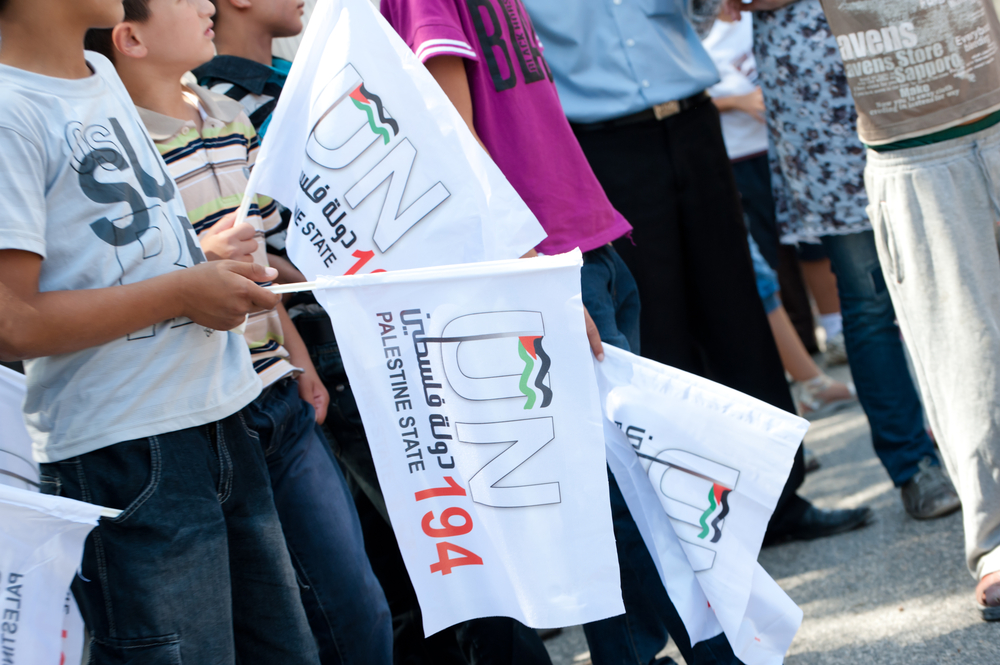
By some measures, the Palestinian bid for statehood has never been stronger.
By the end of last year, at least 157 countries had recognized the state of Palestine, which represents slightly more than 80 percent of the world’s nations. Some of those countries are quite powerful, such as China, India, Indonesia, the UK, France, Australia, and Russia. Palestine is a member of the International Criminal Court, UNESCO, the Group of 77. A Palestinian delegation has competed in every summer Olympics since 1996.
The Palestinian Authority, which functions as the closest thing to an internationally recognized government, has even prepared a draft constitution that would, if it passes a referendum, formally transform Palestinian lands into a state.
And yet, the territory that could be included in such a state is disappearing like sand in an hourglass. What’s happening today in both Gaza and the West Bank is a deliberate effort by the Israeli government to change the facts on the ground and make any “two-state solution” a territorial impossibility.
Palestine is disappearing in another sense as well. What was once a unifying goal for countries in the Middle East—siding with the powerless in an effort to create a state—has been replaced by an overriding desire to make deals with powerful countries, the United States chief among them. In the scrum of Donald Trump’s mano a mano diplomacy, Palestinians simply don’t have the leverage to gain a meaningful position.
As Canadian Prime Minister Mark Carney memorably stated in Davos last month, if you’re not at the table in these carnivorous times, then you’re on the menu.
Gaza Divided
Gaza has been reduced to 61 million tons of rubble. According to the UN Development Program, it will take seven years just to clear away the debris. It’s hard to create a homeland when 92 percent of homes have been damaged.
It’s not just buildings. Much of the area’s infrastructure lies in ruins. Water, sewage, electricity, roads: these bare necessities weren’t in great shape before the recent war. Now Gaza has become a hellscape.
Still, structures can be rebuilt. Palestinians could return and, if given a significant helping hand, even flourish.
At the moment, however, the Israel military occupies over half of Gaza. It has continued to kill Palestinians—over 500 since October 10—that it accuses of violating the ceasefire. And the Yellow Line, meant to be a temporary feature of the ceasefire dividing the Israel army from Hamas, is becoming more like a semi-permanent border.
Israeli withdrawal from Gaza, according to the three-stage peace plan, is predicated on the disarmament of Hamas. But the Palestinian militants have shown no willingness to give up what may well be their only form of leverage—the arms they retain that can strike at Israeli cities.
As a result, the development plans for the reconstruction of Gaza—either as a zone for Palestinians or a luxury resort for vacationing oligarchs—are on hold. A transitional authority of 15 technocrats has been formed, with a former Palestinian Authority minister in the top post, but it hasn’t entered Gaza or started functioning (though it did announce the recent opening of the Rafah crossing to Egypt). There is no international stabilization force on the ground to enforce the terms of the ceasefire.
Meanwhile, the Israeli far right has attempted to cross into Gaza to realize a long-held dream: the resettlement of the region.
It was two decades ago that the Israel government, bowing to the demographic reality that Israeli Arabs would eventually outnumber Israeli Jews, withdrew from Gaza and prepared the ground for Palestinian self-government. Israelis faced shocking pictures of their government physically removing Jewish settlers from their Gaza houses. The far right has long desired to reverse that decision.
The far-right activists who last week climbed a fence to enter Gaza and plant trees, before being returned across the border by Israeli soldiers, are not isolated kooks. Reports Haaretz:
Ministers and lawmakers from Prime Minister Benjamin Netanyahu’s Likud party said they would take part in a tree-planting event organized by the Nachala settlement movement, in which posters shared on social media call for “no surrender to Trump’s dictates, no to an international Gaza, yes to a Jewish Gaza!”
The Israeli far right is still only dreaming about Gaza. It is making its dream a reality in the West Bank.
West Bank Divided
The West Bank contains some of the most iconic Palestinian areas, including the cities of Hebron, Ramallah, Jenin, and Bethlehem. There is also east Jerusalem, which many Palestinians consider the capital of a future Palestine even though Israel has occupied the area since 1967.
The Oslo Accords in the 1990s divided the West Bank as a temporary measure into three zones: A, B, and C. The first is under Palestinian control, the third under Israeli control, and Zone B is jointly administered, though all three were eventually supposed to fall under Palestinian governance. In addition to all the territory it controls in the West Bank, the Israeli government has also supported the illegal Israeli occupation of Palestinian land where 700,000 Israelis live in 250 settlements.
Israeli authorities have long demolished Palestinian homes in the Israeli-controlled Zone C. But now the government has authorized the destruction of Palestinian homes in A and B as well. Over the course of its war in Gaza, Israeli forces also killed over 1,000 Palestinians in the West Bank, detained over 20,000 people, and displaced more than 30,000 people.
The Israeli authorities have long fragmented the West Bank with walls and checkpoints. But the government has recently gone even further—thanks, in part, to Donald Trump.
Since the 1990s, Israel has planned a housing development east of Jerusalem called E1. The plan, which was held up for years by U.S. pressure, cleared the Israeli courts over the summer once Trump removed U.S. objections. The development is now up for construction bids. The plan calls for 3,401 housing units and a road that will effectively cut the West Bank in half.
Lest you think that any description of E1 as an instrument of apartheid is an overstatement, consider this statement by Israeli finance minister Bezalel Smotrich. “Those in the world trying to recognize a Palestinian state will get an answer from us on the ground,” he has said. “Not through documents, not through decisions or declarations, but through facts. Facts of homes, neighborhoods, roads and Jewish families building their lives.”
E1, he continued, would “bury the idea of a Palestinian state.”
A People Without Land
Israel, like the United States, is a settler state. The Palestinians, like Native Americans, face a future of limited sovereignty, fragmented land holdings, and “land acknowledgements” on behalf of people who have disappeared from the land.
Unlike some stateless people—the Roma, the Kurds, the Rohingya—international opinion overwhelmingly favors statehood for the Palestinians. But even that support has withered where it matters most—the Middle East.
The Abraham Accords that the Trump administration pushed in its first term was designed to solidify diplomatic recognition of Israel at the expense of Palestinians. Even Saudi Arabia was on the verge of recognizing Israel while removing its longstanding demand for Palestinian statehood. The attack by Hamas on October 7, 2023 disrupted that process (and was likely a major reason for the timing of the action).
Today, Saudi Arabia is no closer to recognizing Israel. Israel’s attack on Hamas leadership in Qatar last year revived Gulf opposition to Israel and support for Palestinian statehood, all the while undermining its faith in U.S. assurances. However, Saudi Arabia and the other Arab countries that have joined Trump’s Board of Peace are falling back on another position that effectively prioritizes economic over political benefits for Palestinians. Gulf money will flow to rebuild Gaza, but the status quo will likely remain unchanged: no Saudi recognition of Israel and no Israeli recognition of a Palestinian state.
The problem for the Palestinians is that the regional order has been disrupted, and not in their favor. Iran, once a major supporter of both Hamas and Hezbollah, has lost its regional allies and is struggling to suppress dissent at home and fend off U.S. threats from abroad. It has little muscle left over to push for Palestinian statehood. Its ally in Lebanon, Hezbollah, pummeled by Israel, agreed to a ceasefire last November. According to the Lebanese government, however, Israel has continued its attacks, violating the ceasefire 2,000 times in the final three months of 2025. Israel continues to occupy five villages in southern Lebanon. Hezbollah poses no threat to Israel.
Syria had an off-and-on-again relationship with Hamas under Bashar al-Assad. The new Syrian government supports Palestine, but it is also preoccupied with holding the country together and working out a new security understanding with Israel. Egypt and Jordan, home to large Palestinian communities, have consistently supported Palestinian ambitions, if only to encourage Palestinians to return to their lands. But they alone cannot persuade either Israel or Hamas to change their positions.
The Israeli government of Benjamin Netanyahu, like the Russian government of Vladimir Putin, has refused to back away from its maximalist position: destruction of Hamas, creeping annexation of the West Bank, and prevention of any Palestinian state. Elections in 2026 might bring new leadership to Israel but a fragile opposition coalition shares Netanyahu’s rejection of Palestinian statehood. So does about 70 percent of the Israeli public.
Palestinians face a very narrow path to statehood. They can hope to achieve some compromise on Hamas demilitarization—with the group giving up their rockets but retaining small arms and some disguised role in the administration of Gaza—alongside pressure from the international community to stop Israel from fully taking over the West Bank. With time perhaps, Palestinians can recuperate and rebuild.
Here, they can take some inspiration from Native Americans who have successfully regained control of some of the lands taken from them. “There was a time when it was questionable whether our people were even going to survive,” Native American Rick Williams told me recently. “In 1900, there were only 250,000 American Indians left in North America, and we were expected to become extinct by 1913. But we’ve continued to survive. We’ve continued to grow.” Today, there’s somewhere between 3.1 million and 8.7 million Native Americans, a more than tenfold increase.
Palestinians have shown similar resilience in the face of unimaginable adversity. They, too, may one day soon have a successful landback movement. But in the push for an independent state, it must be Palestinians—not Donald Trump, not Saudi Arabia, and certainly not Israel—who are the architects of their own future.