
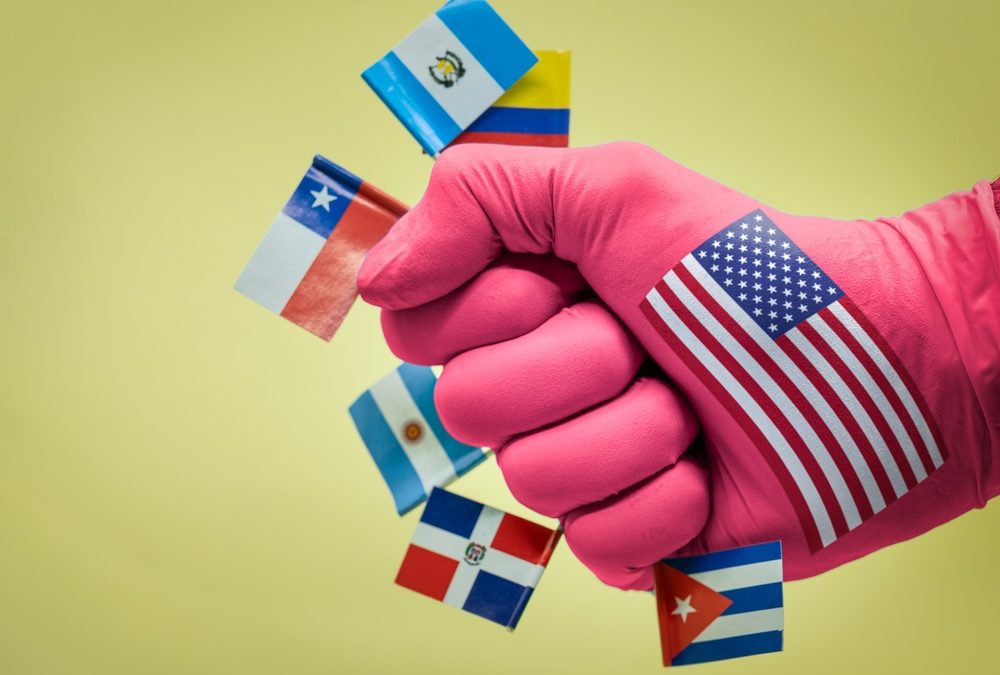
If you consume mainstream foreign policy analysis, the current posture of the United States appears to be a chaotic sequence of impulsive actions. The bombing campaigns in Iran, the military abduction of Nicolás Maduro from Caracas, and the sudden, violent return of nineteenth-century gunboat diplomacy to the Caribbean are framed as isolated brushfires. The pundit class debates Washington’s role in a volatile world: defending democracy here, deterring rogue nuclear actors there, and fighting narco-terrorism everywhere else.
But viewing these events as disjointed spectacles misunderstands the American empire during the second Trump administration. Beneath the veneer of erratic aggression and Trump’s endlessly quotable gaffes lies a coherent project of global enclosure.
Welcome to the Donroe Doctrine era.
This new doctrine represents a ruthless, calculated attempt by Washington to synthesize the dying Oil Revolution with the ascendant Mineral Revolution. As the world teeters on the edge of an epochal energy transition, the United States has launched a two-front war to preserve capital: violently asserting dominance over the traditional fossil fuels that power the present while simultaneously enclosing the critical minerals required to build the future.
The strategy is entirely zero-sum. By turning the Middle East and the Caribbean into militarized chokepoints, the United States is suffocating China’s independent oil supply lines, starving its industrial capacity while guaranteeing temporary windfall profits for Western supermajors. Concurrently, from the lithium flats of Bolivia to the ports of Peru, Washington is deploying right-wing proxies and military coercion to systematically dispossess Chinese capital in Latin America, re-colonizing the Andes to secure the supply chains of the twenty-first century.
The United States is attempting to freeze a shifting global order in time for long enough to guarantee that when the climate clock runs out, American capital will maintain its global hegemony and monopolize the means of production, while continuing to extract maximum profit during the transition.
Starving the East, Gorging the West
Look past the Pentagon’s stated justifications for its recent military escalations and examine the beneficiaries. The ongoing war in Iran and the sudden, dramatic regime change in Venezuela are not two separate foreign policy crises. Both are brutal operations resulting in civilian deaths and casualties, designed to consolidate global fossil fuel reserves under Western control while disproportionately impacting America’s primary economic rival.
Take the war in Iran. The mainstream press has dutifully regurgitated Washington’s narrative, framing the bombardment and the drive for regime change as a necessary intervention to halt a nuclear program, deter regional proxies, and punish a long-standing ideological adversary. But the true strategic objective is for the war to act as a violent economic blockade against Beijing. Iran has historically served as an independent artery for Chinese energy consumption, operating entirely outside the jurisdiction of Western sanctions and U.S. naval hegemony, and importantly, the dollarized SWIFT system.
By systematically dismantling the Iranian state and choking off its export capacity, the United States is manufacturing an energy crisis that accomplishes two goals at once. First, it artificially bottlenecks the cheap energy required for China to continue industrializing and competing on the global stage. Second, it functions as a massive subsidy for U.S. oil supermajors. With a major independent supplier knocked offline, Western energy conglomerates are guaranteed windfall profits, effectively forcing the Global South to purchase their continued development at a premium from American corporations.
This strategy of violent enclosure extends directly into the Western Hemisphere, where the United States has abandoned any pretense of diplomatic subtlety. The escalating boat strikes in the Caribbean (which have killed over 151 people, despite their trivialization in the mainstream media) signal the total militarization of the region’s logistics network.
The crown jewel of this hemispheric offensive, however, was the unprecedented military abduction of Nicolás Maduro. The operation, executed by U.S. Special Forces in Caracas, was heralded in the Western press as a triumph for human rights and democracy. Yet the immediate aftermath laid bare the true motives. The United States did not facilitate a broad, democratic transition. It simply swapped the executive, installing Maduro’s former vice president, Delcy Rodríguez, as acting president.
Why Rodríguez? Because she was willing to execute the economic shock therapy Washington demanded. Almost immediately upon taking power, the new, US-backed government gutted the remnants of Venezuela’s resource-nationalist guarantees. The narrow, singular objective was to crack open the largest proven oil reserves on the planet, reserves that had been heavily targeted for Chinese investment, and hand them directly to American oil companies.
This is the Donroe Doctrine in practice. It deploys the world’s most advanced military apparatus to syphon oil out of the ground, lock Chinese capital out of the hemisphere, and ensure that as the world slowly transitions away from fossil fuels, the final, lucrative decades of the oil economy belong exclusively to Wall Street.
Recolonizing the Andes
Although the offensive in the Caribbean and the Middle East secures the twilight of the fossil fuel era, the Donroe Doctrine’s second front is fixed firmly on the Andes. Whoever controls the lithium, copper, and rare earth metals of South America controls the energy grid of the twenty-first century. To ensure that this control remains firmly in Western hands, the United States is actively re-colonizing the continent, deploying a mix of manufactured crises and right-wing proxies to create a security corridor while physically dispossessing Chinese capital.
Ecuador serves as the blueprint for this new era of militarized extraction. Following a failed democratic vote to allow U.S. military bases back onto its sovereign soil, the country was suddenly plunged into a hyper-violent “drug war.” This crisis provided the perfect pretext to militarize the state and crush domestic opposition. Under the guise of boosting the economy (given the downturn created by this manufactured crisis), the government systematically gutted the country’s environmental protections, transforming the Andean nation into a deregulated playground for Western mining conglomerates eager to extract critical minerals while externalizing the social and environmental costs.
Further south, the imperial squeeze on the world’s largest lithium reserves has been rapid and devastating. The recent election of Rodrigo Paz, under a “Capitalism for All” mandate, represents the return of a U.S. right wing to Bolivia, with the aim of dismantling state-led industrialization of the lithium sector and cracking open the Salar de Uyuni for private Western capital. Next door, the establishment of a “two-tracked” economy has completely insulated foreign capital from domestic volatility in Buenos Aires. By promising unprecedented 30-year guarantees to maintain a favorable investment climate, the government of Javier Milei has essentially surrendered Argentina’s economic sovereignty for a generation. It ensures that Western mining monopolies can extract critical minerals risk-free while the working class bears the brunt of the country’s austerity.
But the hostility to Chinese investment has reached a fever pitch under the recently inaugurated far-right administration of José Antonio Kast in Chile. In an unprecedented move, the president-elect pulled out of the transition process over a dispute about how information regarding Chinese joint ventures to build telecommunications infrastructure was shared. This happened a week after the United States revoked the visas of three members of the outgoing Boric administration who helped court that investment. In the Donroe Doctrine era, South American technological and infrastructural independence from the United States will not be tolerated.
The Geopolitical Stranglehold
To guarantee the success of the Donroe Doctrine’s two-front war on energy and minerals, Washington must enforce geopolitical discipline across the hemisphere. It is not enough to simply extract resources, the United States must also control the transit routes, isolate any regional counterweights, and build a unified, militarized proxy force to defend Western capital.
This empire relies entirely on the uninterrupted flow of capital and commodities. Washington’s recent, successful pressure campaign to expel the Hong Kong-based logistics giant CK Hutchinson from the Panama Canal was a naked assertion of monopoly power. By forcing out Chinese port operators from one of the world’s most critical maritime chokepoints, the United States aspires to hold the literal keys to global trade, able to throttle the supply chains of its rivals at will.
Absolute hegemony precludes the possibility of regional solidarity. Consequently, the US has initiated a campaign of diplomatic and economic isolation against Colombia and Brazil. As the two most significant economies in the region possessing the commodities and industrial power to act as independent poles, their governments represent a direct threat to the Donroe Doctrine. By sidelining them from regional integration initiatives and weaponizing the Washington Consensus against them, the US can easily prevent a multi-polar reality from emerging in South America.
The most potent and obvious manifestation of this strategy, however, requires no economic deciphering. Trump’s weekend “Shield of the Americas” summit with right-wing Latin American leaders and military brass stripped away any remaining pretense of democratic partnership. At that meeting, flanked by the flags of Ecuador and El Salvador, Secretary of War Pete Hegseth announced that 17 countries (including Argentina, Chile, and Bolivia) had joined the “Americas Counter-Cartel Coalition.” Hegseth further explained that this is “not just an organization that’s going to hold conferences and release white papers… it’s an action coalition of like-minded countries who are going to bring their capabilities to bear with American leadership at the forefront.”
The United States is making no secret of its cultivation of a technologically advanced, pan-American, right-wing military apparatus that is loyal to Washington, designed to crush domestic labor movements, and protect foreign mining investments. The Donroe Doctrine views Latin American cooperation in the war against cartels as a natural extension of its existing security agreements with Europe and Israel in the war against Iran. In this way, the Donroe Doctrine is less of a return to the Second Bush and Obama eras of neoliberal colonialism, and more of a return to form of Cold War-era colonialism circa the Iran-Contra scandal, with China substituting for the Soviet Union.
The Profits of Transition
By executing a militarized stranglehold over the fossil fuels that China relies on today, while simultaneously enclosing the green minerals the rest of the world will desperately need tomorrow, American capitalists are trying to construct a fail-safe. Their preferred American foreign policy under the second Trump administration is global extortion designed to ensure that Western supermajors and mining conglomerates get paid right up until the consumption of the last drop of oil.
For workers in the Andes, from the lithium flats of Bolivia to the copper mines of Peru, the promises of a “green transition” are proving to be nothing more than a new phase of colonial extraction. Their localized hopes for a sovereign, prosperous future are being systematically crushed beneath the macroeconomic ambitions of Wall Street and Brussels.
The wealth of the transition is destined for export. The ecological and social consequences will remain at home. And the United States will try to remain in control of it all.