
China has been nipping at the heels of the United States for a quarter of a century. By some measures, the size of the Chinese economy exceeded that of the United States about a decade ago. China has a huge trade surplus thanks to the fact that it is the leading trade partner of 145 countries (about 70 percent of the world). Although the U.S. military remains globally dominant—based on extraordinary expenditures and state-subsidized research—China’s military power has been growing and now bests that of the United States in some fields, like size of navy.
At the level of society, China puts the United States to shame in terms of level of public transportation, bridges and tunnels, and other amenities. China’s high-speed Internet connectivity is much greater than the United States. Eight of the top ten universities in the world according to scientific output are Chinese.
And it’s not just Beijing or Shanghai. Dan Wang, a Canadian technology analyst, writes of his visit to Guizhou province: “China’s fourth-poorest province, I was surprised to see, had much better levels of infrastructure than one could find in much wealthier places in the United States, like New York State or California.”
China has also been investing a lot into soft power, moving up from a rather lowly eighth position in 2020 in the Global Soft Power Index to the number two spot in 2025. If you haven’t seen the movie Nhe Zha 2 or played the video game Black Myth: Wukong or bought a Labubu, then you haven’t experienced Chinese influence. But it’s capturing the imagination of your friends and your kids.
China possesses one quality above all that has put it on this upward trajectory. It is consistent—or, at least, it has been consistent since the 1990s and the aftermath of the Tiananmen Square protests. With the advantage of economic planning and a ruthless determination to suppress political opposition, the Chinese Communist Party has taken the country from the wild vicissitudes of the Mao era to the predictable equilibrium of the current era.
Planning, predictability, expansion of soft power—these hallmarks of current Chinese governance are the complete opposite of Donald Trump’s approach to politics and economics. And this is why 2025 will mark the turning point in the relative power of the two countries.
China isn’t just eating our lunch. The Trump administration is preparing the meal and delivering it all the way to Beijing on a silver platter.
Trump Cuts Off U.S. Nose
If the Chinese had managed to install a real Manchurian Candidate in the White House, it couldn’t have done a better job than Donald Trump.
The first thing Trump did was eliminate U.S. soft power. He zeroed out U.S. humanitarian assistance, leading to the death so far of hundreds of thousands of people. He cut back on U.S.-positive messaging like radio broadcasts through Voice of America and defunded programs in the sciences and the arts that showcased American talent abroad and encouraged collaboration with U.S. counterparts.
Next, he made it super-difficult to come to the United States. The administration suspended immigrant visa processing for 75 countries. It raised the cost of the H-1B work visa from a couple thousand dollars to $100,000. And forget about achieving refugee status unless you’re a white South African.
With a punishing series of tariffs, Trump has pushed countries to diversify their trade portfolio. It has become more expensive to sell goods in the U.S. market, so countries are looking for other buyers. By politicizing tariffs, making them contingent on for instance accepting administration policies around deportation, the administration has further alienated allies. The sheer unpredictability associated with U.S. economic policy—Trump’s tariffs, Trump’s “chickening out”—has added more stress to trade relations that require at least a measure of stability.
Finally, there’s been Trump’s blithe disregard for international law. His threats to take Greenland, by military force if necessary, was the last straw for a lot of governments. If Trump was willing to go to war with NATO allies, the United States could not be depended upon for anything. Europe is boosting its independent military capacity. So are Japan and South Korea. No one trusts the United States any more.
All of this unpredictability has had its effect on the U.S. dollar, which has plummeted in value. Huge government budget deficits, which contribute to a massive overall debt, contribute to the problem. But the “Trump factor” is driving the recent downturn, as David Lynch explains in The Washington Post:
But perhaps the key to the dollar’s drop is the ripple effect of the president’s erratic policymaking, including abrupt stops and starts with tariffs and military action against a lengthening list of countries. After more than a year of nonstop upheaval emanating from the White House, many foreign investment managers are exhausted.
Even the most even-tempered of allies have had it with Trump and his tantrums.
Canada Leads the Way
Mark Carney, Canada’s otherwise straight-laced prime minister, delivered a shot across the U.S. bow at the World Economic Forum earlier this month.
“We knew the story of the international rules-based order was partially false that the strongest would exempt themselves when convenient, that trade rules were enforced asymmetrically,” he told the audience in Davos. “We participated in the rituals, and we largely avoided calling out the gaps between rhetoric and reality. This bargain no longer works. Let me be direct. We are in the midst of a rupture, not a transition.”
Canada, like many countries, is not sitting back and watching the rupture happen.
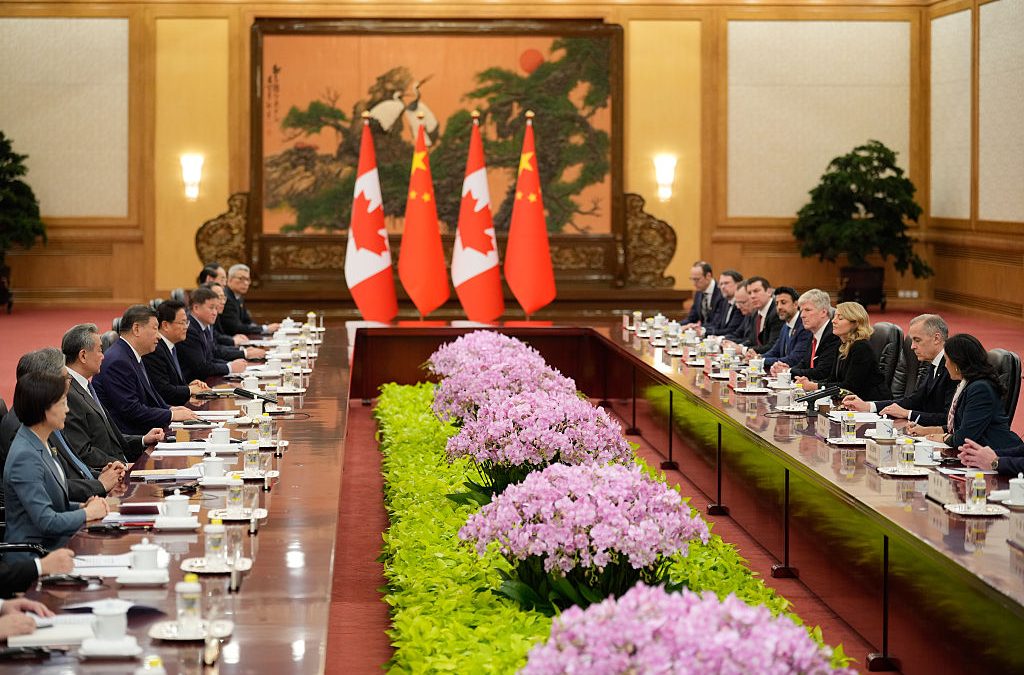
By visiting China just before the meeting in Davos, Carney made clear that other, less stressful, options exist. The trade deal—Canada reducing tariffs for about 50,000 Chinese EVs and China reducing duties on canola—is relatively modest in size. But it is huge in significance. The United States has made a bipartisan push to keep Chinese electric cars out of North America. The Trump administration was making noises about using the U.S-Mexico-Canada Agreement—the successor to NAFTA—to circle the wagons against China. Carney’s visit to Beijing effectively raised a middle finger to Washington.
It’s not just trade. In December, Canada joined the European Union’s Security Action for Europe (SAFE) program, an effort to reorient military spending away from dependency on U.S. contractors. Carney said that participation in SAFE would provide Canadian defense companies “tremendous opportunities” in a “dangerous and divided world.” Ordinarily such a phrase might refer to U.S.-Russian or U.S.-Chinese rivalry. But Carney also had in mind the border dividing Canada from the United States.
Prisoner’s Dilemma
You’ve been arrested along with your two friends. All three of you are held in separate cells. The police officer visits you in your cell and offers you a deal. If you implicate your two friends, they’ll go easy on you.
You’re tired and scared. But you have enough presence of mind to know that this scenario is being repeated in the other two cells.
So, what do you do? If all three of you refuse to make deals with the authorities, there’s a good chance you’re all go free. But you can’t call your friends to find out what they’re thinking. You have to make a decision in the dark.
This is the “prisoner’s dilemma.” The Trump administration is effectively holding the world hostage with its erratic trade and security policies. So far, each country has decided to make deals with Trump out of fear that they will be punished.
But countries are not prisoners in cells without the ability to communicate with one another. Carney has publicly declared that there are other options for middle powers. In response to his threats to take Greenland, European leaders threatened retaliation of their own. Even the European far right, previously Trump’s greatest fans, has realized that the U.S. president is a huge liability, given his widespread unpopularity across the political spectrum in Europe.
What is lacking so far is a determined collective response to the Trump administration. China is quietly taking advantage of all the opportunities that Trump is throwing its way. Canada and the European Union are increasingly coordinating their economic and security policies. Other countries are diversifying their portfolios to reduce dependence on U.S. trade and financial decisions.
There’s not enough common ground among these diverse actors to create an anti-Trump bloc. But they could put together an alliance in defense of at least a minimal adherence to international law. That could save some of the essential parts of the rules-based order with regard to such things as sovereignty, maritime security, and even some basic human rights.
The optimal solution to the prisoner’s dilemma, after one round, is the selfish one—make a deal and forget about your friends. But if you run a simulation across multiple rounds, the case for cooperation and solidarity among “prisoners” becomes stronger.
Trump, the bully, has so far successfully pushed his “tit-for-tat” strategy. Only now, as the world heads into more rounds of engagement with an erratic United States have countries begun to explore other, more useful strategies. China has billed itself as the more responsible partner, and it’s a compelling argument. Meanwhile, Beijing continues to feast on the lunches that Trump is delivering on a daily basis.