
American democracy faces an unprecedented crisis. Trump’s second victory represents more than a mere political setback or symptom of political polarization—it constitutes a systemic assault on shared reality and a gradual erasure of objective truth.
America is experiencing what scholars call “hypernormalization”—a quiet coup against reality, replacing it with an artificially engineered alternative, leaving citizens disoriented within an increasingly surreal existence. Mass societal delusion in which millions of citizens believe in “alternative facts” due to propaganda outlets and industrial-scale disinformation is novel to Americans, but there is a historical parallel: the manufacturing of a fake reality in the Soviet Union.
During the Soviet Union’s final decade, citizens found themselves living in a strange contradiction: they knew their government was lying about the country’s implosion, yet understood the futility of resistance. Despite endemic corruption and nearly half the population living in poverty, the state continued to pretend that everything was fine. Citizens participated in this collective fiction, not from authentic belief, but because confronting collapse was more terrifying than maintaining the charade.
This phenomenon—hypernormalization—was coined by anthropologist Alexei Yurchak in his landmark book Everything Was Forever, Until It Was No More. Unlike simple propaganda, hypernormalization represents institutionalized deception, whereby lies are methodically integrated into social structures. In such systems, even the political elites know it’s broken, yet everyone continues performing a pantomime of normalcy because no one can imagine a viable alternative. Adam Curtis explored this concept’s relevance to Western democracies in his documentary HyperNormalisation, warning that reality becomes “worse-er and weirder” as fundamental dysfunctions fester.
America now exhibits all the classic symptoms of hypernormalization. Objective truth feels increasingly elusive. Important contextual frameworks are thrown out in favor of cheap conspiracy theories. Facts drown in a sea of podcast vibes, TikTok clips, and meme-based political discourse. The U.S. information ecosystem has devolved to the point where deception isn’t just commonplace but structurally essential, as politicians have proven incapable of addressing critical challenges.
During his first term, Trump epitomized this distortion of reality through systematic falsehoods: declaring legitimate elections “stolen,” recasting criminal indictments as political persecution, dismissing climate science as a Chinese “hoax,” and claiming that a pandemic that killed over a million Americans would magically “disappear.” Each lie served as brick and mortar to construct an imprisoning maze such that even those who could see past the walls of deceit felt too powerless to tear it down.
January 6
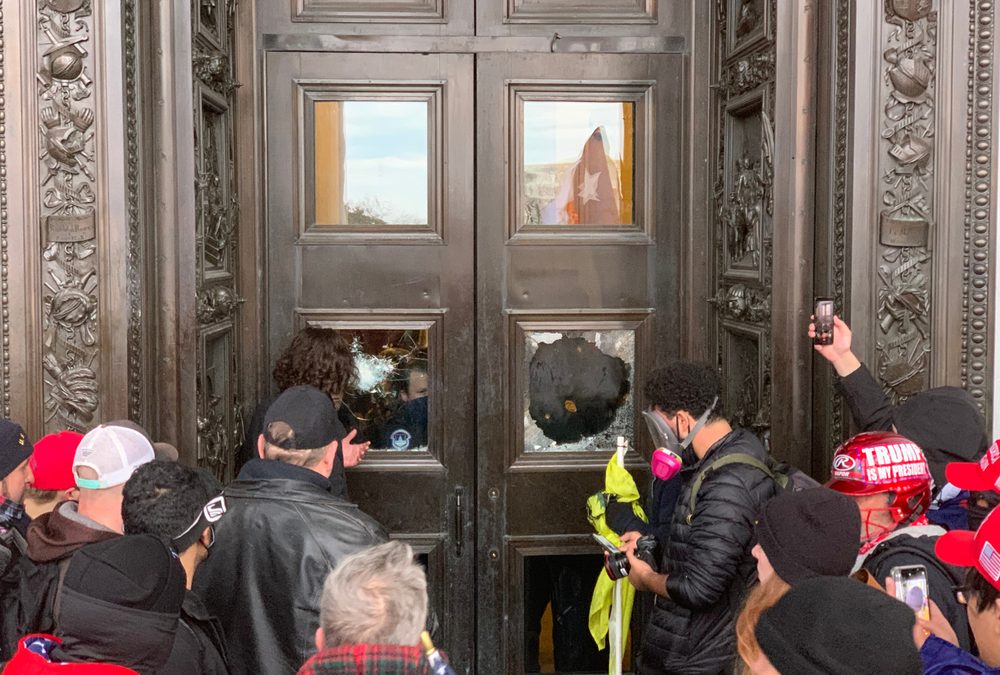
Perhaps the most profound example of this reality distortion is Trump’s bleaching of the January 6 attempted coup. His ability to deceive 90 percent of Republicans into believing that a violent insurrection was a mere “tourist visit” by “sightseers,” whom Capitol Police had “hugged and kissed,” is a staggering feat.
This deliberate falsification of history demands closer examination for two critical reasons: first, many Americans seem ignorant about the fact that five officers lost their lives; second, remembering these heroes can help guide us out of the hypernormal labyrinth.
Howard Liebengood. Jeffrey Smith. Kyle DeFreytag. Gunther Hashida.
These are the four police officers who committed suicide after defending the Capitol on January 6. For nearly five hours, these men bravely fought against a violent mob, with some suffering serious injuries. But it was the emotional wounds that ultimately killed them.
The Justice Department formally recognized Liebengood and Smith as line-of-duty deaths, acknowledging the direct connection between the trauma of January 6 and their subsequent suicides. DeFreytag and Hashida, who took their lives roughly six months after January 6, were denied the same recognition due to a bureaucratic restriction of 45 days, as if trauma politely adheres to Kafkaesque deadlines.
At the center of this tragedy stands Brian Sicknick, the police officer who died in the Capitol assault. Sicknick suffered two strokes after rioters sprayed him with chemical irritants. He died on January 7, and his sacrifice likely saved the lives of Congress members.
In 2016, Trump boasted that he could “stand in the middle of Fifth Avenue and shoot somebody” without losing voters. Yet the reality proved worse: he incited mob violence that led to multiple policemen deaths, injured approximately 140 officers, and almost overthrew American democracy. Voters not only allowed him to avoid legal accountability, but they rewarded him with a second term.
On his first day back in the Oval Office, Trump shattered centuries of presidential precedent by signing an executive order pardoning approximately 1,500 January 6 insurrectionists, who should be more accurately described as domestic terrorists. Although five families still mourn the loss of their loved ones who died defending the Capitol, the perpetrators of that violence have been allowed to return home. Enrique Tarrio, the Proud Boys leader sentenced to 22 years for seditious conspiracy, and Stewart Rhodes, the Oath Keepers founder given 18 years for orchestrating the attack, were among the 14 militia leaders released. After being freed, both men were publicly unrepentant and requested that Trump seek vengeance. “Success,” Tarrio said, “is going to be retribution.”
For Officer Michael Fanone, who was dragged from the Capitol, beaten unconscious, and repeatedly tasered in the neck, causing a heart attack, the pardons represent more than policy. They put him in personal danger. The four assailants who nearly killed him, sentenced collectively to nearly 30 years in prison, now freely walk the streets. “The rule of law in this country is dead. Criminal justice in this country is dead,” Fanone observed with the weary resignation characteristic of citizens in hypernormalized societies.
Looking Back, Moving Forward
As he ushers the United States into a self-proclaimed “Golden Age,” Trump has begun dismantling institutional guardrails and introducing the country to MAGA-style hypernormalization. The cost of abandoning reality—releasing over a thousand domestic terrorists, siding with dictators like Russian President Vladimir Putin—could be nothing short of catastrophic.
Let us light a candle to honor the five fallen heroes of January 6. Over the next four years, may their light serve as a beacon to guide the citizenry through the disinformation, misinformation, and propaganda dispensed by the Trump administration. May their light be a reminder of democracy’s fragility and the urgent duty to protect it. Their sacrifice will mean nothing unless the American people rise to defend the ideals for which they gave their lives.
Americans must resist with action. Protest. Organize. Refuse to accept this counterfeit reality. This country’s nearly 250-year experiment in democratic governance depends on a collective willingness to defend factual reality against those who want to replace it with self-enriching fictions. As Benjamin Franklin warned, Americans have “a republic, if you can keep it.”
Remember their names and why they died: Howard Liebengood. Jeffrey Smith. Kyle DeFreytag. Gunther Hashida. Brian Sicknick.