
Maybe you’re reading this article while listening to a podcast. Or you’re participating in a dull Zoom meeting. Or you’re talking on the phone with a relative.
Maybe you’ve just read the first three lines of this article three times without really registering them because your attention is absorbed elsewhere.
You’re not alone.
The modern age, with its multiple demands on a person’s time, seems to require multitasking. It’s not the kind of activity you read about in the classics. Surely that fellow who ran from the battlefield of Marathon to Athens in 490 BC didn’t carry along a couple papyrus scrolls to read along the way. Leonardo da Vinci didn’t paint Mona Lisa’s smile, stop to conduct a scientific experiment on gravity, and simultaneously jot down his thoughts on anatomy, going back and forth among those activities like a whirling dervish.
Though it promises greater productivity, multitasking is not a wondrous invention. Shifting between tasks, according to a number of psychological studies, actually reduces productivity and generates more errors. The result can be banal, as in, “I’m sorry, could you repeat what you just said to me?” Or it can be fatal, as in the thousands of deaths caused by drivers looking at their phones.
It’s hard to imagine Donald Trump multitasking, unless you count sleeping during cabinet meetings, lying and walking at the same time, or eating Whoppers while dispersing them on social media. And yet, his administration has been extremely effective its first year doing multiple things at the same time, if you define “effective” in terms of lives lost, reputations ruined, and institutions destroyed.
Don’t mistake all this destruction for multitasking. The effort to keep all the spinning plates aloft is something pursued, however spuriously, in the service of greater productivity. Instead, let’s call what the Trump administration is doing “multitrashing.” Imagine a bully that pushes the magician out of the way so that all the plates come crashing to the ground. Now multiply that a thousand-fold. Trump and his cohort are busy destroying things on multiple fronts, like a bull in a shopping mall full of fragile wares.
Just look at what the Trump team has done to the federal government: programs gutted, agencies disbanded, regulatory frameworks diluted to the point of disappearance. Just look at the destruction of science funding, the rollback of civil rights, the wrenching apart of immigrant families. Trump has approached domestic policy as if it were an axis of resistance—Bureaucrats, Academics, the Woke, and the Undocumented—that requires a multi-front war of assault and attrition.
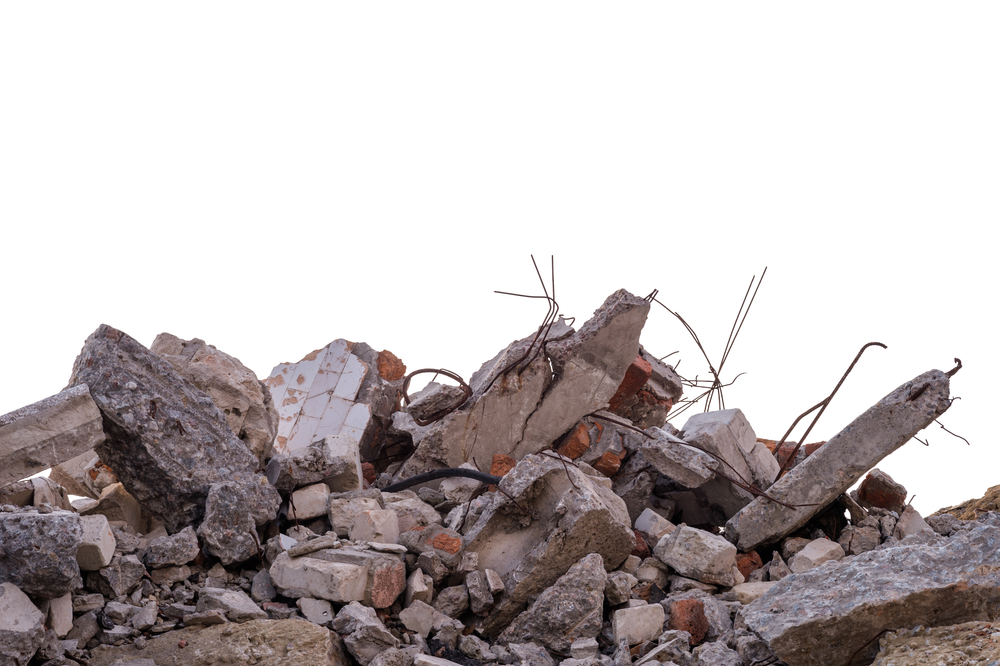
Let’s face it: the frog of America is not in a pot of water coming to a slow boil. The frog of America is in the middle of a pile of rapidly accumulating rubble. What the poor frog can’t perceive is how high and how wide this pile of rubble actually stretches. The frog thinks: maybe it’s not a lot of damage and I can soon jump my way clear. Poor, deluded frog.
If multitrashing has been so egregiously successful at home, it pales in comparison with Trump’s actions in the international arena. The trash-talking and trash-acting president has discovered, in his second term, that the U.S. military arsenal is not just for deterrent purposes. Trump has been released in the FAO Schwarz of military toy stores, and he wants to use all the gadgets. This time around, the generals aren’t holding him in check.
The itinerary of destruction so far this term has involved the U.S. military in Venezuela, Nigeria, Iraq, Yemen, Somalia, and Syria, along with two excursions to Iran. It’s been only a year, but what a long, strange, vindictive trip it’s been.
The Iran War
The Iranian government still stands. This is remarkable given the sheer amount of money and firepower the United States and Israel have devoted to toppling it. If Trump had focused on one task, rather than being engaged in multitrashing, he might have at least avoided some of the worst consequences of this war. Convinced of an easy victory, he did nothing to shock-proof the U.S. economy by, for instance, arranging for naval escorts in the Strait of Hormuz.
Vladimir Putin, for all his similar hubris, nevertheless prepared the Russian economy for the expected sanctions after his full-scaled invasion of Ukraine. Trump, by contrast, is the Alfred E. Neuman of presidents: “What, me worry?”
Iran, meanwhile, is focused on one thing: regime survival. It has caused destruction in turn, in multiple locations, but this has all served the purpose of increasing the pain for Israel and the United States. Closing down the Strait of Hormuz, bombing energy infrastructure throughout the Gulf, selecting hardliners to lead the new government: Iran wants not just to force a ceasefire but to win concessions such as a reduction in sanctions.
Trump, frustrated by a conflict that exceeds his attention span, has moved onto other tasks, like assisting drug operations in Ecuador, threatening NATO countries, and pursuing regime change in Cuba. There is method in his madness. All of this furious activity keeps Trump in the news cycle and in the hearts of his supporters. It keeps Congress out of the loop and adversaries (as well as putative friends) guessing.
Most importantly, it keeps potential successes rather than obvious ongoing failures in the public eye.
The Ultimate End
Other presidents have been vengeful, violent, imperialist. But their destructive campaigns were usually in the serve of constructing something. George W. Bush imagined a new democratic order in the Middle East. Richard Nixon dreamed of an anti-Communist bloc in Southeast Asia. Most presidents from Teddy Roosevelt on have attempted to position the United States as the world’s policeman atop a rules-based order that disproportionately benefits America.
In a recent New Yorker piece, Daniel Immerwahr notes that Trump has “liberated himself from the burdens of empire.” Ironically, horribly, this disburdening has freed the president to destroy at will.
Indeed, it seems that Trump is multitrashing for the sheer malicious joy of it. He didn’t build something new in Venezuela, simply destroyed his rival. He is planning something comparable for Cuba. As for Iran, he is not even sure what constitutes victory, other than a display of epic fury.
As in his domestic campaigns, Trump is up against what he imagines to be a global axis of resistance: the United Nations, all Europeans to the left of Nigel Farage, any rival autocrat who refuses to bend a knee. The international order is the creation of his hated liberals, so it too must go. He has absolutely no idea of what to replace the rules-based system with other than, perhaps, a reality TV show in which countries must submit to humiliating tasks while a single judge, Trump, decides who rises and who falls.
It is the nature of bureaucracy to break a task down to its smallest components, like a Ford assembly line, in order to produce things more efficiently. It is, in theory, a process of focus. In practice, as anyone who has had to deal with the Department of Motor Vehicles knows, bureaucracy is diffuse and unfocused. But again, in its way, bureaucracy has been created to keep a modern society functioning. It is the skeleton of order that keeps everything in place.
Multitrashing is the opposite of bureaucracy. It destroys without a thought to order, efficiency, results, consequences. Only the strong can survive the harrowing process of such destruction. Billionaires thrive in Trump’s America; superpowers dominate in TrumpWorld. Meanwhile, in a rage room of his own devising, Trump continues to flit from one activity to another, using a sledgehammer to destroy computers, a chain saw to cut through furniture, a howitzer to blow up heavy machinery.
It is theater of a sort, and Trump delights in performing on the world stage. But it’s not kabuki. It’s a visceral one-man show that reveals the sickening highs and lows of this new theater of cruelty.