
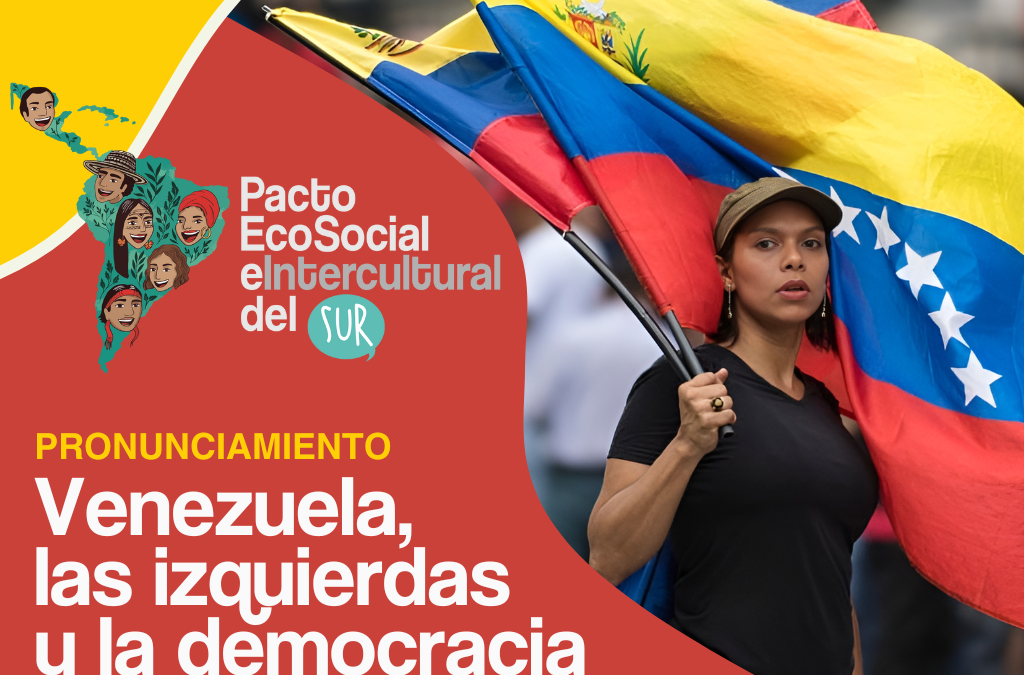
We, the Ecosocial and Intercultural Pact of the South and all those who subscribe to the views below, want to intervene in the debate about what happened in Venezuela before and after the presidential election that took place on July 28, 2024.
A diverse set of international voices have demanded that the government of Nicolas Maduro publish the electoral results in a transparent and detailed format, as a basic minimum of democratic legitimacy that would allow the electorate to endorse the results. It should be noted that the comparison of the figures in each polling station with those that appear in the electoral record in the hands of the witnesses in each polling station is the principal auditing mechanism enshrined in Venezuela’s electoral legislation. It is clear that this requirement cannot be replaced by any decision made from above or by the Supreme Justice Tribunal, which in so doing usurps the exclusive powers of the other authority of the state, the National Electoral Council. We urge an absolute, fact-based transparency, as demanded in a recent communication from the Venezuelan left entitled “The People Know What Happened.” The sun cannot be covered by a finger—the truth can’t be so easily wiped away.
We are worried that much of the media and many social groups still associate the actions of the regime of Nicolas Maduro with the political camp of the left. The argument is usually that any doubts regarding the results of the election are an outside intervention or that doubts about the transparency and legitimacy of the electoral process do not respect the sovereignty of the Venezuelan people, dishonor the legacy of Hugo Chavez, and are part of the imperialist strategy of the United States against Venezuela. According to this view, the conflict is between a revolutionary Bolivarian Venezuela and a fascist opposition that is remote-controlled by imperialists.
The Venezuelan reality, however, is much more complicated than this picture. The policy of the Maduro government, which calls itself a civil-political-military alliance, is far from honoring the legacy of the Bolivarian process and the 1999 Constitution. Its neoliberal, extractivist, and oligarchic policies are the reason why such a large proportion of the population wants a change in government – from the Communist Party (before the government intervened in its mechanisms), to the Left forces at the heart of the Chavez legacy, to environmentalists, feminists, social democrats, and liberals, all the way to the neoliberal, pro-U.S. Right represented by Maria Corina Machado. To call this colorful spectrum “fascist” is not only incorrect, it runs the risk of reducing the adjective “fascist,” which until recently was a precise political category, to just some kind of insult.
In Venezuela today, it’s possible to denounce the inhuman economic sanctions of the empire and, at the same time, criticize the authoritarianism of the Maduro government. This is the position of all those who subscribe to the views expressed here. The Venezuelan people cannot be hostages to geopolitical considerations that idealize a multipolar world according to which the priority is “to play into the interests of the United States” while lacking a critical evaluation of the roles played by other world powers like Russia and China. It’s clear that for all these actors, Venezuela is, in the first place, an immense repository of oil and minerals.
A large part of the Venezuelan population is living in a situation of blackmail with regard to their material survival. For example, the delivery of basic necessities depends on one’s declared loyalty to the government. In 2024, as opposed to 2017, it’s not the middle class that’s going into the streets to protest but, principally, the popular classes. The popular classes have been attacked in their neighborhoods by the government’s shock troops, and their young people have been jailed on charges of “terrorism” and hate crimes.
We are witnessing the legal-institutional installation of an authoritarian regime in Venezuela, which resonates with Stalinism, the darkest historical legacy of the Left that was never completely overcome.
This is happening through:
- The subordination by executive power of all institutions and authorities, including the National Electoral Council, the legislative authority, and the Supreme Justice Tribunal
- The intervention into the majority of the opposition political parties, including the Communist Party of Venezuela, through the decisions of the Supreme Justice Tribunal, appointing new boards of directors favorable to the government
- The censorship, closure, and blocking of media and websites not favorable to the government
- The persecution of those who insist on democratic procedures by, for example, detaining them and canceling their passports
- The approval by the General Assembly of laws like the “Law on the Inspection, Regularization, Performance, and Financing of NGOs and Non-Profit Social Organizations” that severely limit freedom of association and organization as well as political liberties
- The strengthening of a police state made possible by the exceptional circumstances produced by the economic sanctions, the general de-institutionalization, and the “criminal legality” that violates the Social State of Rights and Justice enshrined in the Constitution of Venezuela
- The sacralizing, pseudo-religious discourse of Maduro, as “the one chosen by God,” which aims to stifle political debate and results from opportunistic alliances with anti-rights evangelical groups
- The deepening of extractivism as the only possible trajectory for Venezuela’s macro-economic policy
- The generous distribution of benefits, for example, in the form of concessions for gold mining to senior military commanders to ensure their loyalty
The Bolivarian revolution led by Hugo Chavez was a process marked by many tensions and contradictions that in part continue to influence the current scenario – such as the extended presence of the military in the government or the fusion of the party and the state. At the same time, it was a process that empowered the popular sector, deepening democracy in many senses, and reduced poverty and inequality in a significant way. It was a process, like ALBA, that triggered debates about transformative regional integration in Latin America. This process was closed, dismantled, and reversed by the current government. In a world in which the far right has increasingly won more terrain, both electorally and narratively, we are very worried that the government of Nicolas Maduro—as well as the government of Daniel Ortega in Nicaragua—continues to be associated with “the left.”
If the practical policies of “the left” are no different from those of Donald Trump—ignoring election results, aligning the supreme court with one’s own political positions, encouraging political violence by shock troops, making use of democratic institutions to dismantle democracy—there would be no reason to prefer the left over the right. The same holds true if the politics of the “left” do not comply with its original promises: greater social justice, greater equality, a greater possibility for people to make effective and collective decisions about their future and their environment (a radical definition of democracy). If this “left” is exhausted by mere slogans, which have been emptied of all content concerning solidarity, emancipation, anti-imperialism, popular power or justice, it will be more difficult to maintain the social credibility of the wide range of anti-capitalist and anti-systemic options that are so urgent today and that are inscribed in the trajectory of a pluralist and emancipatory left. The goal of such a left cannot be to cling to the government by all means but should be to transform our societies everywhere and at every scale.
Our societies are increasingly marked by multiple polarizations which invite a reading of social complexity strictly in terms of black and white, polarizations reinforced by echo chambers generated by digital networks. One of these polarizations has to do with belonging to the camps of the left and right. We think it is necessary to defend the idea of plural lefts that have assimilated the hard lessons of the experience of authoritarian history, plural lefts that struggle for more democracy and never less, for more diversity, and for the emancipation of all power relations that surround us.
We subscribe to a left that searches for pathways to a dignified life, alternatives to the current deep polycrisis, always from below, with the people and their organizations, always with Mother Earth. It is urgent to defend, in this context, the very possibility of a plural debate: that the people will have the space where they can deliberate upon their situation and their collective future.
(Translated by John Feffer)