
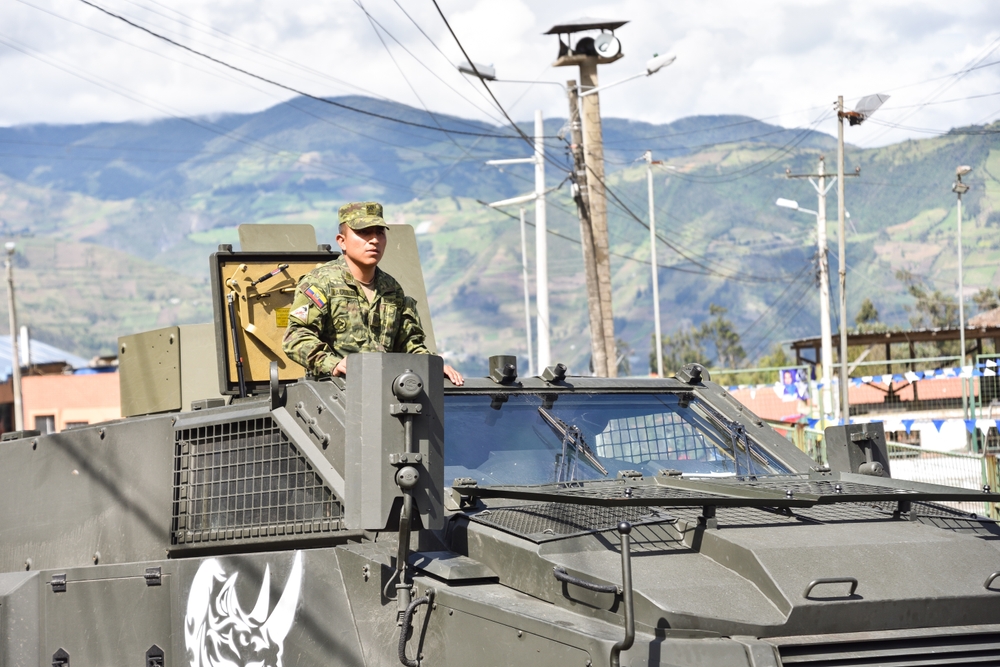
On March 3, Ecuadorian armed forces conducted raids at several locations around the country in an attempt to disrupt drug shipments and criminal gang activities. Once considered one of the safest countries in Latin America, Ecuador has become a violent hotspot since 2020. It has some of the highest homicide rates in the world, which also included the assassination of a presidential candidate in August 2023. Current President Daniel Noboa, along with former President Guillermo Lasso, attempted several policies to deal with the crime and instability, but the events of March 3 have taken the issue to a new level: namely, the increased participation of the United States and other international partners.
Operating through the Southern Command, the United States has argued it is only participating in an advice and support role (along with Europol, the European international police). Given that it’s a dominant producer of coca, the key ingredient in cocaine, the Andean region is an important foreign policy focus for both the United States and Europe. Although levels have varied over the decades, production has nearly doubled in the last 10 years, and by 2024, production has reached some of the highest in history. Ecuador has become a prime transshipment spot for drug traffickers due to its location between the two largest coca producers: Colombia and Peru, its connections to the international transit markets through its Pacific ports (namely Guayaquil), and Ecuador’s use of the U.S. dollar as its currency, which facilitates money laundering and transportation.
U.S. participation in the March 2026 raids has complicated the issue in Ecuador. President Noboa has attempted several policies and decrees to deal with the insecurity issue. For instance, he has attempted to reintroduce foreign military personnel to Ecuador. In the late-1990s, the United States constructed an anti-drug operations center at the air base in Manta, on Ecuador’s Pacific coast. The center was designed to target drug operations not only in neighboring Colombia but those throughout the Andean region. Although there is some skepticism about the relationship, some individuals have noted that the location of the military base may have contributed to creating a bubble of protection around drug trafficking and gang activity in the immediate area. However, former President Rafael Correa, who already was not a supporter of the U.S. presence in Ecuador, lead a push for a 2009 successful referendum that banned foreign military bases in Ecuador.
Noboa has long wanted U.S. support in dealing with drug operations within Ecuador and has throughout the past year worked to influence the Trump administration policies. However, recent events in Ecuador have complicated matters for both the Noboa government and the United States. In November 2025, the country conducted a referendum on whether to allow Noboa to rewrite the 2008 Constitution and, among other things, lift the foreign military bases ban. Although Noboa pushed hard for the referendum to pass, it failed with over 60 percent of Ecuadorians voting against the changes, dealing his presidency its first major blow.
Since the November rejection, Noboa has attempted other strategies to bring in the U.S. military and greater U.S. support. Even before the March raids, Noboa was able to persuade the United States to designate Los Choneros and Los Lobos, the dominant drug trafficking gangs in coastal Ecuador, as Foreign Terrorist Organizations. He also managed to solicit greater U.S. support for Ecuadorian seizures of drug shipments and joint intelligence exercises at Manta.
Given the recent track record of the Trump administration in the Latin America, the March raids are likely the precursor to a greater U.S. presence in Ecuador. Since the March raids, Noboa has also participated in other Trump initiatives towards Latin America, including the “Shield of the Americas” summit at Trump’s South Florida country club on March 7. This strategy of soliciting a stronger U.S. presence in Ecuador may end up backfiring, however, since Ecuadorians don’t support foreign military involvement. If the U.S. presence grows throughout the rest of 2026, either through logistical or physical support, it may generate more intense backlash from the Ecuadorian gangs, leading to higher outbreaks of violence, with civilians right in the middle of the fighting.
In this scenario, Noboa could face an outbreak of protests that threaten the stability of his government. These could even lead to attempts to topple Noboa, as protests nearly did to former President Lenin Moreno in late 2019. A descent into extreme levels of polarization and instability could embolden drug traffickers and gangs and threaten any future anti-drug successes.
Dealing with the illegal drug issue is important and requires some kind of relationship between the United States and the Andean countries. However, if it is not done in the proper manner through intelligent policies and procedures, or without the support of the general populace, such coordination may end up causing a greater headache—not only for the Andean nations like Ecuador, but for the United States as well.