
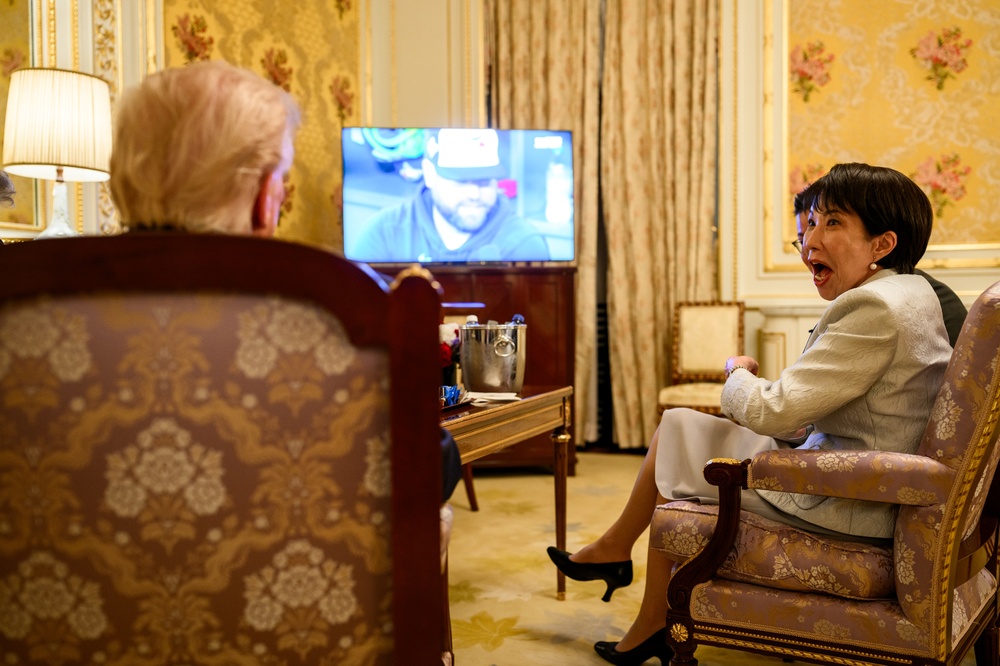
On March 19, 2026, a truly remarkable scene unfolded in the Oval Office. President Donald Trump, hosting Japan’s Prime Minister Sanae Takaichi, decided to explain his decision to launch a massive bombing campaign against Iran without notifying his allies. His justification was simple. He wanted the element of surprise.
Then came the punchline.
Turning to Takaichi, he asked, “Who knows better about surprise than Japan? Why didn’t you tell me about Pearl Harbor?”
The room reportedly fell silent. Takaichi, a seasoned security hawk who has spent her career navigating the delicate constitutional constraints of Japanese defense policy, could only offer a pained, widened gaze. It was a moment of pure absurdist theater. But beneath the cringe-inducing humor lies a deeply consequential shift in how the United States manages its global alliances during a time of active, high-stakes warfare.
We are currently three weeks into a conflict that has fundamentally reordered the Middle East. Since the joint U.S. and Israeli strikes began on February 28, the region has spiraled. The Supreme Leader of Iran is dead. His son Mojtaba Khamenei has taken the mantle. The Strait of Hormuz is effectively a no-go zone for global shipping, and oil prices are behaving accordingly. Just hours before the Pearl Harbor comment, an American F-35 was forced into an emergency landing after taking ground fire over Iran. This was a sophisticated stealth jet nearly compromised by what appears to be Iranian infrared tracking.
In this environment, the casual invocation of the 1941 attack on Pearl Harbor is more than just a gaffe. It is a window into a new, transactional era of American foreign policy where history is not a set of lessons to be learned but a rhetorical cudgel to be used against friends.
The irony is that Takaichi did not travel to Washington to trade historical barbs. She came to manage a survival-threatening situation. Japan relies on the Middle East for the vast majority of its crude oil. With the Strait of Hormuz closed, Tokyo is facing an existential energy crisis. Yet, Takaichi is also governing a country with a pacifist constitution and a public that is overwhelmingly skeptical of being dragged into a foreign war. She is walking a tightrope between Washington’s demands for Japanese warships in the Gulf and a domestic legal framework that strictly limits collective self-defense to situations where Japan’s own survival is at clear risk.
When Trump jokes about Pearl Harbor, he is essentially telling his most important Asian ally that their historical sensitivities and current legal constraints are irrelevant. It is the diplomatic equivalent of a “banger meme” delivered at a funeral.
This approach to statecraft creates several dangerous scenarios. The first is the erosion of the “intelligence dividend.” Alliances work because they are built on a bedrock of shared information and “no surprise” policies. By intentionally keeping Tokyo in the dark about the start of the Iran war, the United States has signaled that it views its allies as subordinates rather than partners. If Japan feels it cannot trust the American security umbrella to be predictable, it will eventually seek its own. That could mean a rapid and potentially destabilizing nuclearization of Japanese defense policy.
The second scenario is the “transactional trap.” Trump has been explicit in his view that Japan needs to “step up to the plate” because of the money the United States spends on its defense. Althougn the burden sharing of the Cold War era indeeds needs an update, doing so through public shaming and historical insults is counterproductive. It strengthens the hand of isolationists in both countries and makes it harder for leaders like Takaichi to sell pro-American policies to their voters.
The path forward requires more than a mere pivot in rhetoric. It demands a restoration of institutionalized consultation. While the “surprise” of February 28 may have yielded a tactical advantage, its strategic cost has been an erosion of the intelligence dividend that sustains the Western alliance. To stabilize the current crisis, Washington must formalize a standing coordination cell to synchronize energy security and operational planning. Such a mechanism would ensure that alliance management remains insulated from the personal whims or historical grievances of any single leader.
Ultimately, we must recognize that the world has transitioned into a volatile post-American order. In this landscape, American influence is no longer guaranteed by past hegemony but by its ability to lead a coalition of the willing, not a coalition of the insulted. The Pearl Harbor joke was intended as a lighthearted aside between “powerful” leaders, yet it served as a stark reminder of a leadership style that views diplomacy as a series of reality television segments. As the emergency landing of an American F-35 suggests, the margin for error in the Middle East is rapidly vanishing.
Although the international system can withstand many shocks, a total breakdown in trust between the United States and its closest allies is not one of them. History is a heavy burden, and it is best not to treat it as a punchline.