
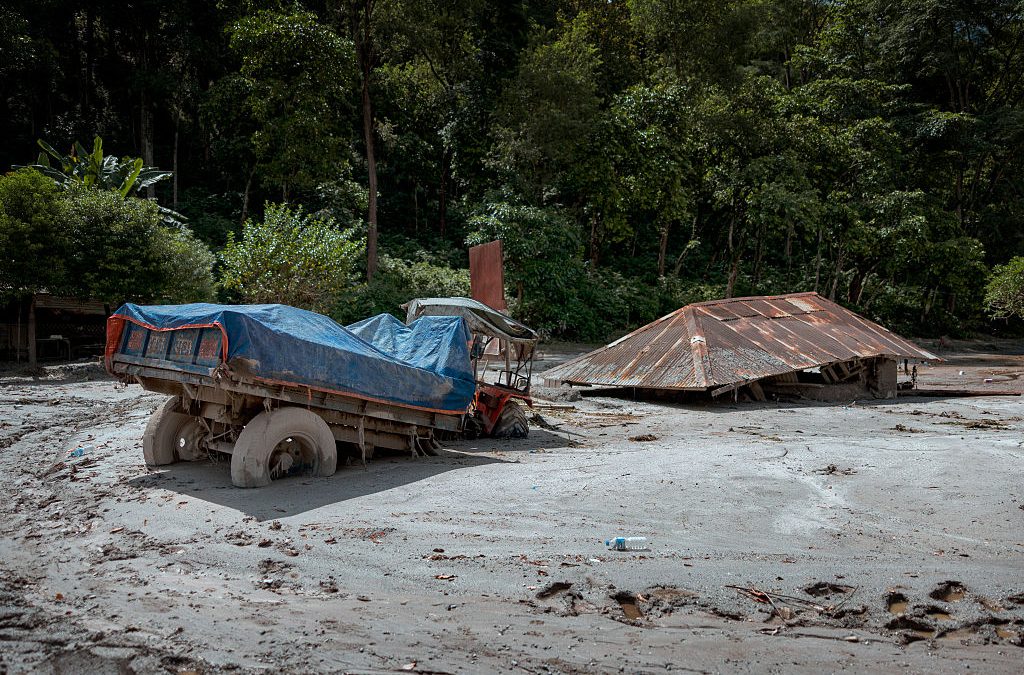
The flash floods that swept through Nepal on August 26 came from a glacial crash, 40 miles from Kathmandu, the country’s capital. A gigantic chunk of ice, half a kilometer thick, broke off a glacier and fell down a river with a seismic force of 5.2 magnitude. This mass of millions of tons of ice shattered on impact into a gushing stream that increased the level of the Bhote Koshi River, which sits at the intersection of the Sino-Nepali border, by nine meters. The Bhote Koshi River merges with the larger river system of Trishuli that, too, got bloated and pushed floodwater almost a hundred miles downstream across Nepal’s border into India.
As of September 5, as many as 1,350 people were listed dead and 5,000 missing. Initial estimates put the economic toll of the disaster at $5 billion, which is 10 percent of Nepal’s GDP. Kathmandu calls the disaster anything but natural and demands “justice and compensation” from “the world’s major emitters.”
Nepal is home to 3,808 Himalayan glaciers spanning 3,902 square kilometers with an ice cover of 286.1 billion cubic meters of water. These glaciers are, however, retreating fast. The reason behind their retreat is rapidly changing global climate. It is not just Nepal’s glaciers that are melting away. Nepal is part of the eight nations that share 54,000 Hindu Kush-Himalayas glaciers, which hold 5.6 trillion cubic meters of water. These glaciers, which are billed as the “water towers of Asia,” feed Asia’s 10 largest river systems. They are also known as the world’s “third pole,” the other two being the North and South Poles.
Although estimates vary, one-third of these glaciers will have melted away by the turn of the century, if global heating reaches 1.5 degree Celsius above preindustrial levels. This will be an irreparable loss for 2 billion people of the region, who depend upon them for drinking and irrigation supplies. A case in point is the Indus, which is one of the largest river systems in south Asia which depends on glaciers for 80 percent of its annual flow. The rapid melting of these glaciers, triggered by global heating, is the death knell for the region’s ecology, as well as its agriculture and agriculture-related industries.
Glaciers are fed by precipitation, especially the monsoons. As climate change has shortened the monsoon season, precipitation across the Hindu Kush-Himalayas has dropped in direct proportion. Worse still, global heating is thinning out the existing ice cover of the glaciers. Nepali glaciers have lost one-third of their ice cover. More importantly, the Himalayas are reportedly “warming twice as fast as the global average.” Although the glaciers at the top remain somewhat replenished by precipitation, climate change is stripping them bare at lower elevation.
The giant ice chunk that snapped off a glacier on August 26 was also at the lower elevation, where snowpack was too weak to hold it in place. In 2011-2020, the region’s glaciers melted 65 percent faster than the decade before. Climate change is, thus, hollowing out these glaciers in three ways. Lack of precipitation leaves them with ever-diminishing ice cover. Global heating is fast melting their preexisting ice cover. And the declining snow and ice cover, which is reflecting less and less sunlight, absorbs more and more heat, accelerating glacial melting in the process.
The site of the Nepali glacier that cracked up on August 26 was the Langtang Lirung peak close to the Langtang National Park, which borders Tibet in China. Around a hundred miles downstream, India also endured loss of life in the glacial collapse. As such it is a cross-national calamity. What gives it a global cast is the suspected loss of life of thousands of tourists from 34 countries, including 75 from the United States. These nations represent four continents of Africa, Americas, Asia, and Europe.
This is a snapshot of the global reach of fossil-fueled disasters that are increasing both in frequency and intensity by the year. Fossil fuels dug in Australia or burned in the United States have real life consequences half-way around the globe, to which even thousands of their own citizens are not immune. The global tale of woes, however, does not end here. On the Chinese side of the border, hundreds of tourists are unaccounted. Two weeks after the disaster, 261 foreign nationals from 23 countries are still missing in China. Although the Nepali government is trying hard to account for every tourist, hopes for their survival are dimming by the day.
The destructive force of the flooding can be gauged at the Sino-Nepali border crossing. Both sides of the border are crisscrossed with shiny customs and immigration buildings that, until before the disaster struck, stood tall. What happened to these buildings when the nine-meter high walls of water crashed into them is a harrowing sight to watch. It took only a second or two to rip them from their foundations and toss them like toys into torrents of water. The same held true for untold numbers of hapless staff and aspirant migrants who tried to sprint away only to be swallowed up by the tide in the blink of an eye.
The World Meteorological Organization confirms that the 11 years since 2015 were the hottest on record. Global temperatures have already reached 1.4 degree Celsius and are projected to reach 1.8 degree Celsius by midcentury, way over the maximum threshold of 1.5 degree Celsius agreed in the Paris Climate Pact.
Some attribute the recent accelerated warming to the El Nino effect, implying that all this global heating is transitory and fueled by a natural phenomenon. That’s not true. Even El Nino has grown 37 percent more intense due to global warming. El Nino is the result of warmer than normal waters in the central and eastern Pacific Ocean, a warming that is driven by climate change. Also, warming Pacific waters are supercharging El Nino. El Nino, in turn, is exacerbating the impact of climate change, making glacial collapses more frequent and even more fatal.
The flood disaster in Nepal is a canary in a coal mine. It should alert the world to the dangers of the continued use of fossil fuels and of not zeroing out emissions. The planet is warming, the glaciers are changing, and disasters just keep happening.