
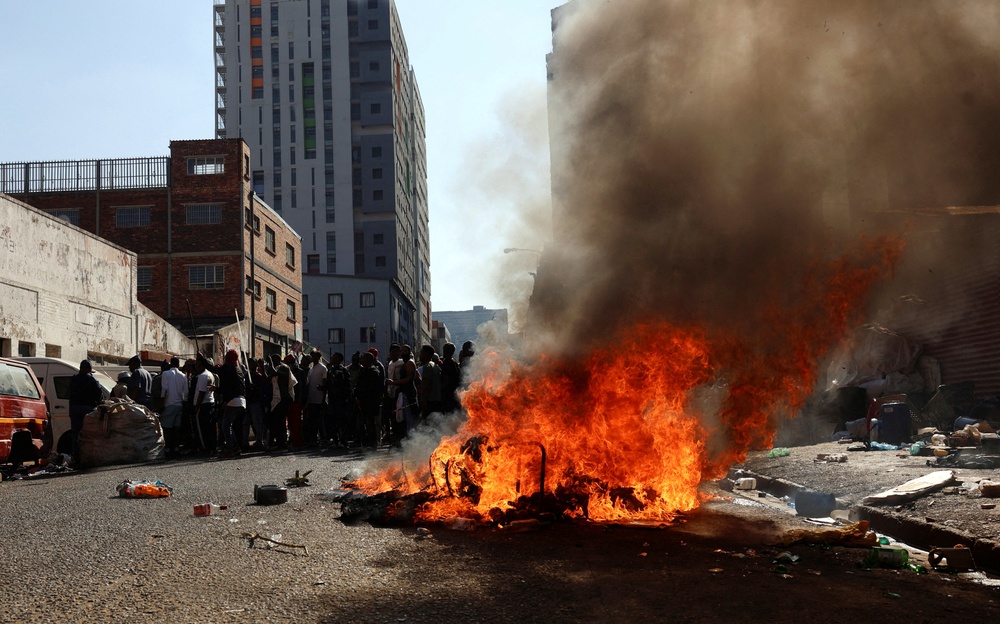
Last month, thousands of migrants across South Africa packed their belongings and left their homes. Parents withdrew children from school, shopkeepers shuttered businesses, employers advised workers to stay away, and families dispersed across provincial borders in search of temporary refuge.
The immediate trigger was not a government order or judicial directive but an ultimatum issued by anti-immigrant groups declaring that undocumented foreigners had until June 30 to leave the country or face unspecified consequences. That deadline did not end the mobilization. The coalition behind it organized 120 marches nationwide on June 30 and later pledged weekly protests until all undocumented migrants had left South Africa.
South African authorities insisted that these notices had no legal standing and reminded citizens that immigration enforcement remained the exclusive responsibility of the state. Yet President Cyril Ramaphosa subsequently announced a “Comprehensive Approach for Migration Management” centered on a strengthened border authority, fast-track deportation courts, and 10,000 additional labor inspectors, prompting critics to argue that official policy had begun to converge uneasily with elements of the movement’s agenda. Meanwhile, embassies from neighboring countries organized assistance for their nationals as many migrants, including those with valid documentation or recognized refugee status, fled because they believed violence was inevitable.
The immediate temptation is to interpret these events as another chapter in South Africa’s long history of xenophobic violence. The country experienced major anti-immigrant attacks in 2008, 2015, and 2019, while organizations such as Operation Dudula have long campaigned against undocumented migration. Those episodes repeatedly targeted not only undocumented migrants but also refugees, asylum seekers, and legally resident foreign nationals, demonstrating that once hostility towards “foreigners” becomes socially acceptable, legal status offers only limited protection.
Yet the developments of 2026 appear qualitatively different. Instead of spontaneous riots triggered by rumors or isolated incidents, there was planning, public mobilization, and announced deadlines designed to pressure migrants into leaving before violence occurred. The objective was not merely to protest immigration policy but to exercise authority over it. By early July, activists were reportedly conducting door-to-door searches in parts of Johannesburg and handing suspected undocumented migrants to police, further blurring the boundary between civic protest and immigration enforcement. Citizens were, in effect, claiming the power to determine who belonged within South Africa’s borders, challenging one of the defining attributes of the modern state.
The Irony of a Constitutional Success
The deepest irony is that these developments are unfolding in the very country that became an international symbol of inclusive citizenship after 1994. South Africa’s peaceful transition from apartheid remains one of the twentieth century’s most remarkable political achievements. Rather than pursuing revenge, Nelson Mandela and the African National Congress embraced constitutionalism, non-racial democracy and reconciliation. The resulting constitution remains among the world’s most progressive, while South Africa retains an independent judiciary, competitive elections, a robust civil society, and one of Africa’s most free media environments, ranking twenty-seventh globally in the 2025 World Press Freedom Index.
These achievements fundamentally distinguish contemporary South Africa from the apartheid state that preceded it. The tragedy therefore lies not in the failure of the constitutional project itself but in the widening gulf between its ideals and social realities.
Yet the post-apartheid settlement proved far more successful at redistributing political rights than economic opportunity. Writing in 2024, the South African-Australian author Sisonke Msimang argued that many South Africans were reassessing the celebrated narrative of reconciliation not because it was misguided but because political liberation had failed to deliver corresponding economic transformation.
The African National Congress, she observed, had failed to generate sufficient employment, reduce poverty, or prevent the deterioration of housing, healthcare, and education. Msimang also rejected two increasingly common interpretations. She challenged the liberal tendency to treat post-apartheid South Africa as a completed success whose present difficulties were incidental, while equally dismissing claims that Mandela had “sold out” the revolution through constitutional compromise. Instead, she located the roots of the country’s predicament in decisions taken long after Mandela’s retirement, particularly the corrosive effects of corruption, patronage, and institutional decay under successive ANC administrations.
A Generation Excluded
By late 2025, the scale of that disappointment had become difficult to dismiss. An Ipsos survey found that 80 percent of South Africans believed their country was moving in the wrong direction, an extraordinary level of pessimism for a democracy barely three decades old. A major study by Harvard University’s Growth Lab concluded that GDP per capita had stagnated or declined for more than 15 years, while unemployment had risen steadily throughout the democratic era.
The burden has fallen disproportionately on the young. Statistics South Africa reported that nearly 4.8 million young people were unemployed in the first quarter of 2025, of whom 58.7 per cent had never held a job. The country was producing a generation whose first sustained experience of democracy was not political emancipation but economic exclusion.
At the same time, Johannesburg has struggled with recurring electricity failures, water shortages, deteriorating roads, and declining municipal services. The Zondo Commission documented the extent of state capture and corruption, yet relatively few high-profile prosecutions followed, while senior police officials warned publicly about organized criminal syndicates penetrating law enforcement institutions. Together, these developments suggested not merely inequality but a deeper erosion of state capacity.
The political implications have been equally significant. Nearly 60 percent of South Africans were born after apartheid and possess no direct memory of the racial order that shaped earlier generations. For them, apartheid remains the indispensable historical explanation for enduring structural inequality but no longer an adequate political explanation for contemporary governance failures. The ANC’s liberation credentials, once an almost unassailable source of electoral legitimacy, has inevitably lost force as the electorate grows younger.
This generational shift was reflected in the 2024 general election, when the ANC lost its parliamentary majority for the first time since the democratic transition and entered a coalition government. Equally revealing was the fact that more than 11 million registered voters abstained, suggesting not only dissatisfaction with the governing party but broader disillusionment with politics. The central political question has shifted from who liberated South Africa to who can govern it effectively, exposing the limits of liberation credentials as a substitute for administrative competence.
It is within this broader context that anti-immigrant mobilization becomes more comprehensible, though no less troubling. South Africa’s structural problems cannot plausibly be explained by immigration alone. Persistent unemployment, stagnant productivity, weak investment, deteriorating infrastructure, corruption, and municipal failure reflect decades of accumulated policy choices rather than the arrival of migrants from neighboring countries.
Yet migrants provide a politically convenient explanation because they are most visible where competition for informal employment, housing, and public services is most intense while possessing little electoral influence or institutional protection. Economic frustration is thus redirected towards a group that is immediately identifiable but structurally peripheral to the country’s deepest problems. The June-July 2026 mobilization demonstrated how quickly this logic could escalate: what began with fear-driven departures ultimately displaced or repatriated an estimated 13,000–25,000 people, while police reported more than 900 arrests linked to the protests and immigration operations.
Liberation’s Unfinished Business
Perhaps the deepest irony lies in South Africa’s regional history. During apartheid, neighboring African states provided sanctuary to South African exiles, hosted ANC activists, trained liberation fighters, and accepted significant diplomatic and economic costs in support of the struggle against white minority rule. Zambia, Mozambique, Zimbabwe and others became indispensable partners in the liberation movement, offering refuge to those who could no longer remain safely within South Africa.
Three decades later, many seeking safety inside South Africa come from those same countries. Zimbabweans, Mozambicans, Malawians, and Congolese increasingly regard it as the region’s principal economic destination, only to find themselves accused of undermining employment, burdening public services, or contributing disproportionately to crime. Such hostility towards fellow Africans would have sat uneasily with Steve Biko, the anti-apartheid leader whose Black Consciousness philosophy inspired a generation of resistance and possessed an unmistakably Pan-African moral imagination. That countries which once sheltered ANC exiles should now see their citizens fleeing intimidation in democratic South Africa is among the cruelest reversals in the region’s recent history.
South Africa’s democratic achievement also endowed it with unusual moral authority because it had experienced, and ultimately overcome, one of the twentieth century’s most systematic regimes of exclusion. That history informed its decision in December 2023 to bring proceedings against Israel before the International Court of Justice alleging violations of the Genocide Convention. Whatever one’s view of the case, South Africa’s argument rested on a universal proposition: a nation shaped by the struggle against apartheid bore a particular responsibility to oppose injustice wherever it occurred. That claim resonated because South Africa had become a global symbol of reconciliation, constitutionalism, and the rejection of politics founded on birth and identity.
Recent events therefore raise a troubling question: how has a society whose democratic identity was forged through resistance to exclusion found itself confronting a new politics of belonging that again asks who has the right to live, work, and feel secure within the nation? The categories have changed, the constitutional order has changed, and the state no longer enforces exclusion. Yet the temptation to explain profound social anxieties by identifying an “Other” whose belonging can be questioned remains painfully familiar.
It was precisely this distinction between liberation and its preservation that preoccupied Breyten Breytenbach, the Afrikaner poet and painter whose opposition to apartheid led to seven years’ imprisonment, much of it in solitary confinement. His prison memoirs and later essays reflected not only the trauma of incarceration but also a profound suspicion of political complacency and any orthodoxy claiming that history had reached its destination. For Breytenbach, freedom was never a permanent achievement but a demanding moral discipline requiring constant vigilance against the return of exclusion in altered forms.
That, ultimately, is the unfinished promise of post-apartheid South Africa. The constitutional settlement of 1994 dismantled institutionalized racial domination and created one of the world’s most progressive democratic orders. It could not guarantee economic opportunity, administrative competence, or social cohesion. As governance weakened, public services deteriorated and economic frustration deepened, anger was increasingly redirected sideways rather than upwards, towards migrants with the least political power rather than the structural causes of stagnation and institutional decline.
The tragedy of June-July 2026 therefore lies not simply in the fear experienced by thousands of migrants but in the reminder that exclusion is not a static ideology confined to one historical era. South Africa has already shown the world that political liberation is possible. Its greater challenge is to ensure that the universal ideals forged against apartheid shape everyday life within its own borders as powerfully as they have shaped its moral voice beyond.