
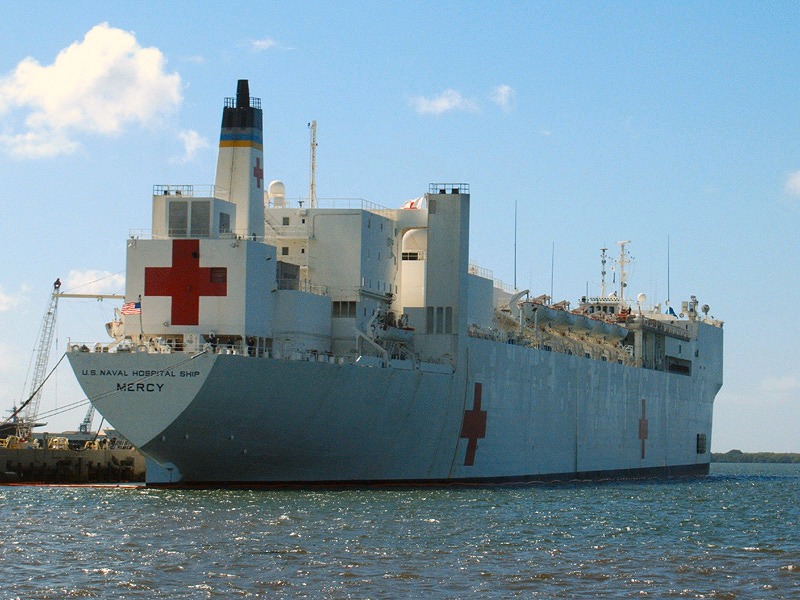
The International Committee of the Red Cross president, Peter Maurer, has apparently thrown his lot in with the recent movement to attempt to achieve nuclear disarmament by focusing on the humanitarian impact of nuclear weapons. In part, it’s a strategy for non-nuclear-weapon states to move toward disarmament without the foot-dragging or outright digging in of heels by nuclear weapon states, including signatories to the nuclear Non-Proliferation Treaty (NPT), such as the United States. Reaching Critical Will provides some background on how the movement is gaining momentum.
Starting with the 2010 NPT, governments officially expressed their “deep concern at the catastrophic humanitarian consequences of any use of nuclear weapons” and reaffirmed “the need for all States at all times to comply with applicable international law, including international humanitarian law.”
Following this, 16 governments delivered a joint statement at the 2012 NPT Preparatory Committee; and 35 governments did so at the 2012 General Assembly First Committee session, highlighting the catastrophic humanitarian consequences of nuclear weapons and calling on all states to intensify their efforts to outlaw these weapons. At the 2013 NPT Preparatory Committee, 80 governments joined in this statement on the humanitarian impact of nuclear weapons, and by the 2013 First Committee, 125 governments were on board.
As for the Red Cross, it
… adopted a resolution on the topic in 2011, which “finds it difficult to envisage how any use of nuclear weapons could be compatible with the rules of international humanitarian law, in particular the rules of distinction, precaution and proportionality,” and urges states to abolish nuclear weapons.
In an interview with Japan’s The Asahi Shimbun, Red Cross President Maurer shed light on the crux of the issue for the Red Cross in the aftermath of nuclear war.
So, the second question, then, is a question of scenario and appreciation of what would happen. We cannot imagine at the ICRC that a nuclear weapon is used in a targeted, limited way, without leading to escalation. If you question this hypothesis, you may question our conclusion.
That is, the extent of the area needing its services won’t be contained.
… our basic hypothesis is that we do not see how a nuclear weapon can be used and can be limited in scope, from what we know today, in just the use of one weapon. And, if you suppose escalation, to a certain extent, the capacities are soon overwhelmed, and so I don’t want to be pessimistic. Maybe I would rather counter and say it’s a realistic assessment that ICRC has done.
… We are not here to cope with every mess that is organized in the world.
There are responsibilities for states, and so we have to be clear on that. Again, it’s difficult to imagine that we can use it in a contained way.
Perhaps worst of all for the Red Cross — and all relief organizations, as well as emergency and medical personnel — is that their numbers will be vastly depleted. In other words, the more vast the nuclear war, the more reduced the rescue efforts. But — black humor alert — that’s okay: there will be that many fewer humans needing rescue and medical aid.