
All Commentaries
R2P: No Love in a Time of Cholera
Because it provides a framework for the prevention of impending humanitarian disaster or for the arrest of a crisis underway, the United Nation’s doctrine on the Responsibility to Protect (R2P) is a notable step forward for the international system. Passing R2P is a move in a right and cooperative direction, one that seeks to further elevate international law and justice. But what’s next? Despite UN Security Council approval in 2006, R2P has yet to be invoked to improve areas currently inundated by natural and manmade suffering. The bottleneck lies in translating concepts into deeds. R2P, it seems, passed on a faulty premise — that there are and will be individual and groups of states with the physical means and political will to invoke and act on their responsibilities to protect.
R2P: Focus on Prevention
Time and again, the world has failed to prevent or halt the worst forms of human rights abuses — genocide, crimes against humanity, ethnic cleansing, and war crimes. The Holocaust, the killing fields of Kampuchea, and the genocide in Rwanda are just a few examples where a host government has failed to protect its citizens or been complicit in committing massacres. In most cases, these massacres occurred in the context of ongoing war or conflict, often behind the curtain of state sovereignty, with the international community turning a blind eye or intervening only to witness the evidence of mass killing.
The Budget’s Foreign Policy Handcuffs
Hopes that a Democratic administration with an expanded Democratic congressional majority might lead to a more ethical, rational, and progressive foreign policy were challenged with last week’s passage of the 2009 omnibus budget bill, which included many troubling provisions regarding the State Department and related diplomatic functions.
Hearts and Minds and Empire
While there is no doubt that President Barack Obama is winning hearts around world, the jury is still out on whether he can convince skeptical intellectuals. A surge in Afghanistan, residual troops in Iraq and the resumption of renditions in the Horn of Africa conjure up fears of quagmires.
Serb Demonization as Propaganda Coup
This is part of a strategic dialogue on Yugoslavia. See John Feffer’s opposing argument here, and their respective responses here. The successful demonization of the Serbs, making them largely responsible for the Yugoslav wars, and as unique and genocidal killers, was one of the great propaganda triumphs of our era. It was done so quickly, with such uniformity and uncritical zeal in the mainstream Western media, that disinformation had (and still has, after almost two decades) a field day.
Sex Trafficking: The Abolitionist Fallacy
Economic hardship, discrimination, and violence have driven millions of women to work in the sex sector around the world, and their numbers will increase as a result of the current global economic crisis. Unless the underlying factors pushing women to opt for selling sex to support themselves and their families are remedied, many women will continue to have few other options.
Clinton in Indonesia: What She Missed
She came to Indonesia as the new Secretary of State, and she came, she said, as a friend. Hilary Clinton met Indonesian President Susilo Bambang Yudhoyono and later told the press that she "wanted Jakarta’s advice and counsel about how to reach out not only to the Muslim world but to Asia and beyond." This overture from Barack Obama’s administration signaled the direction U.S. policy will take toward the fourth most populous nation on Earth.
Foreign Policy In Fashion
Consider the Bush administration’s preferred garb. George W. Bush favored the flight suit look when he landed on the aircraft carrier Abraham Lincoln back in May 2003 for his premature enunciation that the Iraq War was over. The press went wild. “Here’s a president who’s really nonverbal,” Chris Matthews said, turning “nonverbal” for the first time into high praise. “He’s like Eisenhower. He looks great in a military uniform. He looks great in that cowboy costume he wears when he goes West.”
Neocons 1, Obama 0
The Obama administration’s choice to head the National Intelligence Council (NIC) recently withdrew in face of a concerted right-wing attack. Veteran diplomat Chas Freeman would not have had to face Senate confirmation. Instead, he had to face attacks in the right-wing press and blogosphere. His withdrawal was a victory for Bush-era neoconservatives and their allies regarding intelligence and broader Middle East Policy.
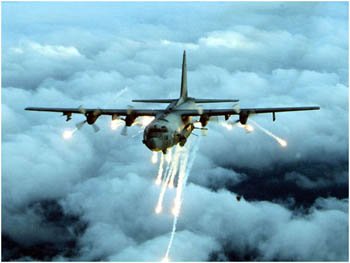
Making Peace or Fueling War in Africa
At the end of President Barack Obama’s inauguration ceremony, civil rights leader Rev. Joseph Lowery invoked the hope of a day “when nation shall not lift up sword against nation, when tanks will be beaten into tractors.” No one expects such a utopian vision to materialize any time soon. But both Obama and Secretary of State Hillary Clinton have spoken eloquently of the need to emphasize diplomacy over a narrow military agenda. In her confirmation hearing, Clinton stressed the need for “smart power,” perhaps inadvertently echoing Obama’s opposition to the invasion of Iraq as a “dumb war.” Even top U.S. military officials, such as chairman of the Joint Chiefs of Staff Adm. Mike Mullen, have warned against overly militarizing U.S. foreign policy.