
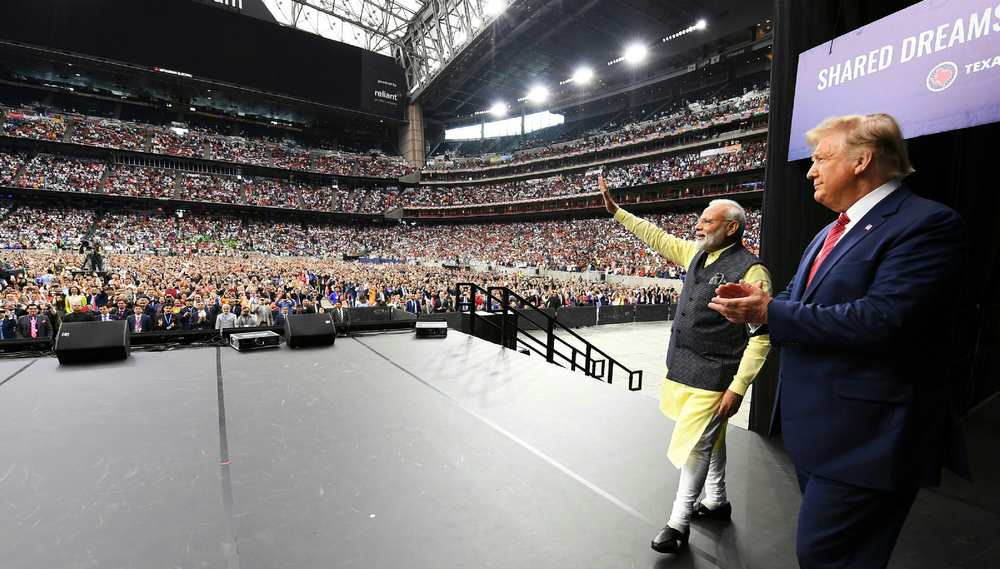
The Trump administration is rolling out a new model for India that marks a subtle shift in U.S. imperial strategy but continues decades of U.S. imperial practices.
Drawing on its National Security Strategy, which claims to be shifting U.S. strategy away from “global domination” toward “global and regional balances of power,” the Trump administration is redefining India as critical pillar in the balance of power in the Indo-Pacific. Although administration officials insist that they want India to function as a key power center, they are requiring limits to its power, determined to prevent the country from becoming another China.
“India should understand that we are not going to make the same mistakes with India that we made with China 20 years ago,” State Department official Christopher Landau told Indian leaders in March.
U.S. Imperial Models for India
Over the past two decades, the leaders of the United States have introduced multiple imperial models for India. Often reformulating models with deep roots in U.S. imperial planning, they have aspired to integrate India into broad regional structures that reinforce U.S. power across Eurasia and the Indo-Pacific.
During the Obama administration, U.S. officials introduced an expansive model that revived an old imperial imaginary. Locating India in a great arc of countries around Eurasia, they aspired to build a network of U.S. military partnerships that stretched across the Pacific Ocean and extended all the way to India.
“We will expand our military partnerships and our presence in the arc extending from the Western Pacific and East Asia into the Indian Ocean region and South Asia,” Secretary of Defense Leon Panetta explained in June 2012. “Defense cooperation with India is a linchpin in this strategy.”
The Obama administration’s model shared many similarities with the great crescent that Dean Acheson had envisioned for the region at the start of the Cold War. According to Acheson, a vast arc of countries enveloped Eurasia. It started in Japan, curved around Southeast Asia, extended to India, and stretched outward toward Afghanistan. This great crescent, Acheson argued, featured many geopolitical advantages, requiring the United States to provide countries in the region with military and economic assistance.
“Our broad national objective in this area is to help the people develop independent and stable governments, friendly to the United States,” Acheson told Congress in June 1951.
At the same time that the Obama administration began envisioning a new kind of great crescent around Eurasia, U.S. imperial planners began thinking of another imperial model for India. Arguing that India and the United States were experiencing strategic convergence due to their shared concerns over the rise of China, U.S. imperial planners began to imagine that they could transform India into a powerful new spoke in their hub-and-spoke model in the Asia-Pacific.
“The more that we and India can work together to expand this hub-and-spoke approach to the region, I think the better,” former Defense Department official Kelly Magsamen told Congress in April 2017.
The hub-and-spoke model, which imagines the United States as a powerful hub that projects its power through several spokes, is often traced back to the thinking of John Foster Dulles, who used it to describe the system of military alliances that the United States was managing in the Asia-Pacific at the start of the Cold War. Although Dulles did not include India in the model, U.S. officials have long aspired to bring additional countries into the system, including India.
Following years of efforts to extend the hub-and-spoke model into the Indian Ocean and construct a broader Indo-Pacific, the Biden administration made a major push to tightly integrate India into the model.
“Our hub-and-spoke model of security in the Indo-Pacific has become integrated so those individual spokes now cooperate and collaborate in a more systemic way,” Richard Verma, a State Department official in the Biden administration and former U.S. ambassador to India, said in September 2024.
Despite U.S. efforts to extend the hub-and-spoke model to India, however, U.S. imperial planners have been considering alternative frameworks. Faced with growing challenges from China and Russia, they have started to think about how they can use India to establish a new regional balance of power.
Earlier this year, War Department official Elbridge Colby gave a major address in which he explained that the Trump administration’s goal is for India to help establish a new balance of power in the Indo-Pacific. “The United States believes that India will play a central role in ensuring a favorable balance of power,” Colby said.
Once again, U.S. imperial planners are tapping into an idea with deep roots in U.S. imperial planning, going back to the balance of power that George Kennan had planned for Europe and Asia after World War II. Although Kennan is often remembered for introducing the strategy of containment, which applied to the Soviet Union, his primary focus was to design a new world order in which the United States maintained a dominant global position while containing the Soviet Union. His major recommendation, as he explained at the time, was for the United States to reestablish a balance of power in Europe and Asia.
“All in all, our policy must be directed toward restoring a balance of power in Europe and Asia,” Kennan’s Policy Planning Staff argued in November 1947.
What is different about the Trump administration’s approach, however, is that it defines India as another major power center in Eurasia. Whereas Kennan had envisioned Germany and Japan as the two key power centers that balanced and contained the Soviet Union, U.S. imperial planners are now thinking about using India as an additional power center for the purpose of countering China.
“I think India is an important ally in our move against China,” Representative Keith Self (R-TX) told an administration official earlier this year.
Obstacles and Aspirations
Despite the Trump administration’s new modeling for India, several obstacles stand in its way, including multiple challenges of its own making.
The president has created major strains in bilateral relations with India. Trump has repeatedly antagonized Indian leaders by imposing tariffs, creating more restrictive immigration policies, and promoting racist views of Indians. His actions and policies have created a backlash against the United States.
At the same time, the Trump administration has displayed an imperial arrogance that has undermined its planning. When State Department official Christopher Landau declared earlier this year that the Trump administration would not allow India to become another China, he alienated many people in India. Although he repeatedly praised India and its potential, his remarks generated suspicion and hostility.
The United States is not “going to let you develop all these markets, and then, the next thing we know, you are beating us in a lot of commercial things,” Landau said.
One of the greatest challenges to the Trump administration’s ambitions has come from India. Since India first gained its independence, its leaders have followed a policy of non-alignment. Indian officials may be trying to rebrand the policy as one of “multi-alignment” or “strategic autonomy,” but officials in Washington understand that India is likely to maintain some distance from the United States, just as it did throughout the Cold War.
“I hope we can move beyond the Cold War model, where India feels compelled to keep the United States at arm’s length,” Landau said.
Regardless of the challenges, the Trump administration remains committed to its plans. Even as the president repeatedly disrupts bilateral relations, his administration is working to position India as a powerful but subordinate country in a new regional balance of power. Administration officials hope that India will pose a serious challenge to China, even if not fully aligned with the United States.
“A powerful India, acting in its own self-interest, advances our shared goal of maintaining a balance of power across the region,” Secretary of War Pete Hegseth said in a major address on U.S. policy toward the Indo-Pacific last month.
In short, the Trump administration is embracing a new imperial imaginary that assigns India a new role but changes little in U.S. imperial practices. Rather than acting on any kind of genuine concern for India and the Indian people, the administration is rallying behind a crude imperial model that maintains Washington’s longstanding position that India must serve U.S. power and influence in Eurasia.