
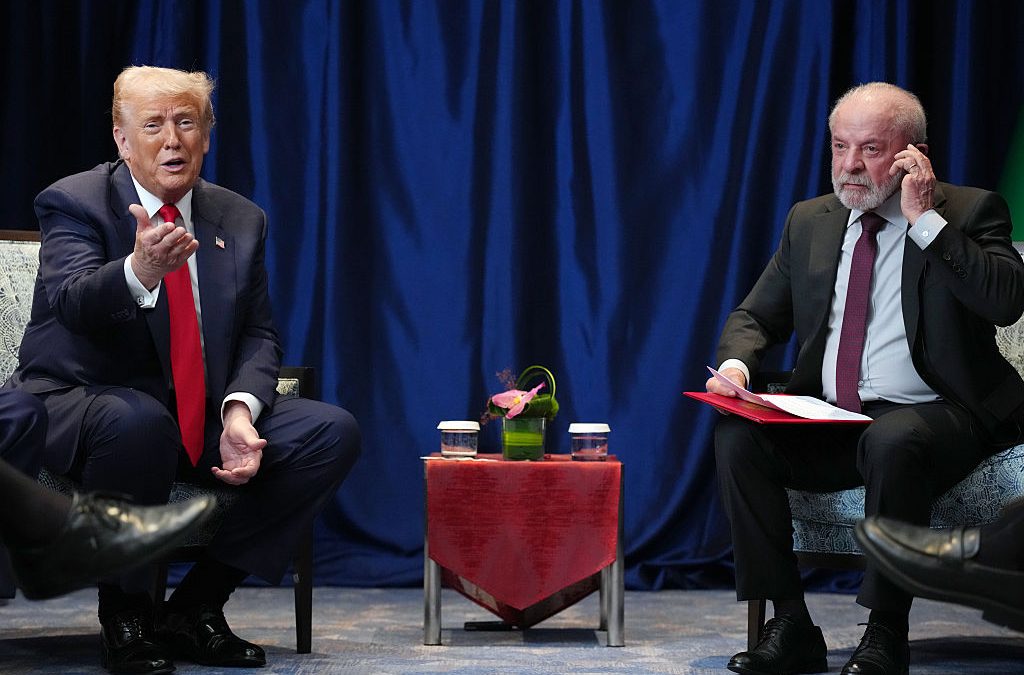
Brazilian President Luiz Inácio Lula da Silva announced this week that his government had denied visas to two U.S. State Department officials headed to Brazil ahead of October’s presidential election. “This week we had to deny visas to two young people whom they are sending to Brazil to meddle in the Brazilian elections,” Lula said.
The officials, Riley Barnes and Samuel Samson, both work in the department’s democracy and human rights bureau. Their trip was billed as a discussion of election integrity, religious freedom, and freedom of expression. It also reportedly included a planned meeting with Flávio Bolsonaro, the right-wing senator and son of former president Jair Bolsonaro, who is now facing Lula in October in the presidential election.
Days before the denial, Flávio Bolsonaro told a room of foreign diplomats that Brazil’s voting machines share design origins with Venezuela’s, citing a CIA report on alleged fraud in that country. Brazil’s Superior Electoral Court rejected the claim the same day, and Flávio later walked it back, saying he had merely intended to invite more international observers.
The Brazilian government accused the American diplomats of concealing the true purpose of their trip. Brasília claimed the pair intended to meet with election skeptics and cast doubt on the legitimacy of the October vote, laying the foundation, in its view, for contesting an unfavorable result. The State Department has dismissed that account as a “baseless lie.”
Visa Reciprocity Between Washington and Brasília
The denial is a small episode in a much larger pattern of Washington and Brasília wielding the visa as a weapon against each other, and it lands at a moment when the relationship could hardly be more strained.
The story starts in 2019, when Jair Bolsonaro unilaterally waived visas for U.S. citizens as a gesture of goodwill. Although Donald Trump professed a great friendship with Bolsonaro, the United States never reciprocated. Despite its appearance, that was less a matter of ingratitude than of compliance: admission to the U.S. Visa Waiver Program is based on fixed criteria in the Immigration and Nationality Act, including a nonimmigrant visa refusal rate below 3 percent, biometric passports, and security and information-sharing agreements with Washington. Brazil’s refusal rate has long sat well above that threshold, so no amount of goodwill or dealmaking could have put Brazilians on the list.
In April 2025, with Trump back in office, Lula’s government let the exemption lapse, and Americans once again need a visa to visit Brazil. From there, the two capitals began targeting each other directly. After Brazil’s Supreme Court moved against Bolsonaro over his attempted insurrection, the Trump administration revoked the visas of Justice Alexandre de Moraes, his family, and seven other justices of the 11-member court, and later stripped the visa of Justice Minister Ricardo Lewandowski.
Washington went further still. Despite the UN Headquarters Agreement, under which the United States pledged not to impede travel to the UN district in New York, the administration weighed restrictions on Brazil’s delegation to the General Assembly, according to a State Department memo leaked to the Associated Press. While Mahmoud Abbas of Palestine actually was barred from UNGA 80, Washington never acted on the Brazil proposal, but two of its own diplomats have now experienced the same treatment.
Bolsonaro’s Shadow
The common nucleus of all of this is Jair Bolsonaro, the former president whose shadow looms over every one of these tensions.
Bolsonaro was convicted last September and sentenced to 27 years in prison for plotting a coup after his 2022 election loss, a scheme that culminated in his supporters storming Brazil’s Congress, Supreme Court, and presidential palace in January 2023. He had already been barred from seeking office.
Even before the conviction, Bolsonaro spent years making unsubstantiated claims about the very subject his son raised last week: Brazil’s electronic voting machines. There are no documented cases of systemic fraud in the system, which has operated since 1996 and includes independent audits, fingerprint verification, and printed tallies.
That prosecution was cited, at least in part, in Washington’s justification for punishing Brazil economically, with a 2025 executive order framing the case against Bolsonaro as a human rights abuse.
The Tariff Battlefield
Tariffs have done far more damage, and are perhaps the most devastating blows on this battlefield.
In 2025, Trump levied a 50 percent tariff on Brazilian goods, tied explicitly to Bolsonaro’s prosecution. When the Supreme Court struck down that tariff regime in February, the administration rebuilt it on new legal footing: a 25 percent duty on most Brazilian goods after a Section 301 investigation concluded that Brazil’s trade practices were unfair, plus another 12.5 percent over allegations of forced labor in Brazilian supply chains.
Brazil has called the measures absurd. On July 27, it filed a formal dispute at the World Trade Organization, arguing that the tariffs violate U.S. obligations under the General Agreement on Tariffs and Trade, the WTO’s foundational treaty binding members to their negotiated tariff ceilings and to nondiscrimination among trading partners. The duties apply to roughly $6.6 billion in Brazilian exports, including machinery, wood products, footwear, and apparel. This disruption in the bilateral trade relationship costs more than $75 billion a year.
And perhaps that is the point. The Trump administration appears to want to make Brazilians blame the current Lula government and support a rival candidate, who just happens to be a Bolsonaro.
Rare Earth Elements
Beneath the visa war and the tariff war sits a quieter competition. Brazil holds the world’s second-largest reserves of rare earth elements, minerals essential to electric vehicles, defense systems, and semiconductors, and a much-desired alternative to Chinese supply.
Earlier this year, the U.S.-backed firm USA Rare Earth agreed to acquire the Brazilian producer Serra Verde for roughly $2.8 billion. The same administration imposing punitive tariffs on Brazil is simultaneously courting it as a critical minerals partner. That contradiction has fed opposition in Brasília, which has made clear that it does not want to be reduced to a raw mineral exporter. Brazilian lawmakers have moved to create a state-owned company to keep more of the value chain at home and out of Washington’s grip.
These tensions between two longstanding allies will converge in October, when Lula seeks another term against Flávio Bolsonaro. Lula has already cast the tariffs and the attempted visit by US officials as a thumb on the scale against him, a message that plays well with the domestic audience regardless of Washington’s true intentions.
The visa, in the end, is the smallest instrument in this fight and the most telling one. Washington spent two years wielding it as a political weapon against Brazilian judges, ministers, and heads of state, and now Brasília has finally learned how to fight with the same weapon.