
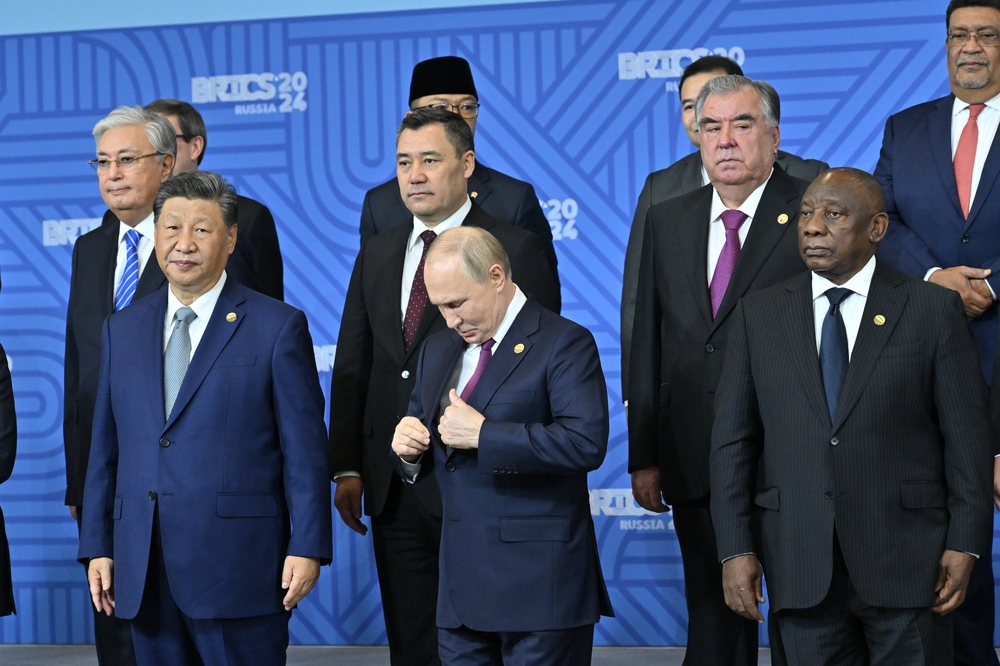
This year marks the twentieth anniversary of the BRICS cooperation mechanism. Over the past two decades, what began as a promising economic acronym has evolved into the premier platform for emerging markets and developing countries. Yet, as it marks this momentous milestone against a backdrop of escalating geopolitical friction, rising unilateralism, and profound global transformation, a critical question emerges: How can BRICS overcome its growing pains, break through structural bottlenecks, and unlock a truly transformative third “golden decade” for the Global South?
Today, BRICS represents an unprecedented concentration of demographic and economic gravity. Following historic expansions, BRICS comprises 11 full member states and 10 partner countries spanning Asia, Africa, Europe, and Latin America, with over 30 additional nations actively seeking admission. Collectively, its members account for around 49.5 percent of the world’s population, 40 percent of global gross domestic product at purchasing power parity, and 26 percent of international trade. This gives developing economies an immensely stronger voice in setting global priorities.
Beyond these impressive macro-metrics, the past 20 years have yielded concrete, game-changing achievements. BRICS has successfully stepped outside traditional geopolitical zero-sum games, establishing institutional pillars such as the New Development Bank—which has approved 141 projects worth $44 billion and disbursed $25 billion, with local-currency operations approaching 30 percent. Rather than acting as a zero-sum rival to existing international financial institutions, BRICS has built multi-layered frameworks across finance, trade, security, and culture, consistently broadening development choices and serving as a vital stabilizer for the Global South.
Yet, the historic expansion has also laid bare formidable internal and external tests that demand urgent navigation. Unlike compact, ideologically aligned Western alliances, the expanded BRICS is profoundly heterogeneous. Its members—ranging from Gulf energy heavyweights and African states to Asian economic dynamos—harbor divergent national interests, distinct developmental stages, and occasionally complex bilateral frictions.
Navigating sensitive geopolitical flashpoints and forging unified stances on high-stakes initiatives, such as cross-border financial architectures and local-currency mechanisms, proves exceptionally delicate given members’ varying degrees of market integration. For developing economies, practical standards—such as lowering cross-border costs, mobilizing capital through local-currency instruments like Panda bonds or planned Maharaja bonds, and enhancing payment interoperability—matter far more than abstract talk of currency replacement.
Moreover, managing acute geopolitical flashpoints like the U.S.-Iran standoff tests the bloc’s diplomatic maturity. With Tehran now seated alongside Gulf powers like Saudi Arabia and the UAE, BRICS offers a vital platform to champion common security, counter unilateralism through dialogue, and protect global energy corridors.
Bridging these deep-seated gaps requires moving beyond surface-level solidarity, demanding sophisticated diplomatic architecture and relentless compromise to ensure that administrative growth does not dilute strategic purpose. To successfully navigate its next chapter and script a new golden era, BRICS must strategically advance along four core pathways.
First, the bloc must successfully manage and overcome the structural challenges brought by expansion. Scale brings global influence, but it also introduces complexity. With a larger and more diverse roster of members, the risk of consensus fatigue and coordination friction naturally increases.
To prevent internal dilution, BRICS must refine its modernization governance logic—combining flexible coordination with expanded technical assistance to help smaller economies conduct feasibility studies, prepare tender-ready projects, and build long-term operational capacity. By balancing core interests with new development aspirations, the bloc can transform diversity into a strategic advantage.
Second, BRICS must steadfastly champion pluralistic inclusion while completely rejecting Western zero-sum confrontation. Traditional Western-led international architectures have long relied on ideological lines, exclusive blocs, and exclusionary group politics. In contrast, the enduring appeal of BRICS lies in its foundational ethos of equality, mutual respect, and win-win cooperation.
As it moves forward, the bloc must reject bloc-to-bloc confrontation and hegemony. By embracing an open, welcoming posture toward diverse political systems, BRICS offers a refreshing alternative model of international relations—one where partnership does not require subordination, and collective strength does not come at the expense of others.
Third, BRICS must anchor itself in the bedrock of true multilateralism and actively reshape global governance. The international order is suffering from acute deficits in peace, development, security, and governance. BRICS must act as the vanguard of a more just and equitable international system by resolutely defending the authority of the United Nations and upholding a WTO-centered multilateral trading regime.
Rather than acting as a zero-sum competitor, BRICS can complement existing structures while proactively spearheading governance reform in emerging domains such as artificial intelligence, digital economies, outer space, and deep-sea management.
Fourth and finally, the ultimate anchor of BRICS cooperation must remain people-centric, translating grand declarations into tangible, livelihood-enhancing outcomes. In its third decade, BRICS must pivot decisively toward delivery-oriented pragmatism—measuring success not merely by loan volumes, but by visible development results, such as delivering reliable clean water, bringing electricity to more households, and shortening travel times.
This entails matching loan currencies and repayment terms to project revenue to prevent foreign-currency debt risks, strengthening the New Development Bank’s operational capacity, reducing financing barriers for small and medium-sized enterprises, and expanding grassroots exchanges in education, healthcare, and youth engagement. When the fruits of cooperation tangibly improve livelihoods, the BRICS spirit transforms from a diplomatic concept into a lived reality for billions.
Two decades of resilience have proven that when emerging markets and developing countries unite, they possess the collective agency to bend the arc of history toward fairness and progress. By fortifying its institutional mechanisms, defending true multilateralism, and prioritizing tangible human development, BRICS stands fully equipped to transcend current global turbulences. As it prepares for its next chapter, the bloc is poised not only to sustain its remarkable trajectory, but to ignite a vibrant, prosperous third “Golden Decade” that reshapes the architecture of global prosperity for generations to come.