
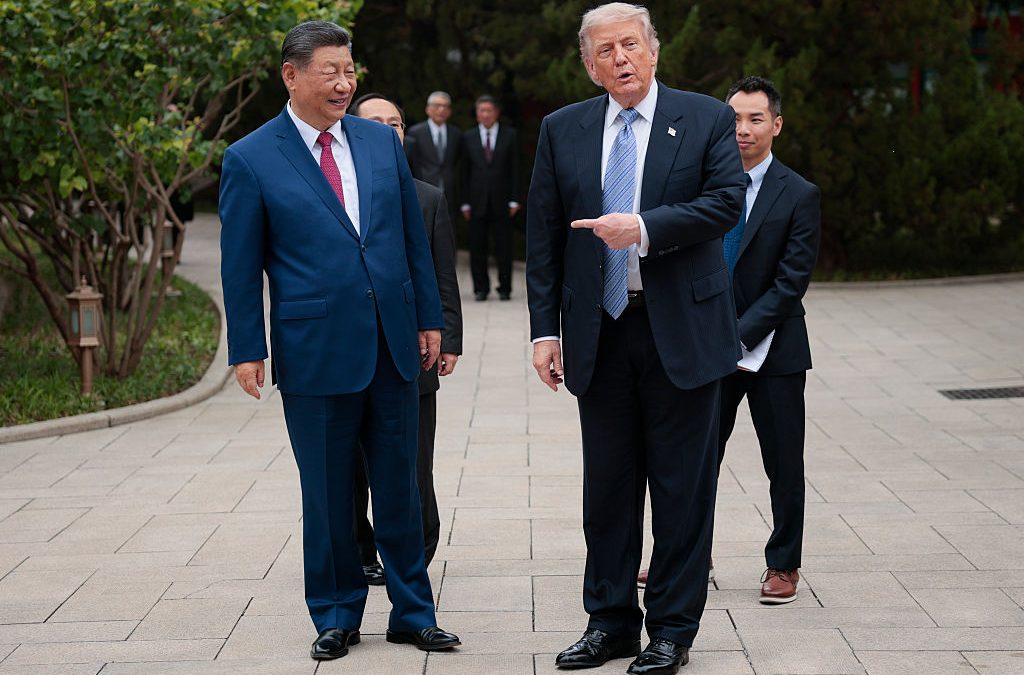
As President Donald Trump concluded his three-day state visit to China on May 15, the world witnessed the birth of a new diplomatic doctrine: “constructive strategic stability.” In essence, China has offered a lifeline of economic support and diplomatic mediation to a crisis-weary Washington, in exchange for what Beijing has long craved: a definitive de-escalation of the trade war and, more importantly, formal American recognition of China’s strategic space.
With the U.S. economy grappling with the fallout of the Strait of Hormuz closure and the domestic pressure of the 2026 midterms, Trump arrived in Beijing needing “wins” that were both gold-plated and immediate. He needed results that could be communicated in a single headline to a domestic audience worried about inflation and energy prices.
The Chinese side understood this perfectly. The results delivered during this visit were a masterclass in addressing Trump’s specific political sensibilities, replacing vague diplomatic promises with binding, hard quotas. Chief among these deliverables is an initial purchase approval of 200 American-made Boeing aircraft for Chinese airlines. Breaking a painful nine-year drought on major Chinese aerospace orders stretching back to 2017, this tranche is a direct injection of adrenaline designed to support high-paying, high-skilled U.S. manufacturing jobs.
The bounty extends deep into America’s heartland. Beijing has committed to purchasing at least $17 billion per year of U.S. agricultural products spanning 2026, 2027, and 2028. Critically, this massive agricultural baseline exists in addition to the substantial soybean purchase commitments China established in October 2025.
To ensure these targets are hit, Beijing has immediately restored American market access by renewing the expired listings of more than 400 U.S. beef facilities, pledging to dismantle all remaining regulatory suspensions, and resuming poultry imports from states cleared by the USDA. Under the newly negotiated terms, China has also agreed to directly address Washington’s supply chain vulnerabilities by securing the export of critical minerals.
This is the “gold” of the bargain: tangible, quantifiable economic benefits that allow the Trump administration to claim the “art of the deal” is alive and well.
However, the most striking element of this bargain is found in the waters of the Persian Gulf and the security landscape of East Asia. According to the White House Fact Sheet, both leaders explicitly declared that Iran cannot be permitted to possess a nuclear weapon, and they unified against any nation or organization attempting to levy transit tolls on the strategic channel.
For the United States, this was a pragmatic necessity to lower global oil prices. For China, it was a strategic triumph. By stabilizing the energy market that the U.S. military could not unilaterally secure, China earned its seat at the head of the global table. Furthermore, this newly cooperative stability extended to East Asia, where both presidents formally reaffirmed their shared strategic goal to achieve the complete denuclearization of North Korea.
To prevent these sweeping economic agreements from dissolving into future geopolitical bickering, Trump and Xi have fundamentally altered how Washington and Beijing do business. Rather than managing trade via escalatory tariff battles, the two leaders chartered two permanent, government-to-government institutions: the U.S.-China Board of Trade and the U.S.-China Board of Investment. The Board of Trade creates an insulated, permanent mechanism to manage and optimize commerce across non-sensitive goods, effectively carving out a safe zone for trillions of dollars in trade, completely separate from the ongoing technology war. Concurrently, the Board of Investment establishes a structured state-level forum to handle corporate disputes, market access, and capital flows before they trigger political crises.
In return, China receives “constructive strategic stability.” For years, Beijing has argued that the first button of the relationship was misaligned—that the United States viewed China as an existential threat to be decoupled from the global order. Through this summit, China has secured a rhetorical and strategic pivot. The United States has moved away from the language of decoupling in favor of de-escalation grounded in fairness and reciprocity.
By settling on “constructive strategic stability,” they are attempting to realign the entire garment. This is not a reset to the era of blind engagement. It is a managed competition. Both sides have acknowledged that they are near-peers who can neither defeat nor ignore each other. The Chinese briefing captured this perfectly: “The great rejuvenation of the Chinese nation and making America great again can coexist, achieve mutual success, and benefit the world.”
By agreeing to a framework of moderate competition and controllable stability, the Trump administration has implicitly acknowledged that China’s social system and its “Fifteenth Five-Year Plan” are realities that cannot be dismantled through sanctions alone. The U.S. recognition of China’s core interests, particularly regarding the sensitive red line of Taiwan, remains the ultimate strategic space Beijing sought.
However, this is not without its critics. Some warn that this is a transactional peace, built on the personal chemistry and immediate needs of two specific leaders. Trump’s foreign policy is inherently fluid; a “win” in May 2026 could become a leverage point in early 2027. While the White House emphasizes immediate agricultural inflows and factory jobs, many in the U.S. security establishment will view the recognition of China’s “strategic space” and the reliance on Beijing for Middle Eastern mediation as a strategic retreat.
The May 2026 Beijing Summit marks the end of the decoupling era and the beginning of a managed stability. For a world that has spent the last decade holding its breath, fearing a “Thucydides Trap” collision between a rising power and the existing hegemonic power, this visit offers a much-needed gasp of air. The giant ship of China-U.S. relations, as Wang Yi described it, finally has a new navigator and a clearer chart.