
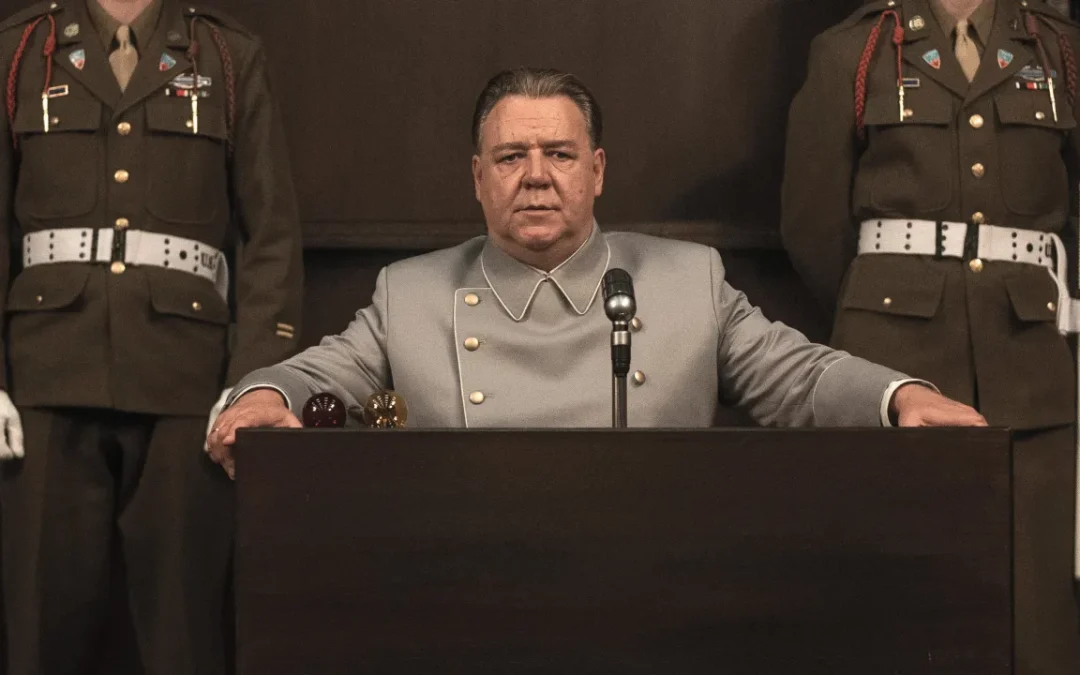
Watching James Vanderbilt’s new film Nuremberg, I found myself scanning the faces of spectators during the many courtroom scenes, imagining I might “spot” my mother. Coming from a small North Dakota farm town in the 1940s to Washington DC for a Treasury Department job, Mae Ness had no clue she would wind up with the Office of Strategic Services (OSS) working at and witnessing not only the trial of the century, but arguably the most important international trial in history.
The immediacy of those proceedings 80 years ago has suddenly reasserted itself, just at the moment when its lessons are in danger of being lost because of both erosion and willful historical amnesia. The film has a lot of territory to cover, but it does manage to raise the big questions the war and the trials made manifest and that continue to resonate: What constitutes a war crime? What is a crime against humanity? How can the international rule of law hold people to account and prevent such horrors from happening again?
I became obsessed with these questions as a pre-teen.
When my father was posted to the U.S. Embassy in Germany in the early 1960s, my mother shared with me her voluminous memorabilia, anecdotes, original documents, indictments, photos, and books about the trials. To this day, from memory, I can recite the sentences various defendants received. There were the numerous executions, including Julius Streicher, Alfred Rosenberg, and Hermann Goering (whose suicide by a cyanide capsule he smuggled into prison totally disgusted me as a child). Architect Albert Speer received 20 years, Admiral Doenitz 10 years for machine-gunning British sailors, and so on.
My mother’s vivid stories and my too-early inundation at eight and nine years old—plus watching the Berlin Wall go up—fueled a fascination with the Holocaust that ultimately formed a foundation that has underpinned my career in international labor rights. Three aspirational ideas from Nuremberg have inspired my work: that everyone has inalienable human rights, that societies have advanced sufficiently to establish universal international standards and laws, and that crimes against humanity can be punished and perpetrators held accountable.
Two years after the trials, the new United Nations adopted the Universal Declaration of Human Rights, which established international principles that are incumbent on all member states and citizens. The declaration framed the moral imperatives that underpinned the UN’s subsequent ground-breaking work, from assistance to refugees and famine victims to an international stage for the urgent African and Asian post-colonial struggles. It asserted the universal rights for people within their own countries, providing a moral framework and amplifier for those suffering from ethnic discrimination and violence to appeal to a larger world. The images of Selma, Alabama in 1965 and the resulting international opprobrium—combined with America’s own strong support of the UN—provided necessary political space for the civil rights movement and pushed the U.S. government to try to live up to its ideals.
When we returned to the United States in the late 1960s and I saw all the conflict and triumphs, it just reinforced the lessons of Nuremberg. For a few decades it felt like some of those lessons had been learned. Jim Crow laws, which had been the basis for the Nuremberg racial laws, were dismantled. The decay of authoritarian states and the rise of civil society and liberal democracies after the end of the Cold War presented a clear upward trend.
All through the 1990s to the late 2010s, I was privileged to work with trade union and labor activists across Asia and in Ukraine, Russia, Georgia, and elsewhere. Hundreds of thousands of Bangladeshi women garment workers formed their own unions, aided in part by International Labor Organization conventions and a global spotlight on the industry. Following adoption of the only universally ratified ILO Convention on child labor by every country, between 2000 and 2025 child labor worldwide decreased by 38 percent, rescuing tens of millions of the most vulnerable through the most successful labor campaign in history. These developments seemed to signal a future that was not an end to history, but rather one with a civilized foundation all nations could rely and build on.
So, the release of the new film Nuremberg couldn’t be timelier. Focusing on a psychological battle between U.S. Army psychiatrist Douglas Kelley and Hermann Goering, the film also raises uncomfortable questions of guilt, impunity, and complicity for both accused and accusers. Recent actions by the Trump administration—including ICE raids, crippling the Department of Labor’s enforcement capacity, blowing up third-country vessels at sea, and the destruction of USAID leading to current estimates of over 600,000 preventable deaths, two-thirds of them children—answers the question of whether this government learned many of the lessons of Nuremberg. In The Guardian, Yale professor and former Pentagon advisor Oona Hathaway recently pointed out that the erosion of international standards dates to the U.S. “war on terror.” She also “admitted international law could seem ‘remote, esoteric, formal and complicated’ but stressed prohibition on the use of force by states had made the world much more peaceful.”
In 2021, after a number of Central American anti-child labor groups reported how even their efforts for children were facing government repression, I wrote the following in Foreign Policy in Focus that “it’s been axiomatic that everywhere right-wing authoritarians have recently gained power they have attacked basic civil liberties including human and labor rights. And child labor is the canary in the coal-mine of all other labor rights violations.” Observed Nelson Mandela, “There can be no keener revelation of a society’s soul than the way in which it treats its children.”
My mother understood and was proud of my work on child labor. In her 2009 memoir, published just as she passed away, she wrote, “Maybe this book will give my grandchildren, who are rapidly growing into young adults, a better grasp of history.” I’m sure she’d be aghast at the situation today, at how so many people have turned their backs on the Nuremberg trials and have ushered a global descent into nationalism, racism, religious extremism, and tribalism. Across a wide front, there’s been an effort not only to erode international laws and standards but the very concept itself. If the Trump administration, among others, is willing to let children die, what hope is there for the rest of us?