
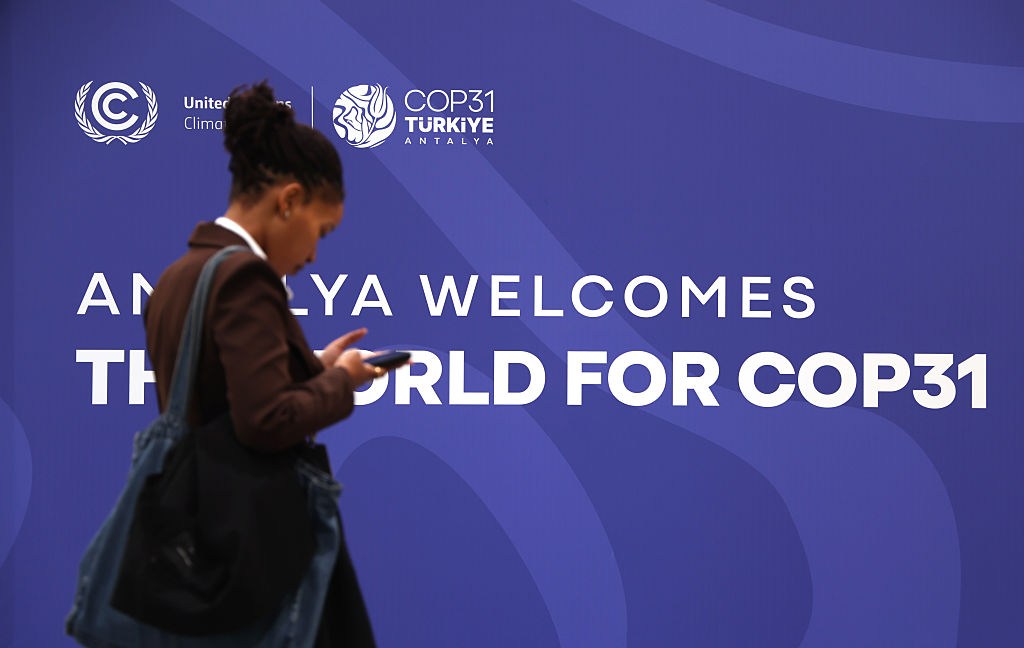
Turkish President Recep Tayyip Erdogan inaugurated the thirty-first UN climate summit (COP31) in Antalya, Turkey, on November 9. A relatively modest contingent of 70 world leaders have committed to attend. How many of them actually show up is a different matter entirely. The most prominent attendees will be the Brazilian President Luis Inacio Lula da Silva and the British prime minister Andy Burnham.
Part of the reason for the insufficient attention to the summit is the geopolitical upheaval stretching from Europe and Eurasia to the Middle East. This tumult has further degenerated into speaking the unspeakable in which threats of use of never-to-be-used weapons in Europe and the Middle East have become banal, pushing aside climate concerns.
The UN that has been organizing and hosting climate summits since 1992 is forced to sit on the sidelines, with an ever-diminished role in resolving the ongoing conflicts. Major world leaders don’t even consider the world body worth their time anymore. At its hallowed annual UN General Assembly (UNGA) session in September this year, leaders of China, Germany, India, Italy, and Russia were conspicuous by their absence. Chinese, Indian, and Russian leaders are no-shows at COP31, too. It is at the UN General Assembly that world leaders lay out their updated nationally determined contributions (NDCs) to bring down emissions in their respective national jurisdictions. Their abstaining from the UNGA session demonstrates their diminished regard for both the UN and its climate action agenda.
The climate summit convened in Turkey is equally weighed down by the global economic and energy crisis that world governments cannot afford to ignore. A case in point is the midterm elections in the United States in which both Democrats and Republicans assiduously evaded uttering the word climate, a caution that was described as climate hushing.
Yet geopolitics or global and national economic and energy crises have everything to do with the climate and its anthropogenic drivers. The Democrats’ sweeping victory in the midterms is widely attributed to their affordability agenda that was bred from concerns over rising gas and grocery prices.
The continuing conflicts in Europe and Eurasia, for their part, have had a dire impact on global food, fertilizer, and fuel supplies. This impact was cross-continental. The Middle East, which is a net importer of food, is heavily dependent upon food imports from Europe. One of the region’s largest economies is Egypt, which is also the world’s largest buyer of foodgrains from Russia and Ukraine alone. Its annual foodgrain imports are as high as 85 percent. In Eurasia, the Russian Federation is the world’s energy and food supplies giant, whose exports in these commodities have almost dried up after the Russia-Ukraine war, leaving countries like Egypt to search for alternative sources. Overall, the global food import bill hit record $2.2 trillion in 2025, which could worsen due to climatic factors, especially the El Nino effect.
Geopolitics has not spared even the very venue of COP31 as Australia and Turkey were the two contenders to host the summit this year. An acrimonious spat between the two festered for two years before they agreed at COP30 in 2025 to co-host the next summit. They consented to a division of labor that defined their hosting duties: Turkey was to set the action agenda for the summit and Australia to lead the negotiations. The agenda-setting largely follows the COP template, which helps make the smooth conduct of the conferences possible. Negotiations, on the other hand, are a sticky subject that drains hosts’ cognitive, emotional, and physical energies, and costs them weeks of sleepless nights without ever reaching an expected outcome as the past 30 COPs show.
At COP31, both the agenda and the negotiations are, however, the least ambitious and most modest. They are rbackward-looking rather than forward-facing, and for a reason. The co-hosts believe that instead of having delegates promise more (forward-facing) and act less (backward-looking), COP31 will be focused on “implementation.”
Hence, COP31 is billed the “Implementation COP.” It will focus on implementing what governments have already committed to doing. This finesse will put an end to any conflict over “adaptation” (i.e., adapt to climate change) versus “mitigation” (i.e., end emissions), or phasing out fossil fuels. The latter is the co-hosts’ nagging concern as their respective national economies are powered by the dirtiest of fossil fuels: coal. Australia is the world’s fourth largest producer and exporter of coal, while Turkey is one of the world’s largest consumers. In an Augustinian twist, both want fossil fuel use to end, but not just yet.
For years now, any talk of transitioning away from fossil fuels, including coal, oil, and natural gas, has come to be regarded as a taboo. The last time the transition from fossil fuels was agreed upon was in 2023 when the United Arab Emirates (UAE) hosted COP28. The UAE was profusely praised for pulling off this feat and forging consensus on phasing out fossil fuels, despite its existential reliance on them.
Not everyone was happy, though and quite a few powerful nations, especially Russia and Saudi Arabia, were staunchly opposed to exiting fossil fuels. They warned the UN summit: “Don’t talk about a fossil fuel exit.” Yet they eventually swallowed the final statement of COP28 to avoid being seen as spoilers. Later, it turned out the UAE’s attempt to rhetorically pull the plug on fossil fuels was no less driven by geopolitical competition between Abu Dhabi and Riyadh and their persistent rivalries. Both split on the language of phasing out or cutting fossil fuels.
Fossil fuels have since been sacrosanct. Any talk of their phaseout or transition is dismissed as bad mouthing a legitimate source of energy. This stifling of dissent has generated widespread frustration among national delegates. At COP30 in Brazil, more than 80 nations, both developed and developing ones, including the United Kingdom and the European Union, staged an alternative COP and prepared its own statement on ending fossil fuels. A number of countries gathered in Santa Rosa, Colombia in April to move more deliberately toward a fossil-free future. Yet Russia and Saudi Arabia again throttled this effort by keeping the promise of ending fossil fuels out of the COP30 final text.
Anticipating these spats, the co-hosts of COP31 in Turkey seem to have taken inspiration from Isiah Berlin’s concept of liberty: positive freedoms (freedom to) and negative freedoms (freedom from). They have set the 35×35 agenda of world electrification (positive freedoms), which is cheered by both climate activists and fossil fuel defenders. The agenda pledges to raise the world’s current use of 20 percent of electricity to 35% by 2035. Global electrification is thus being sought without seeking freedom from dirty fossil fuels.
With such cop-outs, the past 30 COPs have failed to dent either global fossil fuel use or growing emissions. In September this year, to coincide with the UN General Assembly session, the UN Environment Program published a study that the world is set to overshoot the minimum threshold of global warming of 1.5 degree Celsius in the next few years. Even worse, it determined that the global average temperature could exceed 2.0 degrees Celsius.
Each COP, since 1992, has seen more burning of fossil fuels, more carbon emissions, and as a result ever higher global average temperature. Yet COPs are important enough to merit the attendance. This year’s COP attracted almost 70,000 delegates from 200 world governments, non-governmental organizations (NGOs), and businesses. Also, a 120-member U.S. delegation of state and local government leaders, headed by Democratic Governor of New Mexico Michelle Lujan Grisham, is part of this gathering. Their debates and deliberations keep the world apprised of the perils of global heating. If nothing else, delegates at COP31 will amplify the risks of climate inaction, despite geopolitical distractions.