
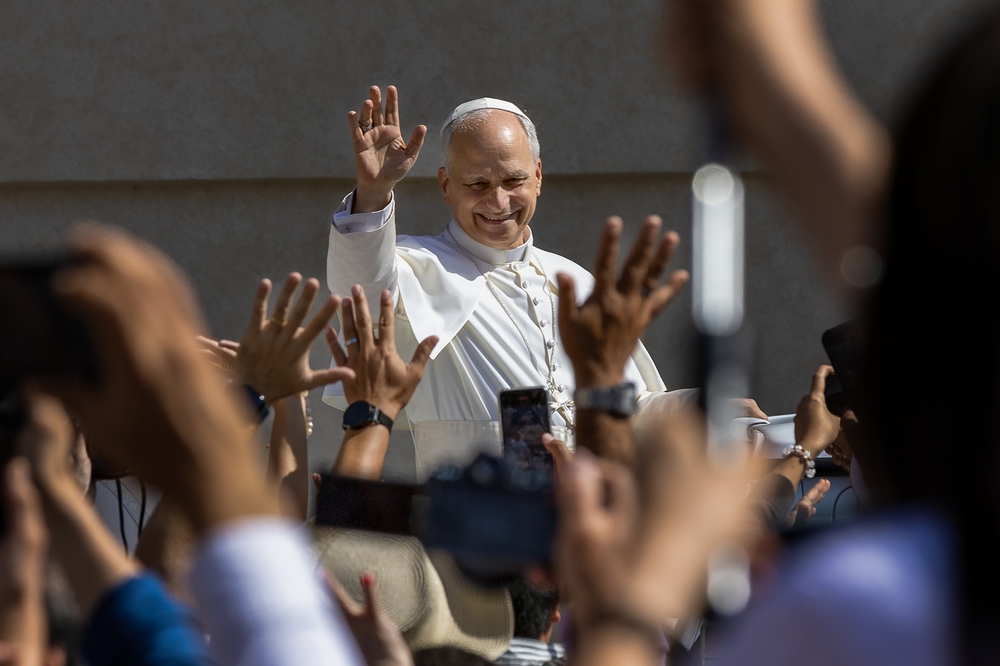
The images coming out of Luanda and Douala this weekend offer a striking contrast to the rhetoric emanating from Washington. While the White House continues its verbal offensive against Pope Leo XIV, labeling his calls for de-escalation in the Iran conflict as a “delusion” and questioning his legitimacy, the Holy Father is busy building a different kind of coalition. His 11-day journey through Algeria, Cameroon, and Angola is not merely a pastoral visit; it is a sophisticated geopolitical pivot. By moving the center of gravity of the Catholic Church toward the Global South, the Vatican is positioning itself as a moral arbiter that is increasingly independent of—and often in direct opposition to—American strategic interests.
For decades, the standard view of the Vatican’s global role was defined by the Cold War alliance between John Paul II and the West. That era is over. Pope Leo’s visit to Angola, a nation scarred by decades of civil war and now a significant player in the global energy market, underscores a new reality. The Catholic Church is growing fastest in the very regions where U.S. influence is most frequently viewed with skepticism. In Africa alone, the Catholic population has surged to over 288 million. When the Pope speaks in Luanda about the “handful of tyrants” ravaging the earth through war and exploitation, his audience is not the Beltway elite, but a global constituency that feels the primary aftershocks of modern warfare and economic blockades.
This shift is particularly consequential as the 2026 Iran war enters a volatile new phase. The re-closure of the Strait of Hormuz on Saturday by Iranian forces, followed by reports of the Revolutionary Guard firing upon commercial vessels, has pushed the global economy toward a breaking point. The United Nations has also warned of a looming humanitarian catastrophe regarding global fertilizer and grain supplies, a crisis that lends immediate weight to the Vatican’s anti-escalation stance. Although Washington frames this as a clear-cut battle against “blackmail,” much of the rest of the world sees a devastating disruption to energy and food security caused by a cycle of escalation they did not choose.
The Vatican has stepped into this vacuum of moral authority. By refusing to back down from his condemnation of the war, despite unprecedented personal attacks from the U.S. administration, Pope Leo is signaling that the Holy See will no longer provide the “moral cover” for Western military intervention. Instead, he is cultivating a “neutrality bloc.” This strategy was evident in Algeria, where he became the first pontiff to visit the nation, fostering a fraternity with the Muslim world that bypasses the traditional security frameworks of the West.
The administration’s response has been to treat the Vatican as just another hostile political actor. When JD Vance suggests that the Pope stay out of American affairs, or when the president suggests that the Pope was “installed” as an American counterweight, they misunderstand the nature of the institution they are fighting. The Vatican operates on a timeline of centuries, not election cycles. By attempting to bully the Holy See into silence, the administration is inadvertently accelerating the Vatican’s alignment with the Global South.
This is not just about religion. It is about the structural decline of the “unipolar moment.” For most of the twentieth century, the moral and political leadership of the West was broadly aligned. Today, they are diverging. The Vatican’s “theology of resistance” provides a philosophical framework for countries in Africa, Asia, and Latin America to resist U.S.-led pressure campaigns. If the Pope can frame the opposition to the Iran war not as a defense of a regime in Tehran but as a defense of “human dignity” and “multilateralism” against “omnipotence,” he creates a diplomatic space that many nations are eager to inhabit.
The current friction highlights a broader trend in global politics: the rise of non-state actors and regional blocs that refuse to take sides in the great-power competitions of the twenty-first century. Angola, as a major oil producer in Africa, is a prime example of a nation that must balance its resource wealth with a desire for stability. When the Pope visits the Muxima shrine, he is not just praying the Rosary, he is validating the cultural and political identity of a nation that seeks a path forward independent of the “diplomacy of force” he decried in his January address.
As the 2026 midterms approach, the domestic political fallout of this rift may be significant, but the international consequences are far more profound. The United States finds itself in a rare position of public confrontation with an institution that commands the loyalty of over a billion people. In the past, Washington could count on the Vatican to be a quiet partner in stabilizing the global order. Today, as the Pope tours the capitals of the Global South, it is clear that the Vatican has decided that the current order is no longer worth stabilizing. The result is a world where moral authority is increasingly decoupled from military might, leaving the United States to fight its wars with plenty of hardware, but fewer and fewer allies of conscience.